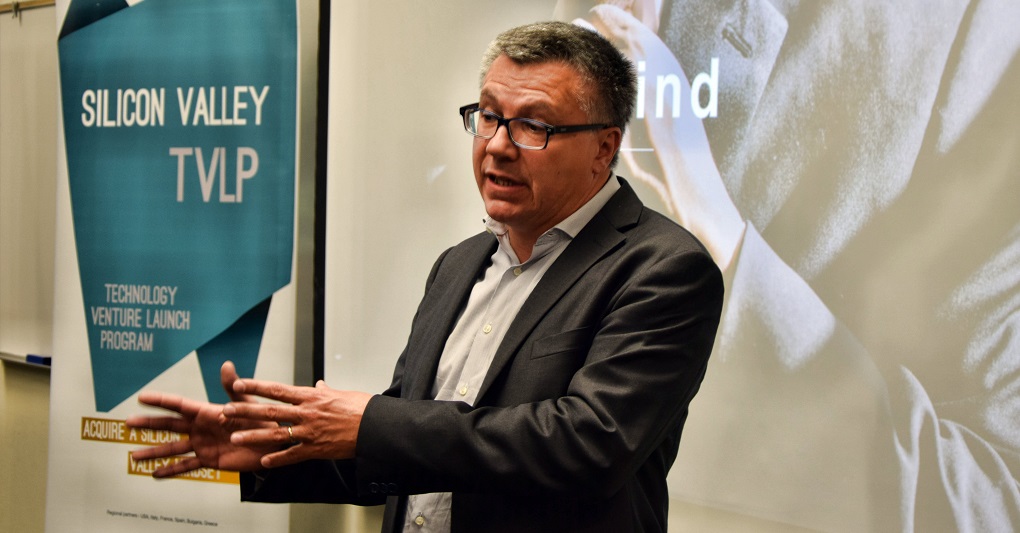
For years Federico Mioni has worked between universities and management training, looking closely at how the work, skills and expectations of the new generations are changing. After a career at the top of Federmanager Academy and CIS – School for Business Management, and after retirement in 2024, he chose to bring these themes into a novel. The noise of the first step (Corsiero Editore) is his debut in the narrative, but it is born from a land that knows well: that of the transformations of labor and restlessness that cross those who today face adult life.
The protagonist is a thirty-year-old Roman who, within a few days, loses work and relationship and decides to move to Correggio, in Emilia. From there a story is opened that holds together more floors: the passage from a large city to a productive and organized province, a new work experience marked also by the impact of artificial intelligence, and a sentimental dynamic that complicates up to touch darker tones. Around this nucleus there is a larger story, made of local stories, relationships and environments that return an idea of society still alive, while the background remains Rome, observed with affection and disincanto.
I’d start by getting into the novel. Already in openness, the protagonist tells of being fired because of artificial intelligence: is it a narrative expedient or is it a concrete fear in the world of today’s work?
I’d say both. I wanted to start from a real fact, but it is a fact that concerns a generation – and not just a generation. I am convinced that artificial intelligence is a great engine of innovation and utility for enterprises. However, if it is not governed and if millions of people are not prepared – even if they remain in the Italian case – to manage this huge mechanism, we risk a scenario out of control: there may be a very strong occupational impact, and not necessarily positive. So yes to artificial intelligence, but in the logic of “augmentation”, i.e. of increase – a somewhat cacophonic word, but makes the idea. Let’s talk about the possibility that technology raises people’s processing skills. As we talk about increased workers, today we also talk about increased managers, using artificial intelligence. The protagonist of the book comes from a company where it is not understood that, with a preliminary training, people can not only avoid dismissal, but also become more productive. To him it went wrong because, in my opinion, in many Italian companies this awareness is not yet there. And so there will be many “victims” of artificial intelligence (and I say it having no neo-ludist feeling or ideas like that). The problem is that, if it is not governed, artificial intelligence will have a negative occupational impact: this is the point.
Is it more for a myopia of workers or companies that decide to replace someone with artificial intelligence? Because this on the one hand can be interpreted as a lack of will to use these tools, so less skills to be able to demonstrate; on the other hand, however, we often talk about artificial intelligence as an instrument still quite limited today, especially when compared with what can offer a particularly prepared human being. The risk, if anything, is that we get stuck by relying too much on artificial intelligence. What is the trade off?
The trade-off is understanding that experienced systems – even in English are called expert systems – are always us. The authoritative source of information, which then becomes knowledge and therefore knowledge, remains human. On one thing artificial intelligence is unbeatable: in managing information. But information does not become knowledge, and does not become qualified knowledge, until there is a human filter that reorders it. The other central theme is the culture of doubt. The machine doesn’t have it: it eventually reasons, according to a binary logic. Human beings have this great and precious gift. The doubt is what leads us to ask ourselves whether something is really right like this, whether it is really correct or whether it should be interpreted differently. It is an extra effort – but it is precisely that effort that will continue to mark the distance between man and machine. As for Italian companies and workers, there is a widespread feeling of fear that should be overcome. It is for those who carry out manual work, even very simple and absolutely dignified, but also for apical and managerial roles. Many companies pretend not to see the problem and think they can move on three or four years like this. But three or four years isn’t a time we can afford. If you look at the latest data, in 2025 in the United States productivity per hour worked has already increased by 2%, with forecasts between 2.8% and 3% in the coming years. In the euro area, however, in the same period the increase was less than 1%. This gives the concrete measure of what it means, today, to use – or not to use – artificial intelligence.
In the book the work is not only a background, but a real force that shapes identity and choices: do you think that today the work still defines who we are, or that instead is becoming something more transient? We talk more and more about burnout, right to disconnection, to separate the work from life and to reappropriate its spaces. Are we still our job, or are we people who work and then, in life, do anything else?
I could say it with a joke: in the years when my generation grew, the work represented 70-80% of our identity. It was something so stable and pervasive to call us. The professional and personal profile were very close, almost superimposed, and the work was definitely preponderant. Today, instead, we are more on a balance that does not go beyond 50 and 50. There is a smoother vision of work and identity also passes through other experiences. Just look at Y generation analyses and even more on Z generation: the relationship with work is different. Continuity and economic stability are no longer the central axes; they count much more the search for an identity, of growth, of a path. This means that today the relationship has rebalanced in favor of the personal dimension: affective, friendly, sporty, volunteering, cultural, musical. In our times, instead, to make the accountant, the worker or the teacher meant to occupy 70-80% of the symbolic space of his identity. Today we are more and more people who work, but who do not exhaust themselves in work.
Why has this relationship changed with work? What has changed in us compared to work?
To my students I explain this: until the end of the 1970s and early 1980s, for most Italians the work was a highway. A long, linear, homogeneous route. He often did the same job throughout his life – perhaps changing place, but not role. There were workers, teachers, employees for decades. The highway had only one exit: the pension. Today it is no longer so, because we are forced to leave the highway continuously, to make alternative routes. What are they for? To recharge our skills, to develop more and more skills. We are in a knowledge economy – or even a knowledge society – and this means that it is not enough to be updated: you have to be able to revert your professional identity. You have to search for skills even out of work in the strict sense: to do different experiences, to attend masters on weekends, to learn a language like Mandarin Chinese or German with evening courses, to take a sabbatical year. Then you return to the highway, but this no longer has only one exit: it is a continuous entry and exit. And this is how we protect our work, because today we are no longer defending it only with what we already know to do, but with the ability to evolve continuously.
The book is crossed by a very lucid form of anxiety, certainly generational, given the age of the protagonist, who has just over thirty years. We know that today is a very widespread feeling, but is it something different than the anxieties of your generation?
The anxiety of this generation is palpable, and young people have all the reasons. They are reasons that are often indicated and that everyone knows. I deliberately wanted to talk about anxiety through the protagonist to represent that band between 20 and 30 years – he is 32 years old – and at some point I also use the metaphor of the fable of Esopo, La volpe and the grapes. Only in the novel we talk about grapes in increasingly poorer vineyards, increasingly reduced, because we are leaving young people a welfare that will certainly be more limited. And you have to understand if it will still be something you can really call welfare. There is a generational anxiety that arises from a sum of factors: global warming, wars, pandemics, the reduction of welfare, an increasingly aggressive finance, artificial intelligence, a “wild” technology – as we speak of wild finance – and the return of autocracies in hybrid forms. We think of Viktor Orbán’s Hungary, Erdoğan’s Turkey, or Trump’s America, which increasingly acts as an autocratic figure. All this contributes to generating a very high anxiety level. Our generation, at least as far as I’m concerned, has not experienced anything like this. There was still the idea of the future as a mobile scale leading up to continuous growth. Today that mobile scale seems to have stopped – and in some cases it seems even to descend. This is why the anxiety of the new generations is something we adults should take on. I have also done this for direct experience: for a decade I teach in university masters – at IULM, in Pisa, at the Catholic University, and I have also collaborated with a campus in Rome. I have spoken with many young people, especially trentennis, and perceived this anxiety, but above all I have perceived a new conviction: that the future will not be better, but worse, than that of the previous generation. We had the opportunity to go beyond what our parents had. Today this perception is no longer there. In fact, many young people fear to take steps back, even significant.
How complicated was it to empathize and create a character who has half his years? And what has it based on: may these experiences have been at the university, or is there someone – or more than one – on which he characterized the character?
I didn’t take precise references. I wanted to tell a different generation without falling into an autobiographical speech, and for this reason I put more than thirty years away between me and the protagonist. I also built a context far from mine: I was born in Modena and raised in Correggio, while the protagonist is a young Roman engineer – how far away there is from my formation, which is humanistic. I graduated in jurisprudence and political science, and I did a doctorate in philosophy: a completely different world. I therefore tried to distance myself, even on the social and cultural level. I wanted to try to talk about a thirty-year-old, not really “paraolino”, but still a boy grown up in a wealthy context of Rome. And relate it to other young people in a town like Correggio. I was inspired by the way of reasoning of my children, who have just over thirty years, and to that of the students I have had in the last eight-nine years at the universities in which I taught. I’ve been trying to reason like a 30-year-old. How much this really did, only the reader can tell.
Let’s go back to the relationship we talked about before. The novel opens with a story already over: the protagonist speaks of Giulia as a relationship that has exhausted itself without a traumatic event, and however for a distance that has created a void. It is less idealized love, someone would say closer to today’s dynamics. But is there really a difference between the relationships of 30, 40, 50 years ago and those of today? And, if yes, what is it?
In the book I often talk about music, a little for personal pleasure – I play guitar and piano – and this leads me to reflect on what we were singing from young people and what you sing today. I read the book also to Enrico Ruggeri, with whom I had the opportunity to collaborate over the years, not as a musician – I have never been – but as a trainer. In the novel I mention it for a song that I am very tied to: Some women. It is a song from the 1990s, but in my opinion it represents a sort of hinge between two different ways of living relationships: that of our generation – we say around the sixty years, more or less – and that of the boys of today. Some women give a measure of what can be a mature love, of what you can really ask for a relationship. I don’t want to mention the words, because it would be almost a theft, but it’s not a case that has inserted it in the novel. The protagonist, who is Roman, is courted (word of other times) by two girls of Correggio. And it is precisely there that we see this difference: the female figure that “winning” on the other does so because it embodies a vision closer to that suggested by Certe donne. It is not an idealized love, but something more aware, stronger, perhaps even more demanding.
Rome is described as a “good of beautiful things”, in contrast with an Emilia that appears more neat, more functional. Is it a counterposition that also implies a stance on how we live today Italy? What is the difference – and what is better – between a metropolitan Rome and a more provincial Emilia but also more organized?
I wrote this book also for a sense of gratitude, which I feel both for Correggio, where I lived the first thirty years of my life and where I often return, both for Rome, where I worked for almost fourteen years. I love both of these dimensions, so there is no real opposition, but rather a recognition of what they gave me. Rome is really a bulimia of beautiful things: there are too many so that they can be enjoyed calmly, to the bottom. It has the limits we know, but it remains something unique in the world. It is not the most beautiful city in the world: it is superior to all, it is out of ranking. It is a dimension of the spirit – as I wrote in the book – and not necessarily in a confessional sense. It is not only the presence of the Church of Christ: it is something more universal. Entering Rome means entering into a dimension of the spirit, and for this I am grateful. Correction, however, is an extraordinary reality for other reasons. I call it a “sweet of beautiful things”, but also of useful things. It has a very competitive industrial fabric, and more generally Emilia-Romagna has been, in recent years, one of the two regions with the most significant growth in income per capita, export and productivity, as well as it has a curated campaign like a garden. The industrial system has not only known excellence, but a set of competitive and quality enterprises. It means investments on young people, innovation, technology – I think, for example, at the Data Valley in Bologna. But above all, for me, Emilia-Romagna is a place where the quality of life is among the highest ever. There is a rare balance: you can work at high level, public administration works, services – public and private – are efficient. And at the same time there is a great heritage of culture, events, music, sports, cuisine. Then there is the quality of people, and I tried to tell also this: a way to be together very direct, very Emilian, made of simple but deep relationships and solidarity. It’s something that formed me, and I’m very tied to.
In the novel there is the comparison between a glimpse of Rome and that of San Francisco, with the climbs and that effect a bit from Fata Morgana typical of the American city. What role does the American imagination play in how we look at our cities?
America has always been a reference for our collective imagination of the future. All over Europe has long been thought that trends in the United States would take place in a tomorrow in Germany, France, Italy. England, if anything, was seen as a point of conjunction, a little further than other European countries. America has for decades been a projection of the near future, and in that short I have seen how to face the future. In the book I tell it with a very concrete image: that climb that starts from Piazza Bologna, the area where I lived and worked, which seems like a balcony. In those fifty meters along Via Lorenzo il Magnifico, in the early morning towards the seven, there is a particular moment, almost suspended, in which Rome still seems “in order”. In that light I was back in mind San Francisco, where I was twice accompanying delegations of managers and entrepreneurs. There is a visual resemblance, almost a suggestion: the climbs, the perspective, that slightly unreal effect. Rome is magic, San Francisco is magic. The settlement was born from there, and it is also a way to pay tribute to Rome. Then, if I have to say it without hesitation: Rome has ten times what San Francisco has.
I would like to dwell even more on these differences. America — even through Hollywood and its imagination — has profoundly influenced the way we imagined our cities and even our lives. We have long thought of an American model made of greater wealth, technology, speed. But is it really so desirable, or in the end European slowness remains preferable?
I leave from a personal data: I loved America a lot. I’ve dedicated her years of study, five or six very intense, then become almost ten. I won two awards for young American historians. I studied the thought of Thomas Jefferson, at the University of Virginia, at Princeton University, worked in Boston and was visiting professor in Chicago. If I have to choose two symbolic cities, I think of New York and Chicago. They are cities that are born on the water and have had an explosion of impressive vitalism. It is as if all the energy of Europe emigrated there had found a vent, creating something completely new: Manhattan, and Michigan Avenue and other big streets or skyscrapers in Chicago. The city of Illinois was born from a swamp – the name comes from a native word that means “palude of wild onions”. Yet, from there an extraordinary city was born. It made me love a dear friend, lawyer Charles Bernardini, of Emilian origin. His grandfather emigrated to the United States and died in the tragedy of Cherry, a mine of Illinois where in 1909 259 people died, a sort of “American Marcinelle”. Despite this, Bernardini has always maintained a strong bond with Italy: his children, born in America, wanted them to baptize here. They are stories that tell what America has been: a place where roots, traumas, possibilities have interwoven. New York is also impressive. Thinking that from a largely swampy territory Manhattan was born is something that has miraculous. If Rome is a bulimia of beautiful things, New York is a bulimia of great things. Big and partly wild. Just think about how she grew up, speed, hardness. There is a famous phrase – “America was born on the streets” – which returns this idea well, and this is especially true for Manhattan. For this reason, beyond the imagination built by cinema and popular culture, America was really a powerful model. But it is a model that comes from historical, social and cultural conditions very different from ours. And it is precisely in this distance that we understand why, even today, the comparison with Europe never settles in a simple imitation.
One of his references goes to La Via Emilia and the West, which is a verse of a song by Guccini, Piccola Città, in which we talk about Modena and is mentioned in the book. I found a small trampoline that Guccini inserted in the book that accompanied that record, and said: “The Via Emilia cut Modena in two; the road where I lived, on one side, crossed with it. On the other hand there were already the large fields on the outskirts. They were a little our domestic “West”: it was enough to take two steps, or cross a road, and there were already Indians and cow-boys, horses and arrows; there was, in short, Adventure, translated into “padano” by movies and comics. Then the Via Emilia continued to cut Modena in two, but the West had a different face, and the “American myth”, that of many generations besides my, spoke a different language, that of rock, of the covers of the records, of the face of James Dean in burned Youth, of the books that others just before us had discovered and translated into Italian. But the two references always existed, one foot from here and one from there, the dream (better, the utopia) and reality…”. Small town is a 1972 track and so many years have passed: the West has changed – which had already changed in reality more than half a century before; but Emilia has also changed. Better or worse? Was it better to be an Emilia alongside the West or is Emilia better today?
No, it is better today’s Emilia-Romagna, because, in my opinion, it is one of the 25-30 most important regions in the world. And it has always been considered among the top 10-12 regions of Europe for development, research and technology, along with Lombardy. If we think that the European Union has over two hundred regions, the fact that Emilia-Romagna is stable in that group of heads says a lot. But it is not only an economic question: it is also a region with a strong cultural identity and a great openness. Bologna, for example, has extraordinary cultural resources. And the same applies to other areas, such as fashion or the widespread production system. So yes, better Emilia-Romagna today. Also because today it is not only a territory to tell through metaphors – like that of the “Home West” – but a reality that has found its own centrality, autonomous, recognized. Unfortunately, the United States is experiencing a season that we could call a “night of democracy”. At the same time, however, in recent months very strong signs of democratic resistance have emerged. For this reason, Europe – in its best part – continues to look to the United States. And the same applies to Emilia-Romagna, which looks to that part of America that, I am convinced, will be able to bring back to the center values such as freedom, rights, acceptance of diversity and tolerance. I believe that this is an evolution destined, sooner or later, to affirm itself.
Is there anything from New York that would lead to his Emilia-Romagna and something from his Emilia-Romagna that would lead to New York?
It is a beautiful question but also very difficult, because it forces you to choose from many things. I would bring a copy of unique things to the world, such as the Cathedral of Modena and Ghirlandina, but also the evidence of an advanced civil conscience, like something of the extraordinary public health of Emilia-Romagna, or one of the Houses of Charity present in Reggio Emilia and other dioceses. On the other hand, if I have to choose one thing in New York that I would take to my region, to show it all over Italy, I have no doubt: Ellis Island [the island on which they were landed and kept in quarantine migrants from Europe and from other countries, n.d.r.]. It is an impressive place, and the first time I was impressed. It is a museum that all my fellow citizens should see, to remember the millions of Italians who have made that hard life, and those who today make it coming to us, hoping to be welcomed.
The Italian diaspora of then to understand the world of today?
The Italian diaspora was one of the symbols to make us understand the diaspora of today’s world. We have to think in broad terms: on Ellis Island we see the poor remains of people from dozens of nations, different stories, all united by pain and hope of a century and a half ago. Italians, of course, but also Irish, Poles, and many others. Ellis Island is, in a certain sense, the seat of the world’s migrant pain that preceded one hundred others: a pain that however did not exhaust itself there, because it was and is often transformed into ransom. Pain is something that is perceived in every room, in every object, in the stories of families, in children arrived and often separated by parents. Yet, from there, many people have managed to build a new life, landing in Manhattan and finding a chance. It is a temple of pain, but also – and above all – a temple of hope, which pushes us to overcome the many Ellis Island of today, which are also in Italy.
L’articolo Starting (and falling in love) at thirty years proviene da IlNewyorkese.