For more than thirty years it has been the daily interface with the New York transport system: the MetroCard, introduced in 1993, has accompanied millions of shifts in the network managed by the Metropolitan Transportation Authority, gradually replacing the old metal tokens. Since 2023 the city has completed the passage to the contactless OMNY system, marking the operational end of the magnetic card. In parallel, however, the MetroCard entered a new phase: that of cultural object, an urban symbol recognized as artistic material.
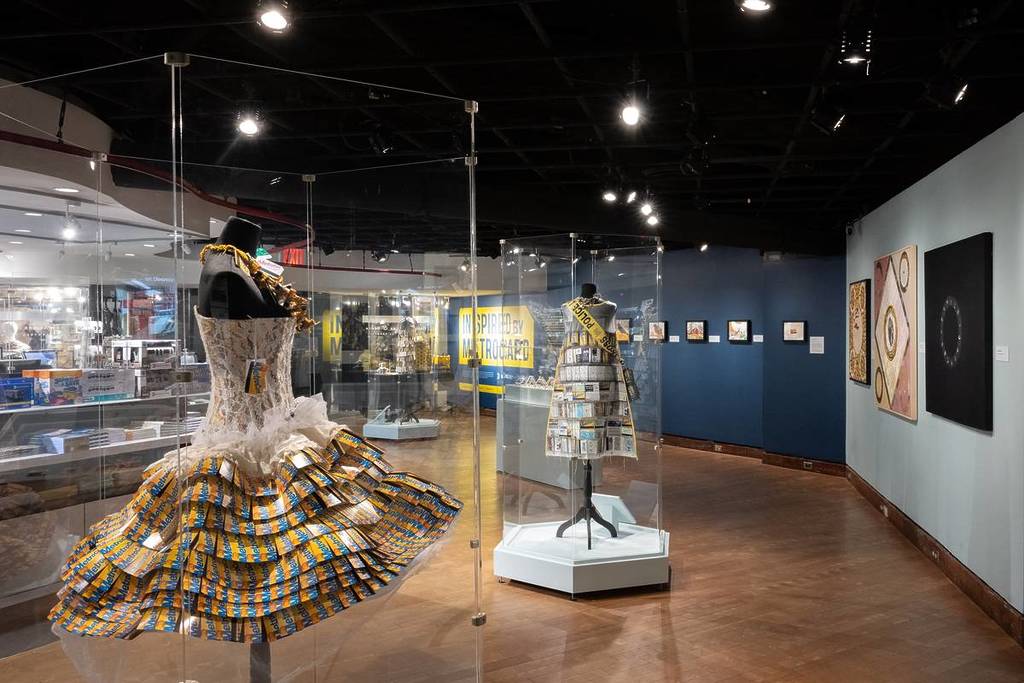
It is from this transition that “Inspired by MetroCard”, the exhibition set up at the New York Transit Museum Gallery & Store, in the Shuttle Passage of the Grand Central Terminal. The exhibition collects works by artists who have reused the abandoned tiles in recent decades, transforming them into creative media. According to the interim director of the museum, Regina Shepherd, the MetroCard was “one of the most accessible design objects in the history of the city”, and this widespread diffusion has favoured artistic reinterpretation.
The works on display cover very different areas, but share an element: they all start from a standardized object and reconfigure it. The artist Nina Vishneva, with the MetroDress project, uses hundreds of cards to create clothes, including a wedding dress and a dance dress built entirely with recycled plastic. Nina Boesch works instead for subtraction and recomposition, cutting the tiles to create detailed mosaics depicting skylines, bridges and urban animals. VH McKenzie uses the surface of the MetroCard as a miniature canvas, painting street scenes; Thomas McKean builds architectural models inspired by New York buildings. Among the exhibited pieces are the so-called “Hype Cards” designed by Barbara Kruger for the Performa Biennial 2017, an example of how the card was also used in institutional contexts and not only spontaneous.
The exhibition will remain open until October 2026 with free admission, confirming a line already followed by the museum: to treat public transport not only as infrastructure, but as part of the cultural identity of the city. In this sense, MetroCard follows a path already seen in other urban contexts, where everyday objects released become narrative materials. Even in Italy there are similar practices related to creative reuse, but rarely a single service object has reached a comparable level of recognisability: the MetroCard, for diffusion and duration, has ended up representing a shared experience hardly replicable elsewhere.
L’articolo An exhibition that transforms old MetroCards into works of art proviene da IlNewyorkese.