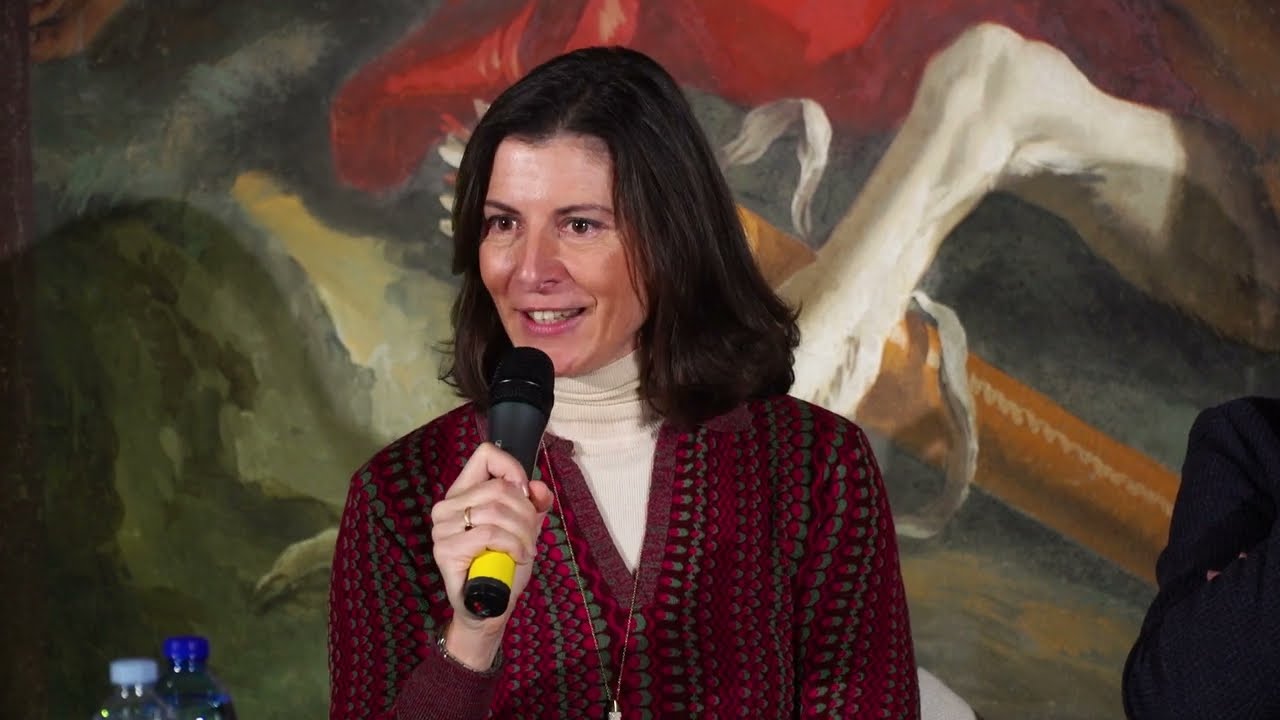
A rich part of experts, lovers and art lovers, style and refinement all Italians have met in the precious halls of the Circle of the Union of Naples, for the presentation of ‘Vivere in Florence’ by Livia Frescobaldi. Together with the author, they intervened: Giuliano Buccino Grimaldi, President of the Union Circle, Francesca Amirante, of the Museum Project Association and Giuseppe Ascione of the Museum and Archives of Casa Ascione.
‘Vivere a Firenze’ is an intimate story of the Florentine capital and added the author, ‘I last kept the presentation in Naples as the cherry on the cake, after being around Italy because I wanted to finish this route stopping me a few days to breathe the air of the sea, turn around the alleyways of the Sanità district I did not know, drink the real coffee with the Neapolitan friends and cuddle me eating!
How was the idea of the book ‘Vivere a Firenze’ born?
I have written with my heart this volume, drawing on my memories and my professional training dedicated to the protection and promotion of cultural heritage, so it is my way of making a tribute to the artisans, whose gestures and voices I have imprinted in the memory since childhood, and who are protagonists, like the hosts, of a world still today expression of beauty and values. Florence is a city famous all over the world, synonymous with beauty since the Renaissance, a destination chosen by more than 10 million tourists a year, who flocked to see masterpieces universally recognized as Michelangelo’s David, the Botticelli Spring or the Brunelleschi Dome. For a few years the fashion of making aperitif at sunset on the Holy Trinity Bridge has also spread, and dozens of people fill it for that occasion. The postcard image is therefore widely consolidated. As a Florentine, in love with his city, I tried to tell instead what is behind this wonderful showcase, choosing to do it through some special places for me, because intimately linked to my life. A combination of houses and workshops that allows you to discover different personalities and stories interwoven with each other, part of the cultural identity of my city. The journey is made away through the events connected to my personal experience, offering a personal and private panorama, of which authenticity is the guiding thread. The reader is accompanied to find out what we could define a “love topography”, taking a term from the preface of Vernon Lee’s book, Genus Loci.
What is this book for you?
This volume, which is also translated into English, comes from the observation, the sensations, perceptions, emotions, that have transmitted me the places and the people I tell, as well as the authors I admire, as Natalia Guinzburg speaking of emotional memory in his novel, The city and the house, and Emanuele Coccia who writes that it is in the house that “memory exists”, so with this volume I was given the opportunity to share with others a very intimate Florence that I chose to unveil, not to speak of me, but with the hope of giving an image of the city more authentic, through the values and the character that each house and shop carry forth, and this not because I look to the past with nostalgia, on the contrary for What happened to me, after receiving Marsilio’s proposal to think of an illustrated book with the most beautiful houses in Florence, was to reflect on the emotions that some houses and places had aroused in me during my life rather than to throw down an analytical and detailed list. So it was a beautiful emotional journey, a bit like putting together pictures in a family album. With the mind, I took a path backwards until I was a child and from there, then I left until I arrived today. I combined a workshop with each house, through a detail of the furniture connected to the specific activity carried out by the artisan and restorer because it is precisely in the details that our life assumes quality. And “there must not be an art detached from life: beautiful things to look at and bad things to use” as Bruno Munari said and for me ‘Living in Florence’ means this: taking care of the details. I’m sure many readers of other Italian cities will find themselves in these stories. I speak of Florence because this is what I know, but Italy is full of similar examples. Because in the volume we tell the life that is inside the houses, palaces and artisan workshops touching topics that inevitably revolve around themes common to many other Italian and European cities, I would say, such as: the cultural heritage, succeed in reconciling the past with the present, how to face the generational passage, and maintain the values on which our identity is founded, without remaining crushed by the tradition and history of the past. Even in the Italian Constitution, in 1947, the founding fathers wanted to include a specific article in defense of the crafts of art, aware of the importance they hold in society and in our culture: “the law provides for the protection and development of crafts”. With the refined, intense and intimate frames of photographers Alessandro and Eugenia, I think that even an audience of fans of aesthetics, can be attracted by the volume. I hope it is also a useful guide to those who are looking for handicraft products, thanks to the advisory of the shops inserted at the end. As well as those who love anecdotes and stories will be able to view them through images in the places where they were held.
In conclusion, his book ‘Living in Florence’ to whom is dedicated?
To my children, Andrew and Thomas, because they do not become like John Ruskin described the Florentines in the mid-19th century “unworthy guardians of unsurprising treasures” encouraging them and stimulating them to look with always curious eyes what surrounds them without ever giving for granted beauty.
What could you do to help young people get passionate about the beauty of our country?
As a parent, I always thought that the best way to convey something to my children, for example, the passion for literature was to see people reading around them, or the passion for food, was to have a kitchen always full of ingredients and pots on fire. Then each of them will choose their own passion and are often even better than their parents, we think of the current generation as it is more sensitive to climate change, sustainability, pollution, equal opportunities, just to name a few. For this reason, I am optimistic that beauty and quality, which are not related to luxury, will always be values to which future generations will inspire.
L’articolo Art, culture and so much beauty in the book of Livia Frescobaldi presented in Naples proviene da IlNewyorkese.