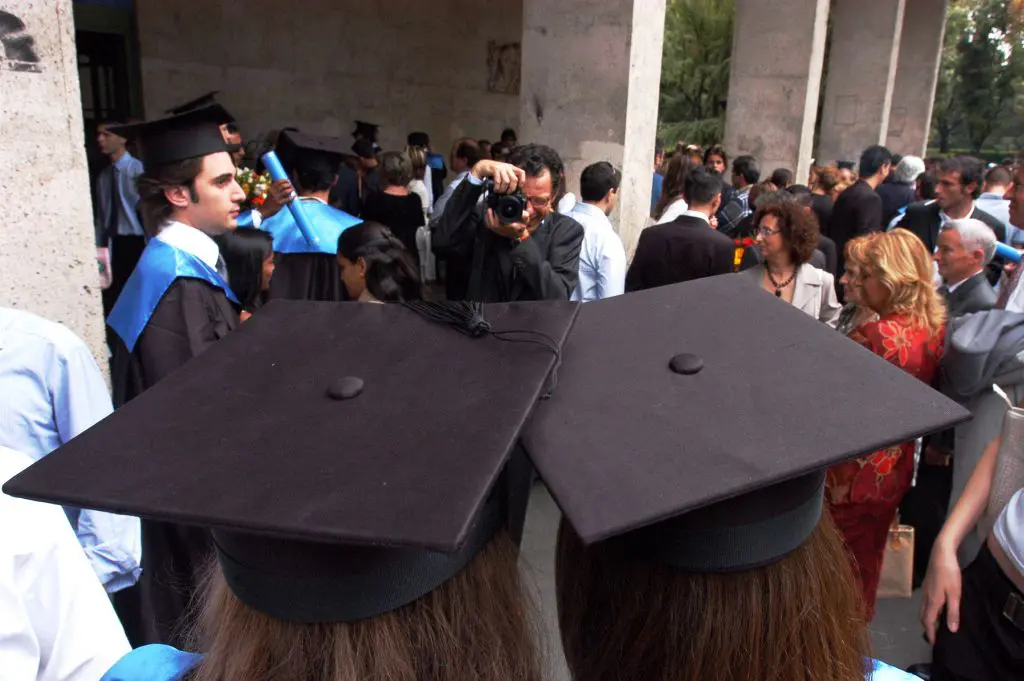
VERONA (ITALPRESS) – Half of ITS graduates and graduates who are looking for in 2025 are considered “introvable”. This is demonstrated by the Excelsior Information System, created by Unioncamere in collaboration with the Ministry of Labour and Social Policies, thanks to the National Youth, Women and Work Programme co-financed by the European Union.
The data are presented today, at the 34th edition of Job&Orienta, the national exhibition dedicated to orientation, school, training and work, inaugurated this morning at the fair in Verona. Excelsior 2025 shows that during this year the companies had planned the activation of 670 thousand contracts for graduates, 120 thousand for graduates ITS Academy, 1.3 million for graduates and 2.3 million for qualified and professional graduates.
But the mismatch between demand and offer is definitely important: It is difficult to find almost half of the desired profiles (47%), with tips of 57.3% for ITS Academy technicians and 50.9% for graduates.
“The gap between demand and job offer remains very high this year,” says Andrea Prete, president of Unioncamere. “It is not an Italian prerogative but certainly represents an important brake on the competitiveness of the country system. It is essential to continue working on multiple fronts, including orientation, which must be as early as possible; on a more intense relationship between universities and enterprises to stop the escape of brains; on a better meeting and dialogue between training and demand for enterprises”.
The most sought after degrees remain economics (193 thousand profiles) and engineering (127 thousand). Wide opportunities also for teaching and training addresses (117 thousand) and for the health and paramedical area (54 thousand). For young people under 30, the major employment opportunities are concentrated in statistical addresses (51.1% of recruitment) and motor sciences (40%). The mismatch, however, hits hard precisely the STEM disciplines: graduates in Chemistry and Pharmaceuticals are the most “introvable” (refining difficulty at 72.4%); follow the health and paramedic address (70.8%) and medical dentistry (67.2%).
The most sought-after ITS graduates come from services to enterprises (27 thousand entrances), development and innovation of the process and product (16 thousand) and mechatronics (13 thousand). Great opportunities for young people in mobility sectors (94.3% of recruitment under 30), sustainable energy (51.9%) and software architectures and data management (44.6%). But the mismatch remains very high: 67 thousand ITS technicians (57.3%), with peaks of 94.2% for energy sustainability and circular economy and 87.7% for energy efficiency. They then produce diagnostic and medical devices, fashion and development and innovation of the process and product all with a mismatch that affects 3 positions on 4 (around 75%).
As regards diplomas, the most requested address is administration, finance and marketing (381 thousand positions), followed by tourism (239 thousand), mechanics and mechatronics (121 thousand), electronics and electrotechnical (102 thousand). The major opportunities for young people are artistic high school (51.9%), graphics and communication (46.5%), tourism (43.4%) and computer science and telecommunications (43.2%).
In this case there are strong difficulties of finding: 634 thousand graduates (47.4%) are introduced, with deficiencies particularly marked in the technical addresses: construction, environment and territory (66.4%), mechanics, mechatronics and energy (65.8%), electronics and electrical engineering (60.9%), computer science and telecommunications (58.8%). Among the qualified and graduates Education and Vocational Training (IeFP), the most popular routes are catering (452 thousand entrances), logistic systems and services (265 thousand) and mechanical (222 thousand). The best opportunities for young people are artistic (46.5%), graphic-cartotechnical (40.2%), catering (39.3%) and thermo-hydraulic plants (38.8%). More than 1 million IeFP profiles (47%) are difficult to find, with particularly high criticality in thermohydraulic environments (67.1%), vehicle repair (63.8%), well-being (62.4%), electric (60.5%) and mechanical (60%).
-Photo IPA Agency-
(ITALPRESS).