
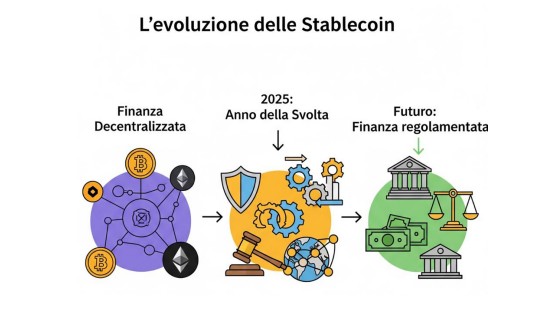
ROMA (ITALPRESS) – 2025 was an important year for stablecoins. In July, U.S. President Donald Trump signed the Genius Act, law on the regulation of these financial instruments and companies dealing with their issue. The already widespread interest in the markets towards stablecoin has so greatly strengthened, and there are analysts who talk about a next revolution in the world of international digital payments. To the ears of many, however, the word “stablecoin” still has an unclear meaning: what are they? How do they work? What do investors do? And why could they be a fundamental theatre of competition between great powers? It is to help clarify the many doubts that still surround these financial instruments that the Fucino Bank has published a new study for the Fucino Digital column, entitled Stablecoin and the new cryptocurrencies. The analysis, carried out by Professor Gianluca Duretto, professor at the University of International Studies in Rome, aims to provide some basic information on the world of stablecoins, their characteristics and regulations to which they are subjected, in Europe and in the USA. The text is divided into several sections. The first provides a definition and main features of stablecoin, hybrid instruments between the world of traditional finance and cryptocurrency. The central mechanism is the anchoring mechanism, which establishes the convertibility 1:1 of the stablecoin with a certain asset, asset group, currency or currency basket. According to the type of anchorage – the document continues in the second section – changes the type of stablecoin in question, as well as some implicit characteristics and risks. The third section clarifies how to invest in these instruments, and what measures should be taken to protect against fraud and risks of various kinds. The fourth, finally, is dedicated to the subject of the regulation of stablecoins, which follows a markedly different approach on the two shores of the Atlantic. But why is this new type of cryptocurrency attracting so much attention? The main reasons – in depth in the study – are basically two:1) The stablecoin are cryptocurrencies devoid of volatility that usually characterizes these financial instruments. However, crypto retains the underlying infrastructure, namely blockchain. This, in turn, allows for safe, fast payments and, above all, with transaction costs much lower than the systems currently most widespread. For banks, therefore, stablecoins are potentially a strategic issue: could cause the displacement of large capital outside the banking circuit, but could also prove to be a great flyer of profits for those institutions that will move with greater foresight. 2) The stablecoin also poses a theme of monetary sovereignty. The issue of currency has always been the prerogative of the State, which manages the offer of money according to the needs of the single economy. The capacity of the State in the monetary field could therefore be strongly limited by a wide spread of stablecoins, also and above all as payment instruments. The European regulation, aware of these risks, places important constraints on companies that issue stablecoin. Unlike the US approach, which sees in these new and particular crypto an opportunity: strengthen the demand for US government bonds, which would compose the reserves of broadcasting companies, and thus strengthen the status of the dollar as an international reserve currency. To date, in fact, is linked to the dollar most stablecoin in circulation: the U.S. therefore see the possibility to egemonize this new sector of non-traditional finance, with all the benefits that from this positioncan result. Around the stablecoin there are many challenges, disputes and issues. Today it is more than ever essential to fully understand this new type of financial instruments, halfway between the world of traditional finance and cryptocurrencies. The analysis of Professor Duretto provides a compass to guide itself in this new and still cloudy universe.
– Press Office photos Banca del Fucino –
(ITALPRESS).