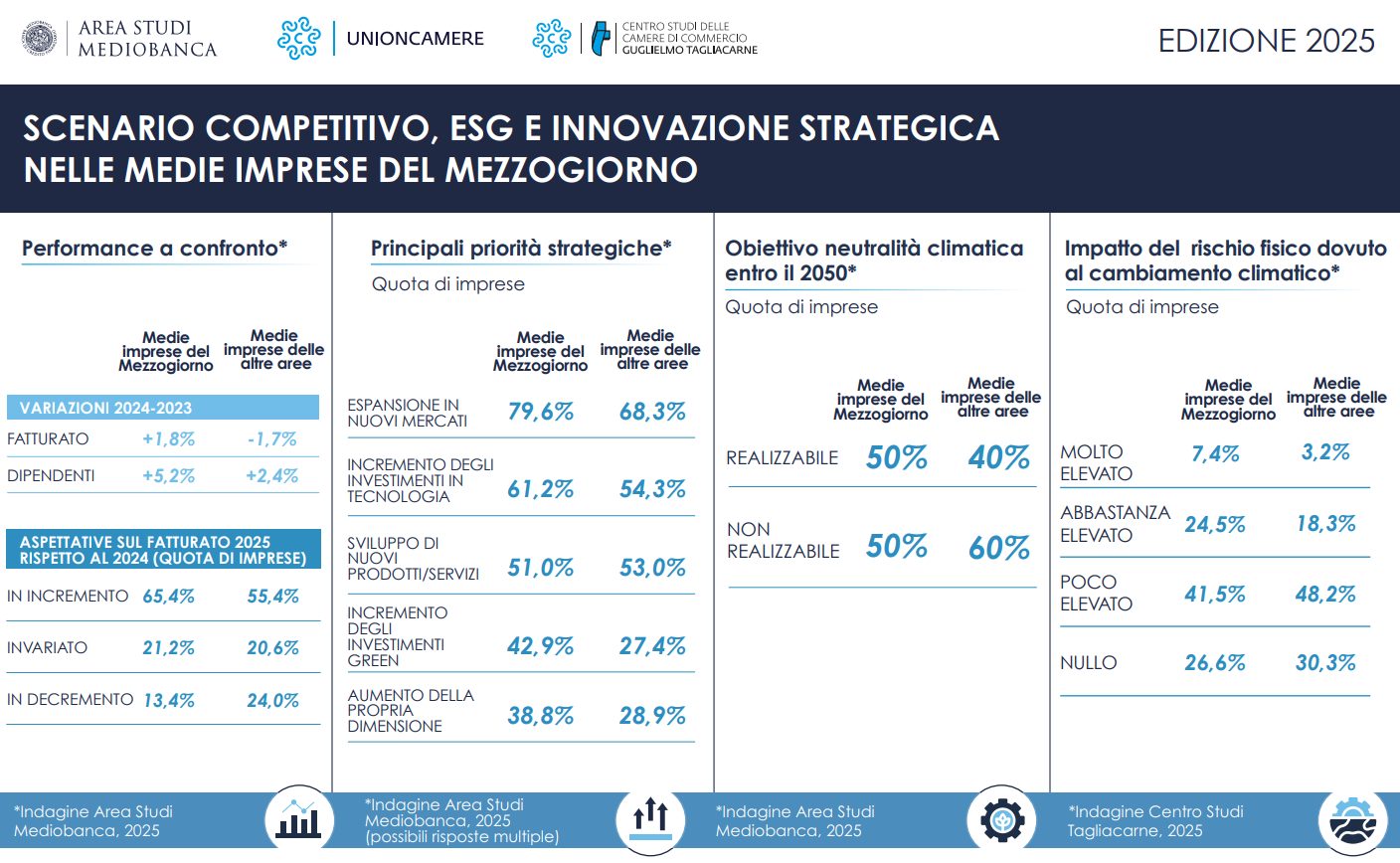
MATERA (ITALPRESS) – They are more optimistic on the trend of their business, more likely to open up to new international markets, more interested in the ecological transition. This is the identikit of the medium enterprises of the South, put under the magnifying lens in the report “Competitive scenario, ESG and strategic innovation in the medium enterprises of the Mezzogiorno” from the Mediobanca Study Area, from the Center for Papers and Unioncamere presented today in Matera. It is a sector that, in twenty-eight years, has almost doubled to count 408 Italian family-controlled capital companies, each with a working force between 50 and 499 units and a sales volume between 19 and 415 million euros, and which generated 11.8% of the added manufacturing value produced in the area. In 2024 the turnover of the average enterprises of the Mezzogiorno grew by 1.8% (against a decrease of 1.7% of the other areas of the country), after a total increase of 78.1% recorded in the previous decade (vs 52.8% of the other territories). In 2025, 65.4% of these realities in the South expect to close with an increase in turnover (compared to 55.4% of those in the Centre-North). However, the challenges are not lacking: for 23.2% of the southern Mid-Cap, for example, the mismatch of skills risks to curb growth, while 41.3% believes that bureaucracy could hinder the path towards sustainability.
In addition, the main concerns include price competition and expensive energy, indicated by about two-thirds of the sample. Looking to the future, in the next two years, to respond to the criticalities of the context – starting from duties – 79.6% of the southern Mid-Cap declares to want to expand its presence in new markets (compared with 68.3% reported to other areas). In addition, to support its ecological transition, three companies in the Mezzogiorno on four aim to reduce fossil sources and adopt renewable energies (compared to 66.6% of the rest of Italy).
“The medium-sized enterprises of the Mezzogiorno confirm themselves to be an important Southern growth flyer and are demonstrating that they can run even faster than those of Central-North.” This was said by Unioncamere’s president, Andrea Prete, who added “that’s why we have to be supported by removing the obstacles that brake its development, starting from the incentives for export and internationalization services where the Chambers of Commerce can give their concrete support. Especially after the difficulties created by US duties.” “The growth of the medium-sized enterprises of the Mezzogiorno and their intention to reiterarla in the near future signal the happy intersection between two attributes: the geographical one and the one related to a specific capitalist model. This is a trend that deserves to be supported both by the public decision-maker and by the actors of the financial market, I think in particular of those private equity funds that are bearers of a true entrepreneurial proposal and not simply of measures of pure efficiency”, says the director of the Mediobanca Study Area, Gabriele Barbaresco.
“Lucan and Middle Ages companies are the real champions of family capitalism and are ready for global challenges: from transitions to expansion on new markets. It is up to all of us to support these efforts of innovation and internationalization, removing obstacles and dislining to the maximum bureaucracy”, said the president of the Chamber of Commerce of Basilicata, Michele Somma.
In the decade 2014-2023 the average enterprises of the Mezzogiorno have recorded an increase of turnover pairs to +78.1% that is compared with +52.8% of the other areas. The competitiveness rate in the same time span is almost 25 percentage points higher than in other regions. On the other hand, the positive trend of the turnover continued in 2024 with a further increase of 1.8% (see -1.7% in other territories). The Mid-Cap of South Italy also show greater optimism for 2025: 65.4% expects to close the year with an increase in turnover (55.4% in other areas) and an additional 21.2% estimate to keep it stable (see 20.6%). However, the context remains challenging. To worry about medium-sized companies is above all price competition which is 64% of the southern ones and 70.7% of the mid-September ones, while competition on quality appears less relevant (22% vs 12.5%). Among the critical factors, taxation continues to penalize medium-sized enterprises, especially in the Mezzogiorno. In the period 2014-2023, the level of taxation of the southern Mid-Caps was constantly higher than that of the other areas, with a gap that generated a significant impact. If these companies had benefited from the same rate applied to those of the Central-North regions, they would have saved some 230 million euros in a decade.
The high energy costs are also weighing on the climate of uncertainty. Over 60% of the companies in the Mezzogiorno reported an increase in the energy bill (compared to just over 50% of the other areas). The increase in these costs has had a significant impact on the margins in more than 6 Mid-Cap of the Mezzogiorno out of 10 (55.5% in the North Center). To cope with energy relapse, 25.5% chose to invest – or plans to do so – in renewable sources, while 22.3% focused on modernising existing plants to increase their efficiency. Between 2014 and 2023 the employment of medium-sized enterprises of the Mezzogiorno has grown by 34.5%, a rate higher than 24.4% recorded in other areas of the country. The positive trend continued in 2024, with an additional increase of +5.2%, against +2.4% of the rest of Italy. These are encouraging signs, however, accompanied by some structural weaknesses. The female presence stops at 12.9%, well below 26.2% found in the Center-North. Looking at age, 21.4% of employees in South Italy are under 30, better than 18% registered elsewhere. The most important problem remains the skill mismatch: 3 medium-sized enterprises of the Mezzogiorno out of 4 report difficulties in finding the skills required, especially technicalspecialists. In this area, southern companies struggle, although less than in other areas (40.4% vs 55.3%). Criticisms also concern STEM profiles (21.3% vs 18.9%) and green (19.1% vs 12.6%).
The difficulty of finding skills affects the workload of employees for 47.8% of the southern Mid-Cap (compared with 49.4% of the other areas) and the operating costs for 36.2% (compared with 37.4% of the Centre-North). This criticality, moreover, represents a brake to the corporate growth for 23.2% of the companies of medium size of the South, compared to 19,3% of the other areas. In contrast to the mismatch, 34.8% of the average southern companies aim to invest in continuous training and 30.4% in automation of production processes, similar to the other areas (respectively, 41.4% and 35.6%). The future of medium-sized enterprises passes through growth and investment (especially in the Mezzogiorno) In response to the complexity of the economic environment, medium-sized enterprises show a strong propensity to growth. In particular, 79.6% of the southern ones declare their intention to expand their presence in new markets over the next two years, a higher share than yet significant 68.3% reported to companies in other areas. In addition, 4 Mid-Cap of South Italy out of 10 are ready to increase its corporate size, compared to 28.9% of those located elsewhere. Investments are another strategic pillar for the medium-sized enterprises of the Mezzogiorno: 61.2% plans to increase those in technology (vs 54.3% of those in other areas) and 51% is engaged in the development of new products and services, in line with 53% of the rest of Italy.
Particularly significant in the South is, moreover, the drive towards sustainability with 42.9% of companies that intends to accelerate green investments, against a lower share of the average enterprises of the other territories (27.4%). The medium-sized enterprises of the Mezzogiorno show a particular interest in the ecological transition, even greater than that of the companies of the Centre-Nord, also sensitive to the theme. In detail, 73.7% of southern companies (compared to 66.6% of central and northern ones) aim to reduce fossil sources and to adopt renewable energies. The circular approach to waste management and the promotion of recycling involve 63.2% of South enterprises, compared to 61.9% of Central-North, while the responsible control of supply chains affects 55.3% of the first, against 37.5% of the latter. The main obstacle to the start of an environmental strategy is the bureaucratic difficulties, reported by 41.3% of the medium-sized enterprises in the Mezzogiorno and by 32.9% of those in other areas. European environmental policy can represent 41.5% of the medium-sized enterprises of the Mezzogiorno an opportunity to improve energy efficiency (compared with 38.5% of other areas), but for 12.8% it increases the bureaucratic weight (16%) and for 13.8% is an economic cost (15.5%). Moreover, only 12.8% of these companies are willing to take advantage of the opportunities that EU green policies offer in technological innovation (7.6% in other areas).
A medium-sized enterprise of the Mezzogiorno out of four suffers a high impact from the duties introduced by the American administration and one out of two provides for a reduction in exports to the USA. In addition, only 7.8% is willing to bear the weight of tariffs to continue selling in the United States. This is why 35.3% focus on alternative foreign markets within the EU, while 20% seek new opportunities outside the EU. Not by chance, export incentives are the most demanded support tool for the South Mid-Cap (66.7%).
– Photo screenshot report “Competitive scenario, ESG and strategic innovation in the medium-sized enterprises of the Mezzogiorno” –
(ITALPRESS).