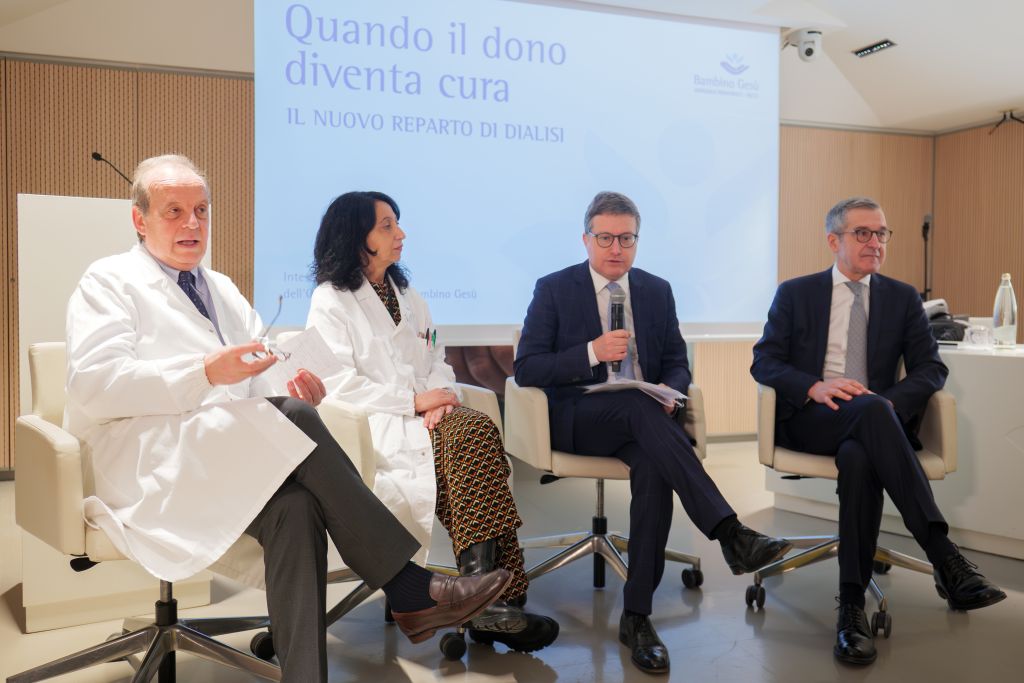
ROMA (ITALPRESS) – New spaces designed to guarantee greater quality of care in a safe and welcoming context: this is the photograph of the new department of pediatric Dialysis of the Child Jesus Hospital, inaugurated today in the headquarters of the Janiculum in the presence of the Secretary of State of the Holy See, Cardinal Pietro Parolin. The dialysis of the Child Jesus is the only pediatric character in Lazio and has been restored thanks to the contribution of Intesa Sanpaolo. At the end of the inauguration a meeting was held on the theme “The culture of gift” moderated by the Vaticanist of Rai Tg1, Ignazio Ingrao. In addition to Cardinal Parolin and the President of the Child Jesus, Tiziano Onesti, Paolo Bonassi, Chief Social Impact Officer Intesa Sanpaolo, Francesco Emma, Head of Nefrology of the Child Jesus, Isabella Guzzo, Head of Pediatric Dialysis and Clinic of the kidney transplant of the Child Jesus and Samuel Galimberti, a young patient who received the gift of kidney transplant. The new department of pediatric dialysis is the result of the redevelopment of existing spaces, completely renovated. The structure includes a main room with six locations dedicated to hemodialysis, life-saving treatment for chronic or acute kidney failure, which purifies blood from toxins and removes excess fluids through the blood passage in a filter (synthetic membrane) mounted on a specific equipment. Among the main novelties is the presence of a controlled pressure contumaciale room, equipped with two additional stations. This room is structured to isolate patients with infections or immunodepressants, which require special protective measures. Within these premises, it is possible to regulate pressure from corridors and adjacent rooms: usually, a negative pressure is used, which is lower than the external one, to contain pathogenic agents and to safeguard the surrounding environment. On the contrary, for immunodepressants, a positive pressure is used, which prevents entry into the potentially contaminated outdoor air room. The department is designed to facilitate operational efficiency and ensure greater comfort to small patients during long and frequent treatments, which can vary from two to four sessions of weekly hemodialysis (also 6 in more complex cases), each lasting about 4 hours. To make these seats more pleasant, each station is equipped with TV, remote control and wireless headphones and is located in a cozy and relaxing environment with colorful decorations. Thanks to the school teachers in the hospital, boys can also continue their course of studies, not interrupting the lessons. The equipment of the department is one of the most technologically advanced, with monitors for continuous monitoring and dedicated PCs for real-time management of patient clinical cards. The department has an organic of a nurse each two patients compared to a relationship between nurses and patients in adult dialysis centers which is normally one to six. The dialysis department of the Child Jesus is the only pediatric center of Lazio. It welcomes 30 to 50 new patients annually and guarantees dialysis treatment in acute hospital intensive care units. In addition to hemodialysis, the hospital has been offering for over 20 years a service of domiciliary peritoneal dialysis, a treatment for chronic kidney failure that uses the peritoneum membrane to filter blood directly into the body through a catheter, ensuring greater autonomy and flexibility than hemodilysis in smaller children. In case of chronic kidney failure, dialysis treatment continues until kidney transplantation. Over the last 30 years, the Child Jesus has made over 600 kidney transplants in collaboration with the Epato-bil Surgery Uniti-pancreatic, led by prof. Marco Spada. There are currently around 30-35 new transplants per year, of which 30% from living donors, making this activity one of the most important in pediatrics both in Italy and in Europe. The results are extremely positive: survival 10 years after transplantation exceeds 98% for patients and 86% for transplanted organs. The department is also Regional Reference Centre for dialysis and kidney transplantation and is part of the European Network for Rare Diseases (ERKNet).The Center for Pediatric Dialysis of the Child Jesus – states Francesco Emma, responsible for Nefrology – has recorded a significant process of growth, both in terms of volume of assistance and of qualitative standards of the services offered. Currently, it is established as a reference point for the care of children with kidney diseases playing a fundamental role for the entire region. Every year, the center welcomes a significant number of small patients, helping to significantly improve their quality of life. In addition, it promotes the creation of a network of support among families, offering an important sharing of experiences and resources for those facing challenges similì. ‘The new Dialysis Center – says Isabella Guzzo – represents a concrete response to a clinical condition that is still often unknown: chronic kidney failure, a progressive pathology that in the initial stages may not give obvious symptoms, but which can evolve until it requires dialysis. The Centre aims to provide qualified assistance and to help improve the quality of life of pediatric patients with chronic kidney disease and their families. ‘We live – said at the opening of the meeting “The culture of gift” the Secretary of State of the Holy See, Cardinal Parolin – at a time when almost everything is measured in terms of profit, efficiency and utility. Yet, the most important realities of life do not buy or sell themselves: they receive and donate. The gift is the silent but powerful language with which men and women express the best of themselves. Today’s event has meant to celebrate the importance of solidarity at various levels: from the gift of organs for those suffering from chronic kidney failure and needs dialysis, to economic support for the activities of the hospital. The collaboration with Intesa Sanpaolo has consolidated over time various initiatives, including the Family Friendly Project and the realization of the Centres for the autistic spectrum disorder and anorexia. The opening of the new Dialisi was an opportunity to discover a plaque that recalls the contribution of the banking group to the restructuring of the department. “We are proud – commented Paolo Bonassi, Chief Social Impact Officer Intesa Sanpaolo – to be at the side of a reality of excellence like the Child Jesus Hospital. For Intesa Sanpaolo, creating lasting social value, especially in the health sector, is a choice of responsibility: putting our solidity at the service of the country helps to improve the welfare of people and social cohesion. ‘High complexity pediatric health – said the President of the Child Jesus Onesti – requires structured skills, organization and partnership. With the new Dialysis we strengthen a center that welcomes up to 50 new patients every year and accompanies over 30 paediatric kidney transplants a year, with survival rates among the highest in Europe. Intesa Sanpaolo’s contribution demonstrates how the economic system can generate a measurable social value when operating in a framework of transparency and responsibility. Our commitment is to transform every resource into clinical innovation and concrete improvement of outcomes. The health of children is the most concrete parameter with which the quality of a community is measured.
– photo press office Children’s Hospital Jesus –(ITALPRESS).