The new school year of public schools in New York will begin on Thursday, September 10, and among the things families need to check before returning there is also the vaccination situation of children. The rules concern children and children between 2 months and 18 years of age who attend kindergartens, public, private and parish schools in the city.
This year there is some extra reason to pay attention to local indications. In recent months, the federal government has amended some recommendations on pediatric vaccines, but the state and city of New York have decided to keep their school access requirements unchanged. The State Department of Health reiterated this after the executive order signed by President Donald Trump on August 10: New York’s school rules continue to be those already foreseen.
The issue has also taken some importance for increasing measles in the United States. On August 24, 29 cases were confirmed in the state of New York since the beginning of the year, six of which were in New York City. They are small numbers compared to the population of the state, but enough to push the health authorities to remind families to control above all the coverage against measles, parotis and rosolia.
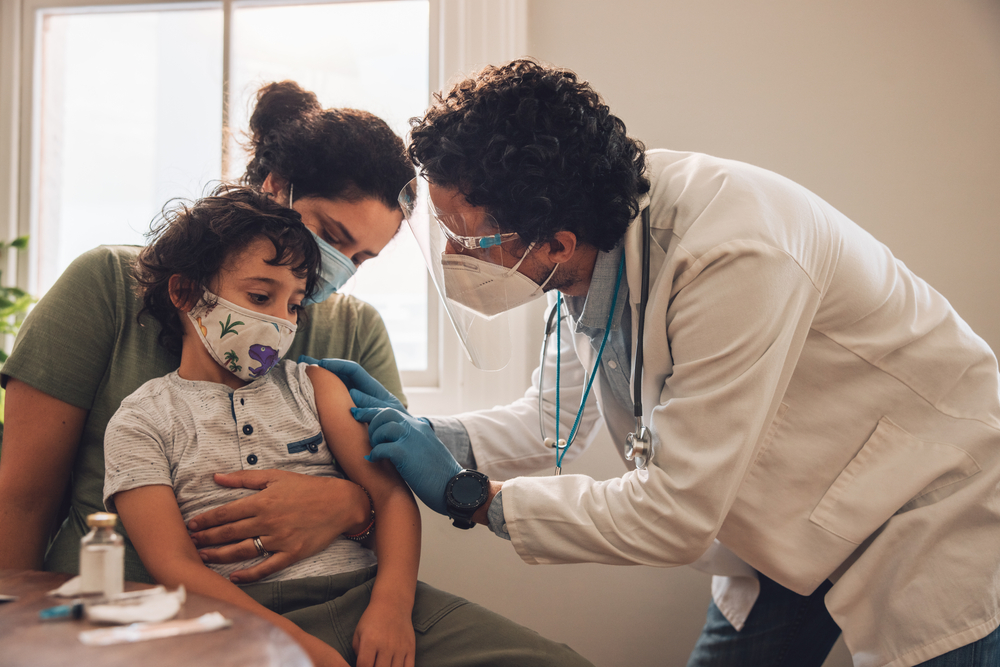
To attend a school or childcare service, all students must have adequate coverage against diphtheria, tetanus and pertox, poliomyelitis, measles, parotis and rosolia, chickenpox and hepatitis B. The number of doses, however, changes according to age, class and vaccinations already received: for this reason the table published by the New York City Public Schools for the year 2026-2027 is more useful than a simple list of vaccines.
For example, from kindergarten onwards, two doses of MMR and two of chickenpox vaccine are generally required, while for polio, four doses are normally needed, with some age exceptions in which the last one was administered. For diphtheria, tetanus and pertox the rules change even more depending on the age and time when the vaccination cycle began. It is one of the reasons why the school authorities recommend that you directly control the booklet from the pediatrician instead of trying to establish yourself if there is a few doses missing.
There are also specific requirements for certain age groups. Children under five years of child care, Head Start, nursery school, 2-K, 3-K or pre-K must also be vaccinated against Haemophilus influenzae type b (Hib) and pneumococco. A dose of flu vaccine is also mandatory for them, to be received by 31 December 2026. The obligation of flu concerns these services for early childhood and not students from kindergarten in advance.
Two other requirements are added from middle school. Class students from sixth to twelfth must receive a Tdap booster dose when they are at least 11 years old. The Meningococcic vaccine MenACWY is instead required by the seventh class: in the classes from the seventh to the eleventh, a dose is usually enough, while in the twelfth, two are needed. One dose is sufficient if the first was given when the student was already 16.
Being late with a vaccination does not necessarily entail immediate exclusion from the school. A student who has already received the first dose of vaccines required and must wait for the expected medical interval before the next one can be considered “in process” and continue to attend. However, it must complete the doses in the established time. The State Department of Health provides that, within 14 days from the beginning of the frequency, the family presents the necessary documentation or a valid medical exemption; if subsequent doses are not performed when they become due, the school may exclude the student until regularization.
Documentation can also be more articulated than it looks. For measles, parotis, rosolia, chickenpox and hepatitis B blood tests can be accepted that demonstrate immunity. For polio the rules are much more restrictive: serological tests are acceptable only in certain circumstances and, in practice, those performed after September 2019 cannot replace vaccination.
Exemptions are only possible for medical reasons. The form must be compiled by a doctor (MD) or an authorized osteopath (DO) in the State of New York, must explain why a specific vaccine would be harmful to the health of the child and is then examined by the school authorities. The exemption lasts for a maximum of one year and must be requested again for the following year. During the evaluation of the application the student can continue to attend. Since 2019, the State of New York no longer recognizes religious exemptions from school vaccination obligations. The official form to request medical exemption is available on the New York City Public Schools website.
For those who enter a school for the first time or in a New York childhood service there is another document to be checked: in addition to vaccinations a complete medical examination is required, registered in the CH205 module. For families who already have all the updated documentation, therefore, the return of September 10 does not require special procedures. For the other these last weeks of summer, they are especially useful to understand, together with pediatrician, what doses are missing and what can be done in the time required by law.
L’articolo What vaccines serve to return to school in New York proviene da IlNewyorkese.