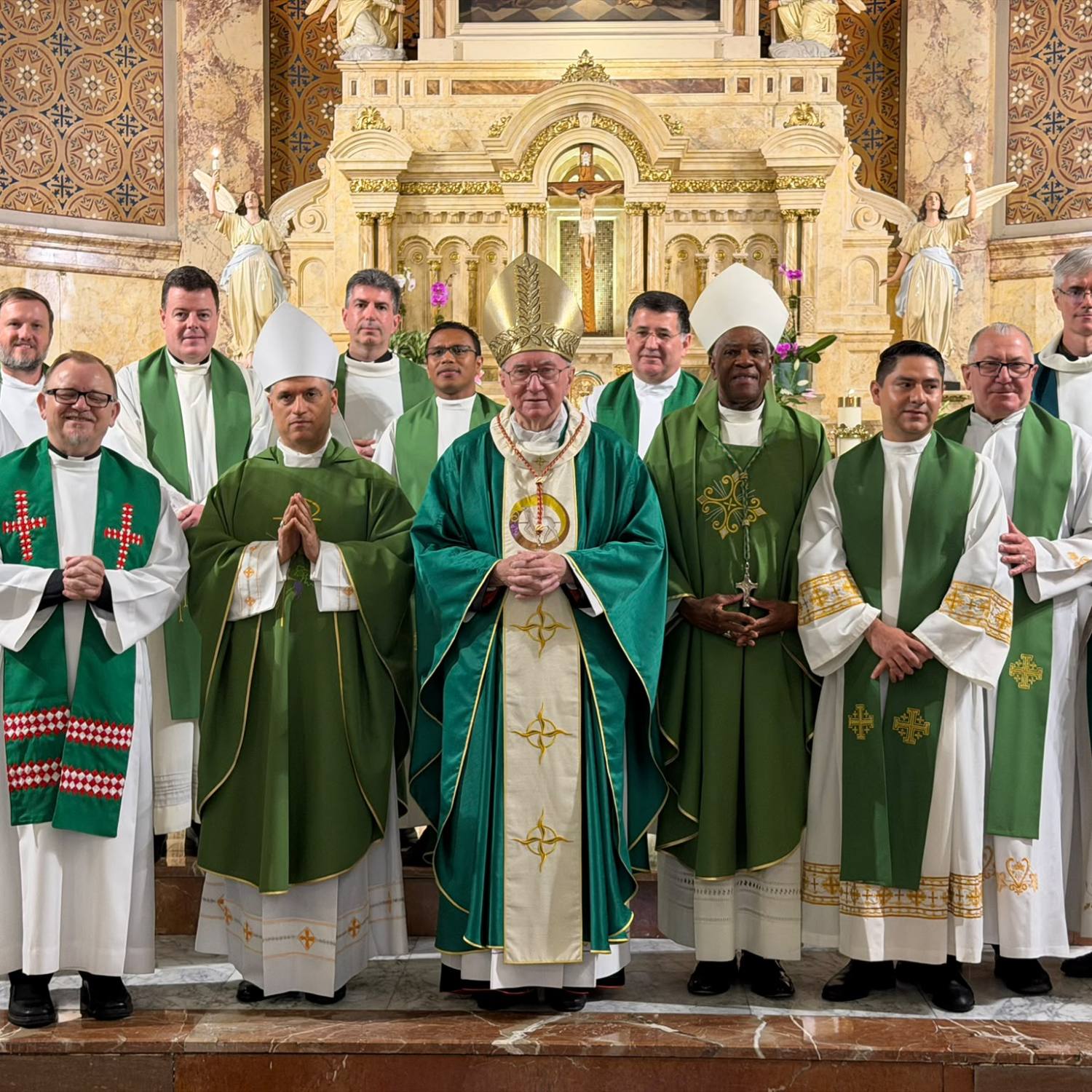
On Sunday morning the visit of Vatican Secretary of State Pietro Parolin in New York began in Greenwich Village, in the Catholic Church of Our Lady of Pompeii. Cardinal Parolin, among the people closest to Pope Leo, is in the city to attend the 81st General Assembly of the United Nations, whose main debate will begin on Tuesday, September 22.
Before meeting international leaders at the Palazzo di Vetro, Parolin celebrated Mass in front of representatives of Italian diplomacy in the United States, including the Consul General of Italy in New York Giuseppe Pastorelli and Ambassador Giorgio Marrapodi, Permanent Representative of Italy at the United Nations, to commemorate a historical anniversary linked to emigration from Italy: the 125 years of travel in the United States of Giovanni Battista Scalabrini, an Italian bishop.
In the summer of 1901 Scalabrini visited Ellis Island, the island in the Bay of New York that worked as a sorting center for immigrants, and saw the procedures of entry and conditions in which the Italians were welcomed, which at the time often arrived in great poverty, without guardians and without knowing English. Scalabrini tried to bring the issue of the conditions of migrants to the American public debate, speaking directly with the then president of the United States Theodore Roosevelt, in a meeting at the White House on October 10 of that year.
During his stay in New York, Scalabrini visited the parish of Our Lady of Pompeiii and inaugurated a seat of the Saint Raphael Society, an organization that provided Italians with fresh legal assistance, transport, meals and currency exchange assistance, protecting them from fraud and exploitation.
Today the church building of Our Lady of Pompeii is not the same visited by Scalabrini, it was rebuilt in the 1920s on Carmine Street after the original seat was demolished to enlarge the Sixth Avenue, but the institution remained. In the course of a century, following the demographic changes of the district and the city, it was transformed: the one that was born as a chapel for Italian only today is a multiethnic parish in which Masses are celebrated in five different languages, including Spanish, Portuguese and tagalog (the language of the Philippines).
The central passage of homily was an invitation to look beyond political differences and borders, starting from a conviction: no country alone is able to face the great contemporary challenges.
A position in line with the principle of multilateralism on which the United Nations is founded, but which today finds strong opposition from various governments that push for nationalist policies and border closure.
Vatican Secretary of State Parolin recalled the need for forward-looking policies, capable not only of managing migratory movements when they arrive at borders, but of understanding and addressing their causes, the conditions that force millions of people to leave their land.
In this sense, he stressed, the intuition of Scalabrini preserves a surprising topicality: an open Church, able to recognize the other and not to consider anyone foreign.
Parolin recalled that in 1901 Italians in New York needed someone to defend them from abuse. Citing this circumstance in front of diplomatic delegations preparing for UN leadership, the Secretary of State suggested applying the same perspective to people who today seek to overcome the borders of the richest countries, reminding those present that migrants were once theirs.
The article Vatican Secretary of State Pietro Parolin in New York on the footsteps of Scalabrini: “No one is considered a foreigner” comes from IlNewyorkese.