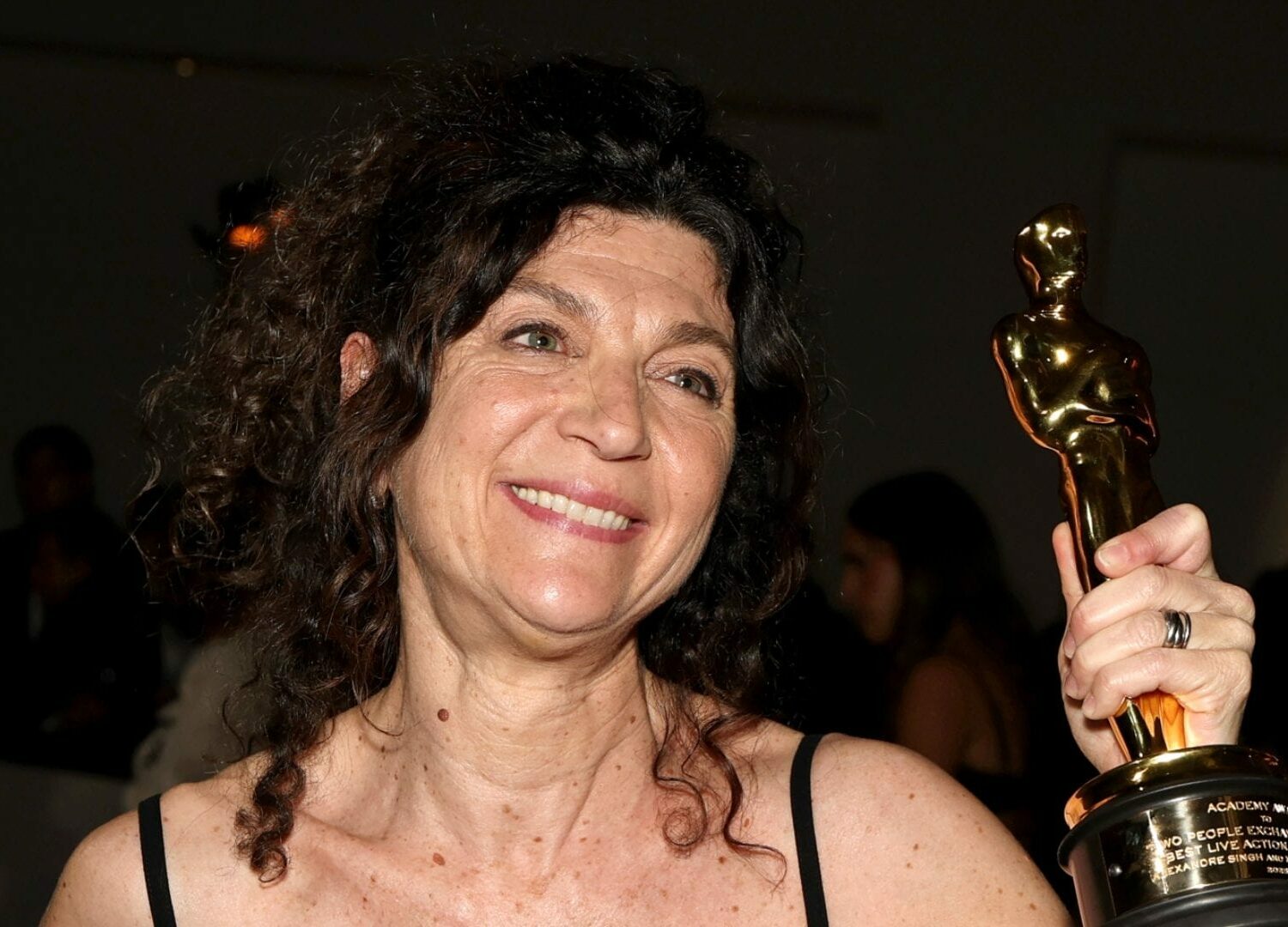
There is still unbelief, but above all a full joy, almost suspended. When she answers the phone, Valentina Merli is “still on the cloud”, indeed, “a very crowded cloud” and has no intention of getting off. The producer of Two People Exchanging Saliva, awarded with the Oscar for the best short film, retraces in this intimate conversation the path of the film, born from a radical idea and become a symbol of resistance, reflects on the future of Italian cinema, the opportunities of Hollywood and the French virtuoso system.
How does it feel, a few days after such an important victory?
Great. I’m still on the cloud, I don’t want to go down, I have to tell the truth. It’s all incredible, really beautiful. And then it is amazing to see empathy, affection, joy that this award has generated in people around us.
What was the strongest emotion along the path to the Oscars?
Already for the prequalification was wonderful. The short films arrive at the Oscars through a precise path, between awards and festivals, and we were among the selected ones: a huge joy. Then we discovered that pre-qualified courts were more than two hundred. The incredible moment was when we entered the fifteen. We were so happy. And even more when, at the end of January, the nomination arrived in the five: there, for us, was already a victory. Sure, when you’re at stake, you start hoping. But we knew we had a “war machine”, movies supported by big platforms, we said: Let’s go. When, in the hall, the winners announced, at first we didn’t even know if it was real and then something very rare happened: a former aequo. We were told that the votes were exactly the same. It was a very strong moment. I had to focus on not crying.
The first thought, at that time, to whom did he go?
To my family: my husband, my children, my parents, my sister. And then myself and my partner. The work of the manufacturer is complex, often invisible. A reward so he did us really well.
Is there a message received that struck you more than others?
I couldn’t make a ranking, but I was very pleased with Paolo Branco, the producer I started with 25 years ago. He wrote to me that he can retire now saying he worked with someone who won the Oscar. It was very exciting.
“Two People Exchanging Saliva”, a provocative title that tells the thirst for saliva, in fact, understood as intimacy. How does the idea of telling this theme arise and so directly?
She was born to the directors. Immediately came out the idea of a world where things are paid with slaps. He slapped us. Then a more symbolic component emerged: a world where kisses are prohibited. There was in the background the theme of protests in Iran and in general tensions related to immigration and repression. All this has contributed to creating a universe that seems absurd, but unfortunately it is not.
The kiss becomes a revolutionary gesture.
That’s right. It is a form of resistance. Love, tenderness remain necessary. I am what allows to resist the evil of the world.
Looking at Italy: how does the absence of our Oscar cinema read?
It is difficult for me to answer, because I do not live in Italy. But I have the impression that culture is a little underrated and that it does not fully understand its economic return. In France this is very clear. There is a strong tradition and a system that supports it. In Italy we have an extraordinary film history and many talents, even young people. I hope they can emerge.
What Italian talents should not miss at the Oscars?
I think of the costume designer Stefano Ciammitti, very good and with great international potential. Then director Francesco Sossai. And Francesco Costabile.
Do you live and work in Paris but what dialogue do you have with the Hollywood industry?
Directed, for now, not very much, also because we work mainly in author cinema. But they will probably open up new possibilities, also because our directors have very strong ties with the United States, living in New York.
What should Italy learn from systems such as American or French?
More than Hollywood, I believe in Europe. In France there is strong public support and great cultural attention. There is a virtuous system, a chain that feeds itself. And then there is an authentic cultural pride, not only symbolic. Cinema is considered art and also economic resource.
How much did you count Bologna in your training?
Very much. It is a city where you can breathe culture from children. The Cineteca, the movies, the videos… everything helped create a look. I, as a child, was watching the titles of tail: I wanted to understand who did what. Only after that I realized it was already an interest in production. Today Bologna is a city of cinema, where love for cinema is felt.
When he comes back to Bologna, what’s the first thing he does? Where’s the first place?
I immediately try to eat ice cream, because for me Bologna has the best in the world. And then I’ll go see my friends.
After so many years of personal and professional life abroad, do you still feel connected to the Italian cultural scene?
No, I don’t feel very inserted.
Would you like to return to work more stable in Italy?
I would like to work with Italy. It’s nice, but it hasn’t happened yet. I hope this happens.
After such an important recognition as the Oscar, do you think it will change its role as a producer? Will you feel more free or more exposed to industry expectations?
I don’t feel expectations. I’ll probably feel freer in choices. And I hope not only doors open, but doors for future projects. But you have to beat the iron until it is hot: it is an environment where everything passes fast and you forget quickly.
As a producer, what is the element that cannot be missed in a good film?
The need, by the screenwriter or the director, to make that film. There must be an internal fire that makes it inevitable.
Do you think of an example of this “fire”?
Yes. One case is that of Oliver Laxe with Sirat.
Remaining on the sector: from the perspective of women in the cinema, not only actresses but professionals at all levels, at what point are we today?
In Italy I can’t say exactly. Here in France I see steps ahead: there are collectives like 50/50 that monitor equality, even in numbers. The Me Too movement then had a strong impact. We are not yet at a real parity, but we are progressing.
If he should tell this moment of his life as a scene of a film, what would be the picture?
It’s a big plan. It’s me, but with a lot of people. I don’t know if I’m right in the middle, but there’s a lot of light around, the sky is blue. We’re all on a cloud.
A crowded cloud, then.
Yes, a very crowded cloud.
The “revolutionary kiss”, the soul of his film, to whom does he dedicate it?
To young people, to future generations. We are not leaving him a simple world, but I hope they can resist and build something better.
L’articolo Valentina Merli and her revolutionary kiss from Oscar proviene da IlNewyorkese.