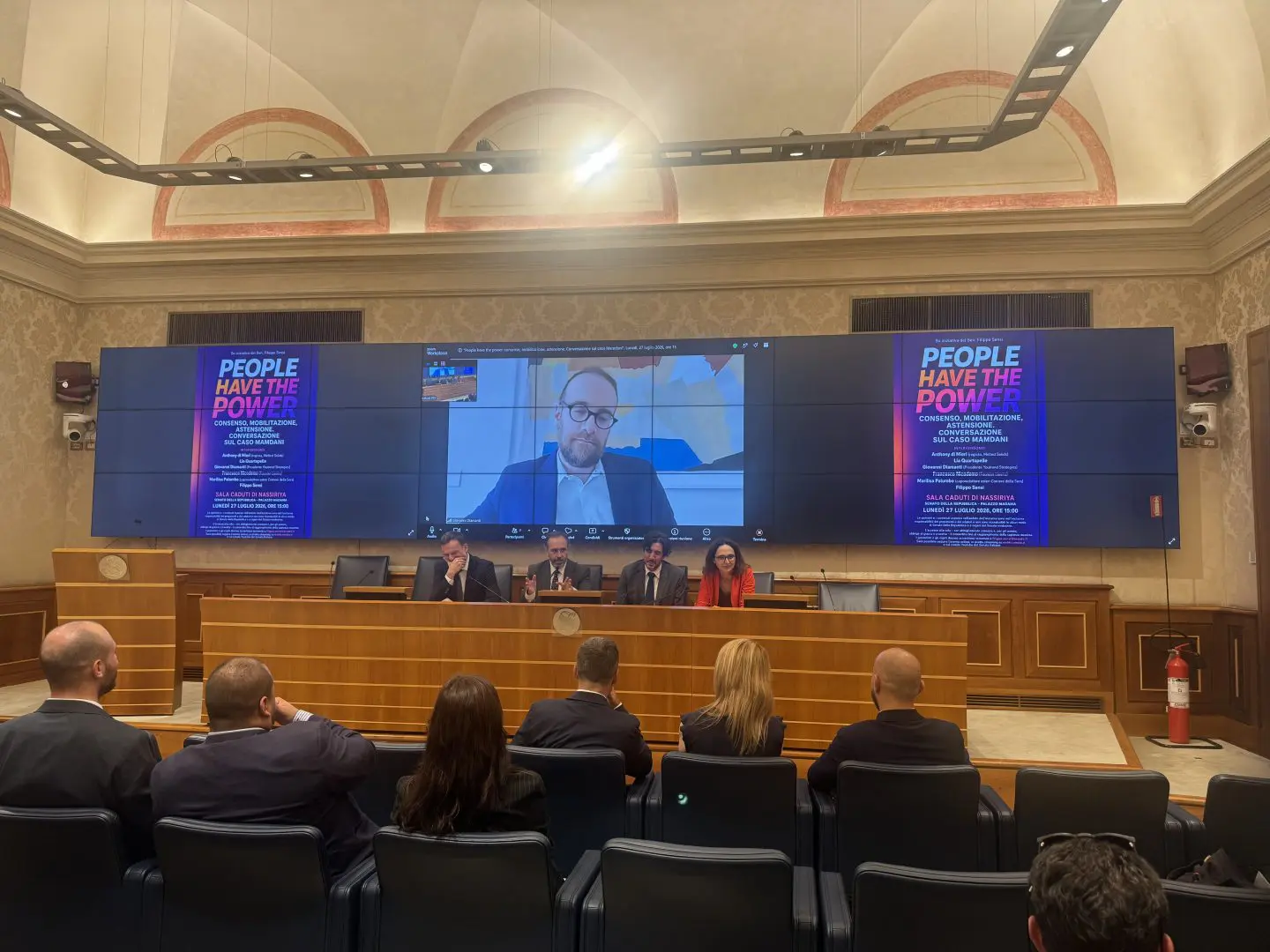
ROMA (ITALPRESS) – Political communication, participation and crisis of astensionism were the themes at the center of the double appointment promoted by the senator of the Pd Filippo Sensi in the Sala Caduti di Nassiriya of Palazzo Madama. Two consecutive events, dedicated to the election campaign of the candidate mayor of New York Zohran Mamdani and to the presentation of the book “Votare” of the constitutionalist Francesco Clementi, have compared experiences and reflections on the relationship between politics, consensus and citizens. The first meeting had as main guest Anthony Di Mieri, director and co-founder of the creative agency Melted Solids, who signed some of the main videos of the election campaign of the mayor of New York Mamdani. Di Mieri told how the communication of the campaign was built, explaining that social media are important, but alone it is not enough. To involve people, he said, it is necessary to convey passion and authenticity, making voters feel part of a project. Hence the meaning of the slogan “People have the power”. Giovanni Diamanti, president of YouTrend Strategies, retraced the evolution of American political communication, from Barack Obama’s campaigns to date. He stressed the increasingly central role of social media and political identity, but also explained that Italy cannot simply copy American models.
“Progressive Italy can take inspiration from experiences like Obama or Mamdani, but each country has a history, a political culture and a different demographic,” he observed. Marilisa Palumbo, editor-in-chief of Corriere della Sera, instead analyzed the American political landscape, focusing on the increasing influence of trumpism and the effects that this scenario can have on the debate of the Italian Democratic Party. Lia Quartapelle, MP of the PD, also took part in the matter of participation, according to which one of the difficulties of Italian politics is able to mobilize voters. “In Italy politics is boring”, he observed, stressing the need to find new languages to involve citizens. To close the first meeting was Senator Filippo Sensi, promoter of the initiative, who moderated a final confrontation with Anthony Di Mieri and other speakers. The debate focused on the perspectives of the political world, with particular attention to the progressive area and the challenges of communication, participation and mobilization of the electorate.
Following was the presentation of the book “Votare” by Francesco Clementi, ordinary of Comparative Public Law at the University La Sapienza in Rome. The debate included the president of the Apulia Region Antonio Decaro, the MEP Giorgio Gori, the mayor of Parma Michele Guerra, the journalist of Il Domani Daniela Preziosi and the Senator Filippo Sensi. At the centre of the debate the theme of astensionism, which now sees more than half of the Italians renounce the vote. Clementi recalled a concept expressed by the President of the Republic Sergio Mattarella, stressing the need to regain the sense of vote. “The vote is a promise that there is a tomorrow. Democracies know that there is no written result, unlike non-democracies,” he said. “The outcome is never discounted.” For the constitutionalist the vote builds the future and represents an active gesture that keeps democracy alive. On the relationship between citizens and institutions the mayor of Parma, who addressed the issue of the reasons that push many voters not to go to the polls. According to War, many citizens are convinced that their vote cannot change things. For this reason, he explained, especially a mayor must maintain a direct and constant relationship with voters.
Precious instead emphasised the responsibilities of institutions and politics in the increase of astensionism. Among the causes indicated the behavior of the elect, who often do not reflect the expectations of voters, and the need for politicians to speak with sincerity to citizens, “without dealing with voters as teenagers”. The loss of the sense of democracy, he observed, coincides with the loss of participation. Giorgio Gori addressed the theme of the selection of the political class and preferences in the choice of representatives, indicating in the confidence between voters and elected one of the fundamental elements to counter astensionism and strengthen democratic participation. “The electorate, in order to vote, must above all be informed”; these are the words of the MEP. To close the panel was Antonio Decaro, who focused on the importance of voting and responsibility that a politician has when he receives consent from voters. The theme of preferences, even in its intervention, was a key theme. According to Decaro, it should also be introduced in the Italian parliament, being these already present in other institutions such as the European Parliament and the municipality. As for Clementi’s book, for Decaro “astensionism is linked to lack of trust”. The two meetings thus offered a complementary look on the challenges of contemporary democracy, highlighting how effective political communication and the recovery of participation in the vote represent central elements to rebuild the relationship of trust between citizens and institutions.
– photo xu1/Italpress –
(ITALPRESS).