I am one of the few journalists, I believe in the world, convinced that next year Donald Trump will take the Nobel Peace Prize. Maybe I’m wrong, we’ll see. There is, however, in our trade, the so-called fact checking, that is, the verification of our ideas and facts. I believe that it is true that never, as Trump says, is perhaps close to peace or at least a truce, in a complex situation like that of Ukraine, which is dragging into a static state on the field and static even in diplomatic terms.
But we come to the role of Europe. The Europe mistreated by Trump, but also here are among those who think that perhaps these distractors, these criticisms, which can be partly rejected, can serve as a stimulus on a structural plan of Europe itself, both political, therefore of the European Union, and geopolitical, or of the inclusive Europe of Great Britain.
Europe cannot be only the one who lives of lasting peace forever (except for civil war in the former Yugoslavia in the early 1990s). The West victorious after the fall of the Berlin Wall. A Europe only cradle of civilization, rightly, and democracy. European law and Europe of sanctions, Europe that discusses Russian assets, therefore of Russian goods, with a thousand legal difficulties, because we, as European countries, are not at war with the Russian Federation and, at the same time, do not know well whether that money is also of the Russian people. But let’s forget this complicated subject, which we will face in another editorial.
We are talking about Europe that reacts to these criticisms, which is a move, which seeks to be protagonist in this peace negotiation. Let us begin with the analysis of that situation that we call “the group of volenterosis”: a term that I do not like, makes men think of good will. In fact, the willing are those European countries who have the will to do something that goes beyond the formal rules of the European institutions, which perhaps should also be revised.
Germany, France, England (which is not in the European Union) are countries that seek to have a role and build a new format, to say that perhaps, within the laborious machine of Europe, in terms of foreign policy, of a common army of which we are discussing — but of which there is still no dawn, neither in terms of governance nor in practical terms — and of a rearmament that frightens Western public opinion (we think of all events, oppositions, the progressive world that claims that every euro spent in that sector is removed from welfare and health), something can still be moved.
In such a laborious Europe, in the end the willing represent a step forward and are dialoguing with Zelensky and Trump to make their contribution to a peace negotiation that was not entirely rejected by Putin.Putin certainly rejects it in good part, because the theme of the occupied territories and that of the future of Ukraine remain widely to be decided.
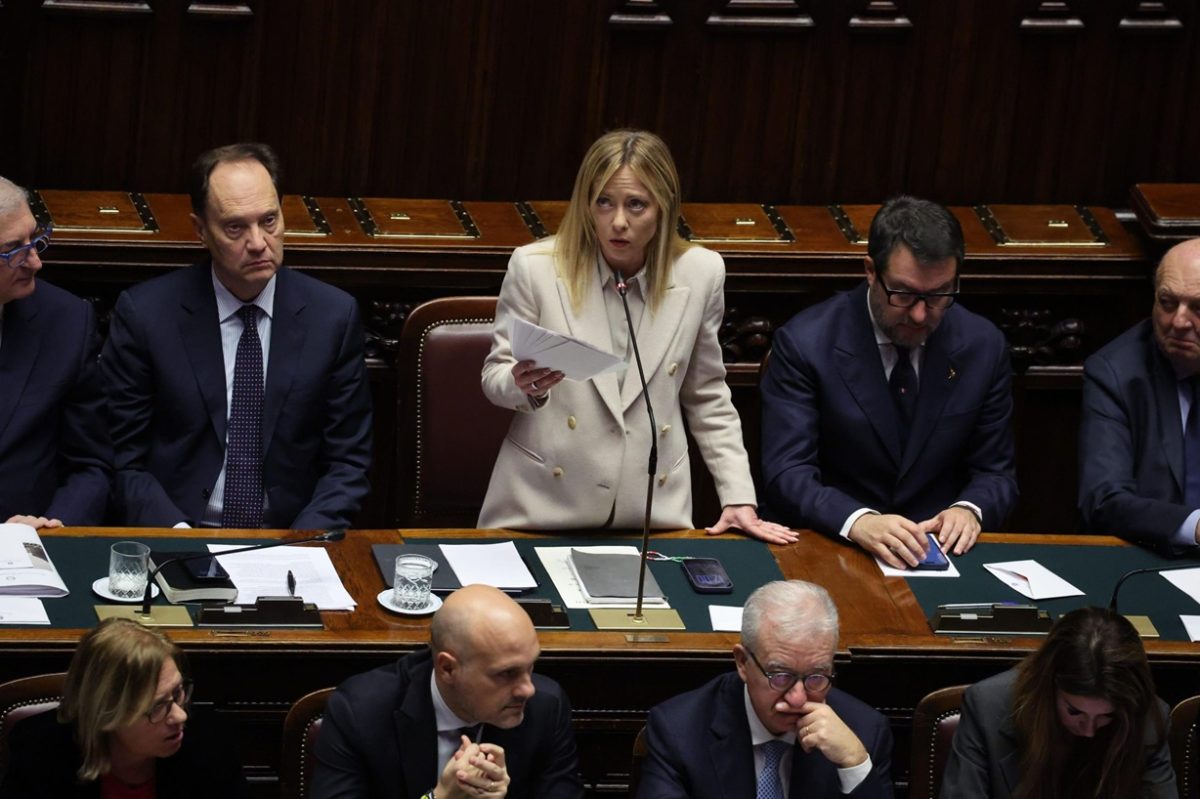
So we were saying a new format. What does Italy have in this sense? There have been very strong criticisms of Meloni’s speech in Parliament, before the European Council, which is the almost “published” decision-making body, of defining the political lines of Europe, while the European Commission is the government and Parliament does the Parliament. But Giorgia Meloni, in the end, remained on an intermediate position, very understandable, because it dialogues with the voluntarians, but remains in a position of relative political distance not to compromise, in a constructive sense, relations with Trump.
Meloni explained Italy’s position in the information that a prime minister always keeps in Parliament before going to the European Council, which is the great government, the place where the heads of state and government trace the lines also of the great foreign policy of the European Union and of Europe as a whole, as it has been said, because Britain is part of this affair at this time.
An information concerning a stable position on Ukraine, however, concerns the weapons that we send, even without specifying its nature, concerns total but balanced support.
Our premier and our government, at this moment, are in a position of baricentro compared to institutional Europe, compared to the voluntari (which we have explained to be a new governance format), compared to Trump and America dealing with Putin.
The goal remains that of peace. Right or not right, but peace, because peace means that you stop dying, you stop destroying. Maybe we’re close, maybe all this can help. Of course we are part of a Europe that, at this moment, participates — and participates in the right way — to what might be the great event that awaits us between the end of the year and the beginning of the next.
Article The will of peace comes from IlNewyorkese.