At the beginning of the twentieth century, in the United States, travelling by train was the fastest and most widespread way to cross long distances, but also one of the most risky. The railways were booming, with thousands of kilometres of lines connecting industrial cities, agricultural areas and new settlements. It was a still unregulated system, far from today’s security standards and largely based on manual procedures: signalling systems were not fully automated yet, and most of the rail traffic was based on telegraphic communications and pen-written instructions. Coordination errors between stations or engineers could lead two trains to the same line without adequate safety distances. Frontal clashes, especially on single-track lines – most of the lines had a single track – were among the most frequent accidents. And accidents, in general, were not rare.
One of these, which took place on 27 November 1901 along the Wabash Railroad line, between the towns of Seneca and Sand Creek, Michigan, involved two trains and caused dozens of deaths. But there is a reason why we talk about it.
Una mappa che mostra le linee ferroviare della Wabash Railroad
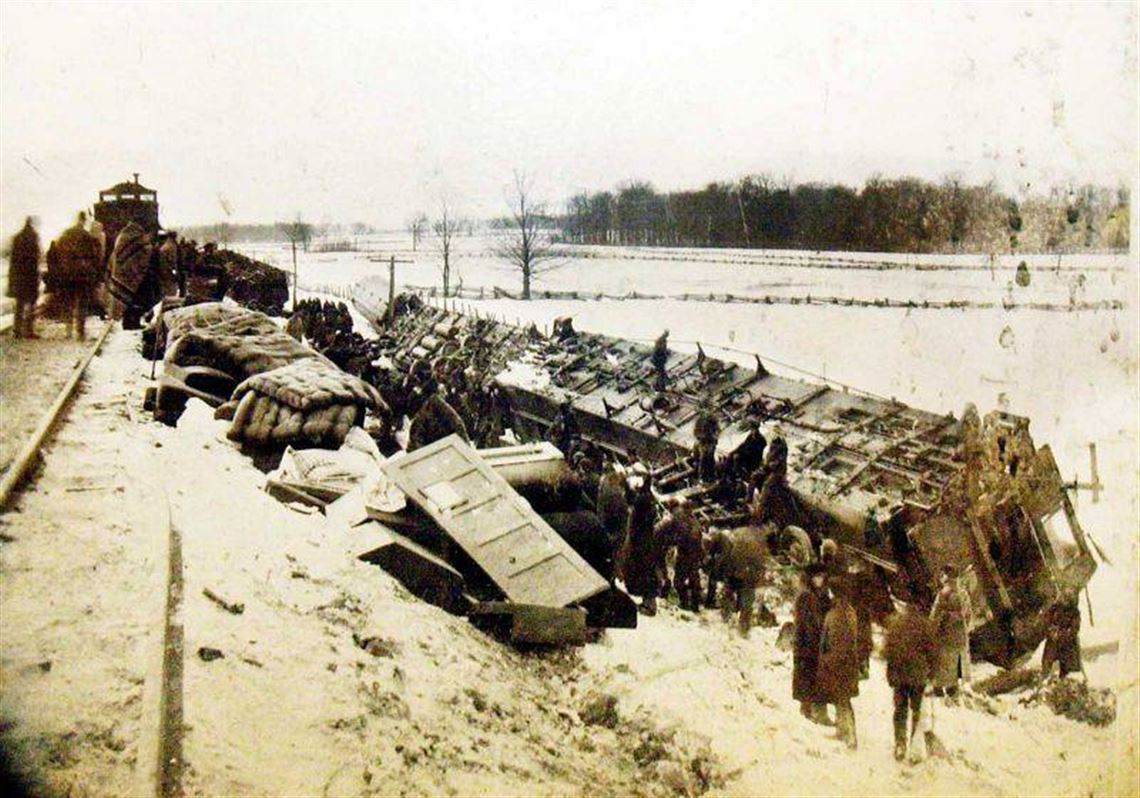
The so-called “wreck on the Wabash” was a frontal confrontation between two convoys. On the one hand there was a passenger train, the Number Four “Continental Limited”, directed towards Detroit and with on board many people of the middle class, mainly American and divided into wagons between first and second class, traveling during the Thanksgiving period, Thanksgiving Day. On the other hand, a much more humble convoy, the train number 13, consisting of a pair of first-class carriages, a cheaper wagon and three water tanks. In these three wagons, built in wood, there were about one hundred Italian immigrants, arranged with lucky seats. The train number 13, which is also a number traditionally associated with bad luck in American culture, had departed from New York and traveled in the opposite direction to Detroit, towards Colorado, where many of the Italians would look for work in the mines.
The most credited historical reconstruction tells that the Continental Limited did not respond to the order to stop at Sand Creek station and ended on the same route occupied by the other convoy: the order was to give precedence to the Treno number 13, which had accumulated a lot of delay due to a broken engine during the trip. It is unclear whether the order was sent late or did not arrive at the engineer in time before redisclosure, or if it failed to interpret it correctly or ignored it.
Particolare della mappa di sopra: è possibile distinguere Detroit, in alto a destra, e, seguendo la linea più spessa verso il margine inferiore sinistro, arrivare fino ad Adrian. L’incidente ferroviario sarebbe avvenuto tra la stazione di Adrian e quella successiva di Sand Creek proseguendo la traiettoria.
However, at 6:45 in the afternoon, the impact between the two trains caused a violent fire: the materials used for carriages, along with the lighting systems of the time – gas lamps or oil lamps, extremely dangerous – made the flames difficult to contain. Many of the Italian passengers were trapped inside the tankers and died without being able to leave.
The Italians involved in the accident were part of the Great Italian emigration, that is the vast migration phenomenon between the end of the nineteenth century and the first decades of the twentieth century that prompted millions of Italians to leave the rural areas of the country, especially in South Italy, to move overseas. Many of them moved within the American territory to reach seasonal or industrial jobs, often organized through recruiting submerged networks. The journeys were in precarious conditions, with very low costs but safety standards much lower than those of the most affluent passengers.
After the accident, the rescues were organized by the inhabitants of the nearby areas, mainly from the most inhabited city of Adrian, with some houses of the nearby Seneca and Sand Creek turned into lucky hospitals, but for many of the passengers there was no possibility of salvation. The bodies of the Italians were recovered only after the end of the fire and quickly buried in a common pit: the reconstructions of the time speak of a few large containers – about 5 coffins – where the corpses were piled together.
Una foto dell’incidente fornita dalla Keene Public Library and the Historical Society of Cheshire County, firmata Keene N.H. | Via Picryl.com
In several cases it was not possible to identify the bodies of the Italian immigrants, both for the conditions of the remains that were taken away after the fire, and for the lack of documents or contacts on the spot; also for this reason the count of the victims is not accurate: some sources speak of about 75-80 victims, while the official version of the railway company mentions only 23, all with tickets of first and second class. In a time when the information was not travelling with the same speed and precision as today, it was the interest of railway companies to try to mitigate as much as possible the consequences of binary accidents. This does not, however, deprive one of the most serious railway disasters in Michigan history.
Of the common pit, over time, the traces were lost, and also of the railway accident did not speak for much, robbing it to a local history only knowing of the few inhabitants of the area of Seneca and the city of Adrian. Moreover, at the time it was frequent that immigrant workers, without family ties in the United States, were buried without identification and without a proper burial rite, and if no one reclaims the bodies for years it is even more difficult for someone to remember the event. And so it was: for most of the twentieth century, the history of disaster remained limited to local studies and reconstructions of historians of the area.
For years, one of the main sources on the disaster was the book Wreck of the Wabash (2001) of the historic local Laurie C. Dickens, which reconstructed the incident but ended with an unresolved point: the fate of the remains of Italian immigrants. The ashes, wrote Dickens, had been transferred to an unspecified place and priests had been prevented from celebrating funeral rites. And there was nothing left until 2016, thanks to Kyle Griffith’s work.
Kyle Griffith is a teacher and school administrator, professor at Adrian College, a private school that counts just under 2,000 students. For years Griffith told his students the episode, but in front of the most specific questions he had no answer. So he decided to start a search to accurately identify the burial site of the victims, collaborating with the then mayor of Adrian, Jim Berryman, and with the staff of the local cemetery, the Oakwood Cemetery. After months of verification on historical records and maps, some portions of land without lapids were identified, dating back to the early 20th century, compatible by position and size with the area where the five coffins used to collect the remains of the victims were buried.
The discovery allowed us to locate the burial site, but did not solve all the uncertainties, as Professor Griffith told us: “Although more than 100 Italian immigrants have died in the accident, the exact number has never been definitively confirmed. Among the most significant stories related to the tragedy is that of a single survivor, a newborn then known as “Baby Wabash”. In a desperate gesture, the mother broke the train window while the flames enveloped the carriage and threw the child towards salvation, where he was rescued from a local family”.
Since then, the city of Adrian has started a path of recognition of the incident and the victims, involving local institutions, descendants and Italian-American communities. The process led to the realization of a memorial inside the cemetery, signed by the Italian artist Sergio DeGusti, and to an official ceremony that included, for the first time, also a religious rite. “This moment of recomposition and memory – says Griffith – represents a clear signal: it is never too late to do what is right”.
L’articolo The history of the disaster of Wabash and forgotten Italian migrants proviene da IlNewyorkese.