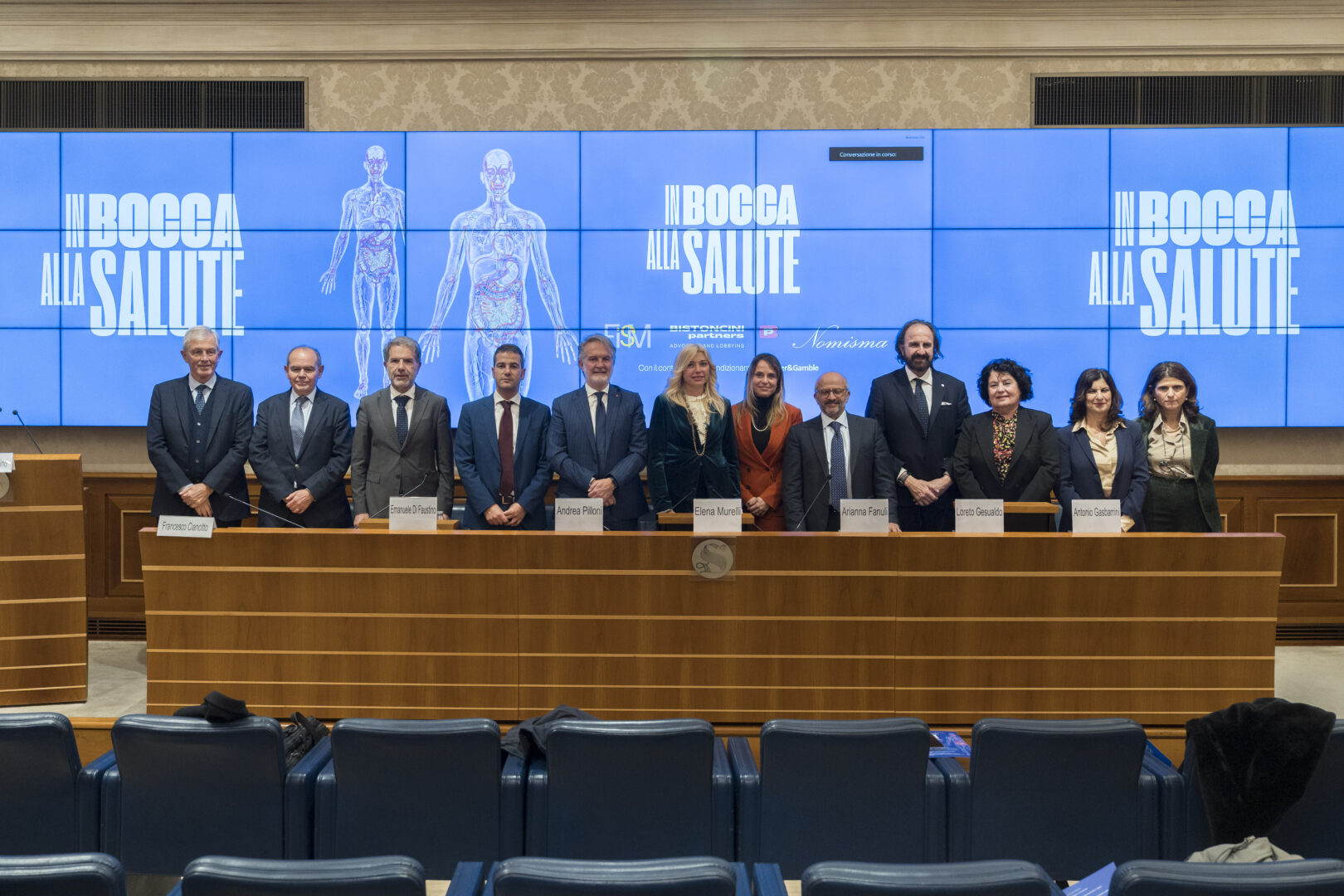
ROMA (ITALPRESS) – Today the first Multidisciplinary Scientific Committee for Oral and Systemic Health, a permanent work table that combines the Italian Federation of Medical-Scientific Societies (FISM), the main clinical-scientific experts, two prestigious universities such as Sapienza University of Rome and the Catholic University of the Sacred Heart, numerous key opinion leaders and, as major adhervisor, Professor Enrico Gnto For the first time in Italy a large multidisciplinary working group brings together institutions, universities and medical-scientific societies with a common goal: make the prevention of oral cavity diseases a national public health priority and increase awareness on the close connection between oral hygiene and general health. The project In Bocca alla Salute, realized with the non-conditional contribution of Procter&Gamble, intends to emphasize how hygiene and, more generally, oral health represent today one of the most underrated, but more strategic challenges for public health and the sustainability of the National Health System. The mouth is the entrance door to the rest of the body and gum problems can increase the risk of serious problems for general health: plaque accumulation around the gum or between the teeth allows, in fact, the proliferation of oral bacteria, including the P. Gingivalis, which release toxins that can cause inflammation and spread throughout the body. Scientific literature shows that people suffering from gum disease are more likely to develop diabetes, suffer from serious cardiovascular events such as heart attack or stroke, develop cognitive diseases such as Alzheimer’s disease, rheumatoid arthritis and develop adverse outcomes in pregnancy. These connections are then influenced by lifestyles and different factors, including hereditary predisposition, stress, smoking, a unbalanced diet, systemic diseases and good oral hygiene. In the coming years the Italian health system and associated expenditure will undergo strong pressures related to the progressive aging of the population, the increasing longevity and the increasing costs associated with the management of chronic and systemic diseases. It becomes, therefore, even more important to invest in the prevention of oral cavity diseases, especially considering the insufficient resources destined for prevention although the demographic trend of Italy anticipates the progressive aging of the population. From the investigation of the Oral Hygiene Observatory of Nomisma and the ReS Foundation (Research and Health) conducted in March 2025 on a sample of 1,400 consumers, it emerges as the oral health of Italians present significant challenges: 85% of the Italians have genuine or dental problems, ignoring the close link between oral hygiene and main systemic pathologies. In this case: 88% ignores the correlation between oral hygiene and cognitive diseases, 74% between oral hygiene and diabetes, 58% with respiratory diseases and 49% with cardiovascular diseases. It is therefore necessary to change mentality that leads oral hygiene to overcome the mere aesthetic question, reaching a broader and more complex concept of preventive paradigm at the center of the habits of the Italian population. Actually, it’s not just an Italian problem: on the occasion of the United Nations Assembly of 25 September 2025, in fact, it was evidenced that the diseases of the mouth represent a significant health and economic problem, with serious and long-term impacts on the lives of people, underlining the need for a global commitment to reduce the excessive rate of oral diseases (they suffer about 3.5 billion people worldwide) through the promotion of health, prevention, early diagnosis and treatment. The theme, as noted by Nomisma, begins with a correct information: Only 63% of those suffering from systemic diseases declare that they have received information on the possible correlation with oral health and, in most cases, this information was only conveyed by dentists and, much less frequently (25%), by the doctor or specialist. The guidelines of the Ministry of Health on proper oral hygiene exist and are clear: brush your teeth at least 3 times a day preferably with an electric toothbrush, use fluorated toothpaste and floss every day and make specialist check visits with periodicity. Yet Nomisma’s research shows a wide gap between these and the real consumer habits: Only 25% of the Italians use an electric toothbrush, only 27% of the floss and 40% of them gave up dental checks or care mainly for economic reasons. Such evidence shows a lack of awareness but, at the same time, they also offer a great opportunity: promote oral hygiene by reducing the incidence of chronic and systemic pathologies, generating direct benefits for citizens’ health and encouraging a higher sustainability of the National Health Service. According to some prudential scenarios developed by Nomisma and Fondazione ReS, in fact, it emerges that, if the incidence of chronic and systemic pathologies connected with poor oral hygiene decreased also by 1 case in 1000, significant effects would be produced not only in terms of improvement of collective health, but also of available resources: assuming a comorbility of approximately 20% among the pathologies analyzed, the annual savings for the SSN would be approximately 25.7 million euros, value equal to 25 times that allocated by the Law of Budget 2026 for the activities of awareness aimed at prevention. This is the context that has led to the creation, for the first time in Italy, of the Multidisciplinary Scientific Committee for Oral and Systemic Health, born under the aegis of FISM (Italian Federation of Medical-Scientific Societies) to carry out a collective awareness project on the importance of proper oral hygiene in order to improve the systemic health of Italians. The Scientific Committee is a concrete commitment that aims to: be a key scientific interlocutor on the need for health and economic policies dedicated to raising awareness on good oral hygiene practices daily home; actively collaborate with the Ministry of Health in order to stimulate the presence of the prevention of oral cavity pathologies within the broadest strategy on prevention and core lifestyles; stimulate and collaborate on updating and further dissemination of the National Guidelines for the promotion of oral health. The Working Group is composed, in addition to the aforementioned FISM and Professor Enrico Gherlone, Major Advisor of the project, also by 10 specialized scientific companies, 2 national universities such as the Catholic University of the Sacred Heart and the Faculty of Medicine of Sapienza University of Rome. Federazione Italiana di Società Medico-Scientifiche (FISM), Professor Loreto Gesualdo, President; Superior Council of Health, Professor Enrico Gherlone, Major Advisor; Catholic University of the Sacred Heart, Professor Antonio Gasbarrini (Gastroenterology); Sapienza University of Rome, Professor Andrea Pilloni (Parodontologia); Society of Hygiene, Preventive Medicine and Public Health (SITS), Professor Maria Teresa Montagna; Associazione Igienisti Dentali Italiani (AIDI), Professor Maria Teresa Agneta; Società Italiana di Diabetologia (SID), Professor Livio Luzi; Associazione Nazionale Medici Cardiologi Ospedalieri (ANMCO) – Professor Federico Nardi; Società Italiana di Cardiologia (SIC) – Professor Pasquale Perrone Italian Society of Endocrinology (SIE), Professor Francesco Romanelli; Società Italiana di Pediatria (SIP), Doctor Anna Maria Musolino; Sapienza University of Rome, Reumatology, Professor Fabrizio Conti; Federation Orders Italian Pharmacists, Professor Francesco Rastrelli; Professor Nicola Scichilone, AOU Policlinico “Paolo Giaccone” (Pneumologia); Professor Giuseppe Bruno, AUO Policlinico Umberto I (Neurology) “We must intercept, educate and accompany – commented Elena Murelli, group leader 10a Commission of the Senate of the Republic -. The first work table of the scientific technical committee was started, health starts from the mouth only if institutions and science walk together. It is fundamental what was emphasized during the morning, because there must be shared paths between mmg and specialists. Prevent is better than cure, all the interventions said this morning have reported this concept. All the interventions this morning, all the collaborations between all disciplines, the collaboration between the 10 disciplines of scientific societies, the two universities bring together a world that wants to collaborate together to do prevention”. For Professor Gherlone “the collaboration between science and institutions is decisive. Building a permanent and non-episodic channel between scientific communities and public decision makers would allow to anticipate emerging trends by avoiding delays in applying scientific evidence. The dentist has been perceived too long as a separate area than the National Health System, but it is a significant part of the national response to systemic diseases. Health starts from the mouth, but will come far only if science and institutions can transform scientific evidence into prevention by metabolising the concept for which prevention is a public health infrastructure. Prevention must evolve into national guidelines that are actually applied, through widespread programs on the territory and multidisciplinary paths shared in all clinical areas. When this passage of information between scientific community and public decision-maker does not happen science remains knowledge and does not become health. And this, to date, is the decisive challenge to reduce the economic and social weight of systemic diseases.”.
– photo press office Bistoncini Partners –(ITALPRESS).