
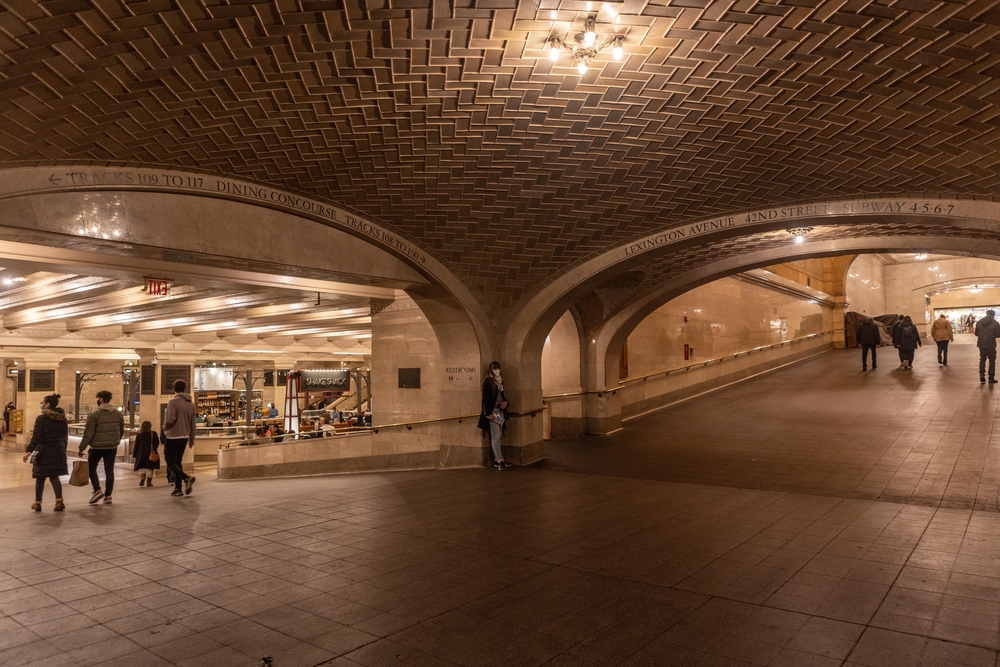
Grand Central Terminal is a huge noise generator. Under the starry ceiling of the main atrium (Main Concourse), the steps of thousands of commuters, the voices of tourists and the announcements of trains merge into a continuous roar, the soundtrack of the Manhattan frenzy. Yet, a few meters from that bubble of chaos, there is a precise point where the laws of acoustics seem to bend to a poetic design. A place where an imperceptible whisper, pronounced in fjord of lips, can travel by meters and arrive sharp to the ear of another person, overcoming the frastuono of the metropolis. It is the famous Whispering Gallery, the whisper gallery.
Finding this magical corner requires you to leave for a moment the main flow of the station. Go down the majestic side staircase of the Main Concourse and head towards the lower level (Lower Level), the historically dedicated area to refreshments.
The gallery is located right in front of the entrance of the historic Oyster Bar & Restaurant, the oldest fish restaurant in the terminal. You will find yourself in a square vestibule, surmounted by a series of four lowered arches entirely covered by the iconic beige ceramic tiles arranged with fish plug, a factory brand of early 20th century architecture.
The suggestion of the place lies in the fact that this acoustic wonder was not intentionally designed. The architects of the complex, the studio Reed & Stem together with Warren & Wetmore who opened the terminal in 1913, had no idea what they were creating in that corridor. The scientific paternity of the effect is attributed to Rafael Guastavino, a Spanish builder and architect famous for his system of brick and tiles vaults.
The discovery happened by chance in the years after the inauguration, probably thanks to the staff of the station or some traveller waiting that, by randomly leaning on the wall, he realized he could hear perfectly the speeches of those who were on the opposite side.
The scientific explanation is linked to the perfect geometry of the dome vaults of Guastavino and to the hyper-lix surface of the tiles. When a person speaks towards one of the corners, the sound waves do not disperse in the surrounding space, but remain “paste” to the smooth curvature of the ceiling, crawling along the arc until reaching the diametrally opposite corner. It is what physics defines a “acoustic phocalization”.
Today the Whispering Gallery is one of the most popular destinations for travelers looking for a New York away from the most trivial circuits. The scene that appears in front of the cronist’s eyes is to say little singular: we see couples of engaged couples, parents with children or even perfect strangers placed at the four opposite corners of the concrete square, with the face strictly facing the wall and the shoulders turned to the rest of the room.
The operation is magical in its simplicity:
Ci si posiziona in due, ciascuno in un angolo opposto della galleria, guardando fisso la colonna di mattoni, quasi in una posa di penitenza.
Si avvicina la bocca alla superficie della piastrella e si parla a voce bassissima, un sussurro appena accennato.
Dall’altra parte, a quasi quindici metri di distanza e nonostante il caos di sfondo delle persone che camminano verso l’Oyster Bar, l’altra persona sentirà la voce chiara e limpida, come se chi parla fosse lì accanto, a un millimetro dal suo orecchio.
This place has become the scene of countless secret marriage proposals and love messages whispered in Gotham cement. In a city that screams to be heard, the Rockefeller gallery teaches that sometimes, to communicate really does not need to raise the voice: just find the right corner and trust architecture.
L’articolo Grand Central gallery where silence challenges physics proviene da IlNewyorkese.