There is a moment in life, in which we understand that “go back” is not a defeat but a choice. Return to a place, in a memory, even in a person. The eight mountains tell this: the continuous movement between leaving and returning, between the momentum towards the world and the silent attraction of its roots. It is the story of a friendship born of children and remained standing despite the time, the characters, the distances and the inevitable fractures that adulthood brings with it. A bond that does not need to be perfect to be true, and that is why it remains on like certain summers of memory: ended for years, but still hot when you think about it.
In the novel by Paolo Cognetti, the heart of the story beats between two opposing and complementary poles. Peter is a city boy, raised with the idea that elsewhere there is always something more interesting; Bruno, however, is the last child left in a mountain village, one of those who seem suspended in time, where snow and fatigue are part of the character. They meet when they are young and, almost without realizing it, they become the firm point of each other. At first it seems the classic “improbable” encounter that life gives when it wants to surprise: the curious and improvised citizen in front of a world he does not know, and the slave mountain that measures people with the same precision with which the time of the hay is measured. Yet, just because different, they get stuck. Their friendship is made of gestures more than words, walks, shared silences, small trials passed together. It is an understanding that is born simple and then, growing, becomes complex, like all the things that really matter.
With adulthood, distances come, and not only geographical ones. Peter becomes what goes and comes, what leaves and returns without ever feeling completely “at home” anywhere, as if his nature was the restless. Bruno remains faithful to his mountains, and this fidelity is not a romantic pose, but a tough, daily choice, which pays with solitude, with compromises, with the frustration of those who feel to belong to a place that does not always return what promises. The most human paradox of their path is that both, in different ways, try to distance themselves from the path of fathers and their bulky shadow, but always end up returning to that point of origin. Not because they are prisoners of the past, but because certain questions do not stop calling you until you really listen to them.
This same emotional trajectory also crosses the film, presented in competition at the Cannes Film Festival in 2022 and rewarded with the Jury Award ex aequo: a recognition that not only celebrates the beauty of the images, but the delicacy with which history manages to talk about feelings that last, resist, crack and then, perhaps, return to look. It is not a story that “pushes” about the drama to hit, but that works by subtraction: it takes you by hand and takes you in time, as if you were told that true friendships do not live in the sentences to effect, but in the returns, absences, missed appointments and in the rare moments when two people see each other and understand, without having to explain it, that something has remained.
Behind all this is the look of Paolo Cognetti, author of the novel published by Einaudi in 2016 and became a literary case in Italy and outside, winner of the Strega Prize in 2017. Cognetti was born in Milan in 1978 and his personal journey seems already to contain, in miniature, the heart of the book: city and mountain, escape and return, need to change air and need a firm point. Before The Eight Mountains had already written stories and novels in which sensitivity to relationships and daily details was evident, but here it finds an even more full, almost definitive form. The surprising thing is that Cognetti does not describe the mountain as a “good” place by definition, or as a postcard to sell to nostalgics: the mountain in his eyes is a living presence, a force that puts you to the test and does not make you discounts. It forces you to be honest, because over there the masks last little. And that is why the title brings with it a particular symbolic echo: it recalls an image linked to an ancient vision of the world, with mountains and seas that define the horizon of existence, suggesting the idea that some travel to know everything, while others choose one mountain and explore it to the bottom. In the relationship between Peter and Bruno there is this question: is it richer who always moves or who remains and digs in the same place until he understands it?
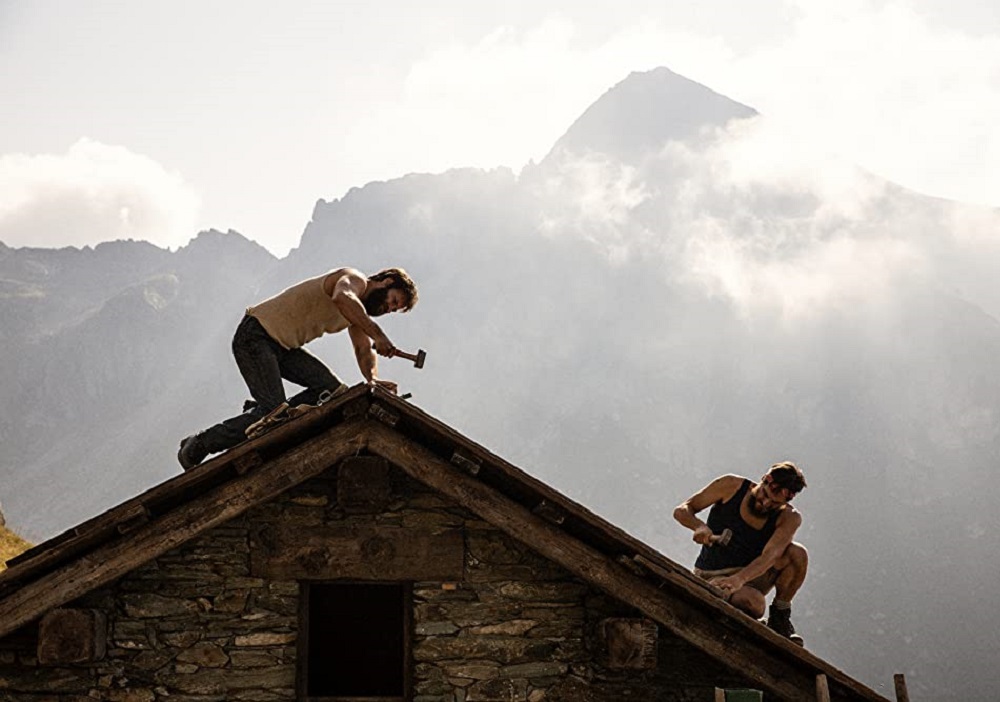
When the story arrives at the cinema, the most interesting choice is that it is not “Italian” in the television sense of the term, but crossed with a European look and respectful together. The director is by Felix van Groeningen and Charlotte Vandermeersch, Belgian authors with an intense sensitivity to human ties; van Groeningen was already internationally known for The Broken Circle Breakdown (Alabama Monroe), an Oscar candidate. In the film, the mountain is not a background: it is almost a character, and the camera takes it as such. Filming in Valle d’Aosta, between Val d’Ayas and other places that smell of wood, stone and resin, gives the images a physical realism that feels on the skin. And then, as in a broader breath, history also opens elsewhere, to Nepal, to suggest that Peter’s research is not only geographical but inner. There is even a detail from connoisseurs that makes this passage more fascinating from the page to the screen: Cognetti appears in a cameo, in a scene in Turin, as a patron in the restaurant where Pietro works. It is a discreet presence, almost an accomplice smile, as if the author said “there are, but now this story belongs also to those who look at it”.
One of the most powerful similarities between novel and film is the way they both tell time without fear of slowness. They do not look for the plot, continuous turns, easy effect. They prefer the duration, the sedimentation, the truth of things that slowly mature. It’s a setting that may seem “simple”, but it’s actually brave, because it asks the viewer and the reader to be inside the emotions, not to run away. Cinema translates this choice with long images, with landscapes that breathe, with the sound of wind and wood, with the repetition of concrete gestures: walking, building, adjusting, carrying weights, waiting. And here we see the fidelity to the spirit of the book: the mountain does not automatically cure, does not “save” as in certain consoling stories. He forces you to look in the mirror.
Even the music, used with an almost moving discretion, follows the same idea. Much of the soundtrack is entrusted to the songs of Daniel Norgren, and the choice works because it never invades the scene: it accompanies as a thought that comes when you are alone, as a voice that does not want to command you what to try, but only beside what you are already feeling.
To make everything even more vivid there are Luca Marinelli and Alessandro Borghi, protagonists who find themselves together after not being villain of Claudio Caligari, the film that had put them in the spotlight years ago and that, in a certain sense, had already shown how capable they were to work on the emotional truth. Here, however, is different: there is no burning race of a youth that is consumed, but the long duration of a bond that passes through stages, seasons, silences and returns. Marinelli, Roman class 1984, brings to Peter a magnetic fragility that belongs to him: that of those who constantly seek something and often cannot even name it. Its path is made of intense and never trivial roles, from the Volpi Cup won in Venice for Martin Eden to the most popular and surprising characters as in Him called Jeeg Robot. In Peter he manages to hold together two things that live painfully: the desire to go away and the nostalgia of what does not stop calling him.
Borghi, born in Rome in 1986, is perfect for Bruno because he can make his effort credible without turning it into rhetoric. He has a way to stand on stage that seems to be made of the same subject of his character: concrete, essential, sometimes hard, but never inhuman. The audience met him and loved him in many films and series, and his work in On my skin brought him the David of Donatello as the best protagonist actor, but here he does something thinner: makes Bruno a man full of contradictions. Not the “pure savage” to admire, not the romantic hero of the mountain, but someone who remains and pays the price of staying. And the most beautiful point is the way the two actors are together: their friendship is not explained, it is shown. He lives in the eyes, in the gestures held, in the anger that occasionally sharpens and then retreats as a cloud that covers the sun.
And this is where the novel and films touch themselves with the same intensity: they both understand that, especially among men, friendship often speaks through what is not said. The important phrases arrive late, sometimes they come badly, and often do not come at all. But affection remains, even when it takes wrong paths, even when it hides behind pride. The story of Peter and Bruno demonstrates it with a sincerity that does not console, but illuminates: being friends “forever” does not mean never to be lost, it means to be found despite everything, or at least to take oneself inside the other as an indelible trace.
In the end, what remains on it is a very Italian feeling, very ours: the certainty that there is no really new future if you first did not make peace with your idea of home. House not as a perfect place, but as an emotional knot, as a starting point and to which, sooner or later, you return to understand who you have become. Perhaps that’s why the eight mountains have had a rare destiny for an Italian title, coming to travel and being seen outside our borders: because it tells something deeply rooted in the Alps, silences and seasons, but at the same time universal, simple and ruthless as the truths that really count.
And when everything ends, when the last frame turns out or the last page closes, it remains a strange, almost sudden desire: not only to see a true mountain, but to call someone who has not felt long. As if the most powerful secret of this story was right there, without special effects: certain friendships do not end, they only make very long turns to return to the point where they were born.
L’articolo <i>The eight mountains</i>: a friendship that knows about the house, even when it seems far comes from IlNewyorkese.