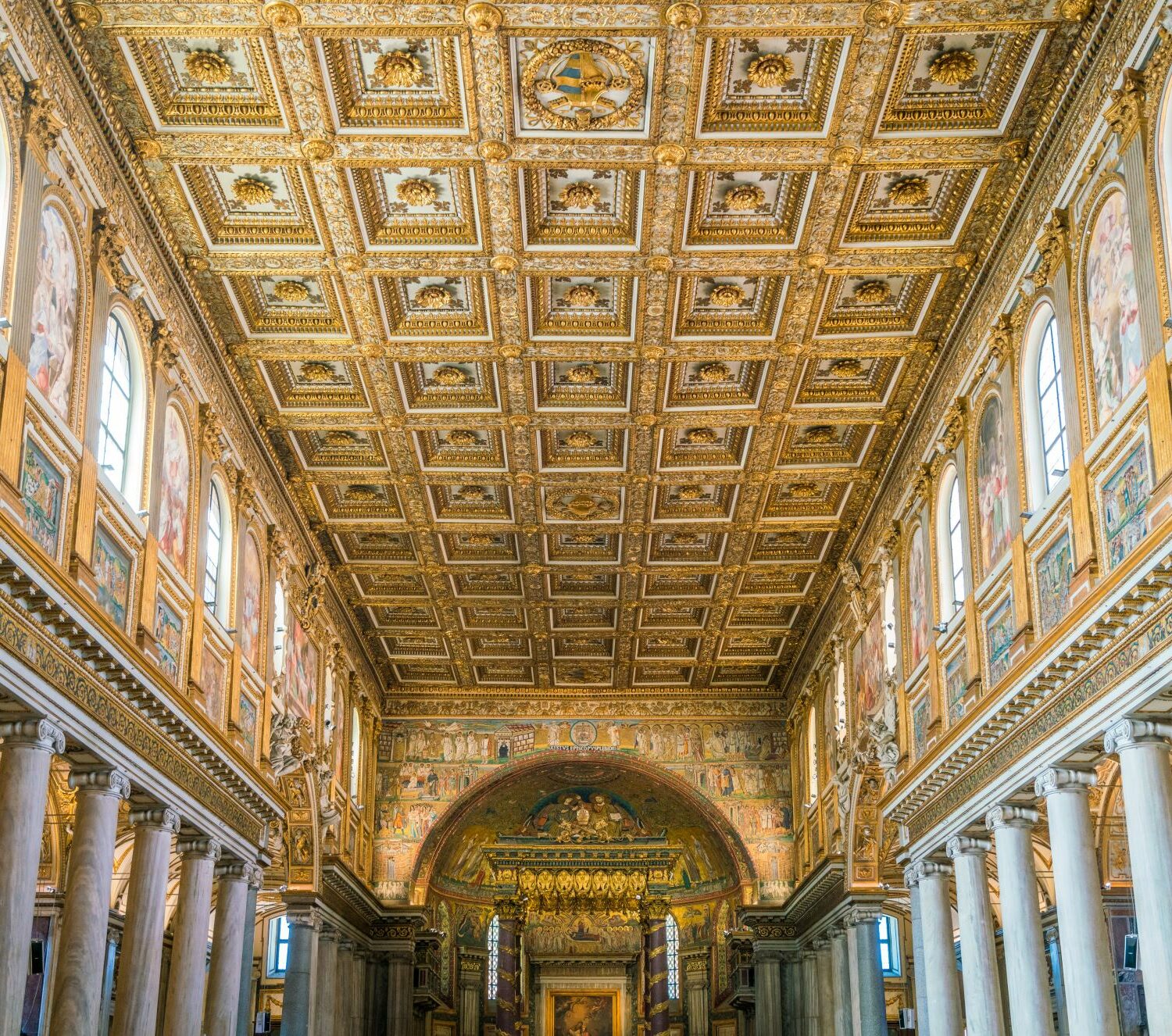
There is a piece of America in the ceiling of the Basilica of Santa Maria Maggiore in Rome, designed a thousand years after the construction of the church by architect Giuliano da Sangallo.
A coffered ceiling about 86 meters long and about thirty meters wide, which was decorated with the first gold brought by Christopher Columbus.
The Catholic kings Ferdinand and Isabella of Spain gave it to Pope Alexander VI, in the century Rodrigo Borgia, also Spanish, climbed to the pontifical throne in 1492 the year of the discovery of the new world. And still today the Spanish royals are benefactors and honorary members of the chapter of the basilica, inside which we venerate the image of Mary, Salus Roman populi, so dear to Pope Francis who wanted to be buried here.
Everything, in this basilica, brings us back to Christmas.
His story intertwines with the legend from a dream and the names he was called with.
The dream is what they did at the same time the night between 4 and 5 August of 358 two Roman patricians, John and his wife, and Pope Liberius.
For a long time the couple, who had no children, prayed to find inspiration for the use of family heritage. They dreamed of Our Lady who expressed their desire to see a basilica built there where that night of August would fall snow.
They ran away from the pope who revealed that he had the same appearance and together they went to the Esquilino hill, at the time outside the city, where in fact the extraordinary snowfall of August.
It was the pontiff to trace on the white mantle the perimeter of the church that had to be built.
When in 431 the Council of Ephesus established that Mary was not only the mother of Christ, but the mother of God. (in prayer: “…santa Maria, mother of God, prays for us sinners now and in the hour of our death.”), Pope Sixtus III, to celebrate the event, ordered to restore and decorate beautifully the basilica called Santa Maria Maggiore because it had to be the largest sanctuary dedicated to Our Lady.
Now it is not clear whether the new basilica was built on the ruins of the old and smaller church designed by Pope Liberius or not distant.
The new building was located near the place where the “matronalia” were celebrated on the ruins of the temple that the Romans had dedicated to Giunone Lucina, protector of the part-orients.
The place would have been chosen precisely to oppose the birth of the Immaculate to the myth of Lucina and to crush the pagan cult.
We are in the years following the decision of Constantine to promote Christianity to become an official religion of the empire.
The councils called then, Nicea before Ephesus, served to direct doctrinal questions and witnessed a Christian overlay on the previous pagan traditions.
In the middle of the 7th century the basilica took the name of Santa Maria del Presepio after the construction of the homonymous oratory that welcomed the relic of the Culla del Signore and the bands in which it would be wrapped.
The space had to reproduce in a reduced scale the one built by Constantine in the basilica of the Nativity of Bethlehem. In the chapel the pope celebrated Mass on Christmas night. There are three documents dating back to the time of Pope Theodore (642-649).
At that time, the relics sent by the Patriarch of Jerusalem, Sophrodius, who believed were safer in Rome than in Bethlehem recently conquered by the Arabs could be arrived from the Holy Land.
The Holy Cot consists of five small axes of wood, one of which was part of the frame of a painting of the Nativity lost as a result of the sack of Rome of 1527. The other four, probably of maple or sycomoro wood, are preserved in a crystal reliquary by Valadier.
Along with the cradle are also preserved some strips of canvas that may have been part of the bands in which the Child was wrapped. According to tradition they would have been brought by the imperators Eudossia and Pulcheria, but in the Middle Ages the traffic of relics from Jerusalem increased a great trade with a proliferation of artefacts whose authenticity there is strongly to doubt.
Until the year one thousand in the documents there is no trace of the miracle of snowfall that spread only in the tenth century. And in a bubble of Pope Nicholas IV of 1288 the church is called Santa Maria della neve.
The film of the legend is illustrated in the beautiful mosaics of the facade of Filippo Rusuti between the end of the two hundred and the beginning of 1300. Mosaics signed by the author who portrayed himself while holding for the bridles a horse, root of his name Philip, from the Greek philos or hippos, friend of the horses.
It was always Niccolò IV, the first Franciscan to become pope and buried in Santa Maria Maggiore, to commission to the sculptor Arnolfo of Cambio a crib of marble, the oldest sculptural nativity in the world, who had to evoke what Francis had done in Greccio in 1223, the first reconstruction with people and animals of the scene of the birth of Jesus.
And still Christmas in the project of Sisto V which in 1527 chose Santa Maria Maggiore as one of the fundamental points of his project of reorganization of Rome.
To symbolize the centrality and brightness of the basilica in the new urban plan, Sisto V used the metaphor of the comet, which with its tail extended in different directions. The basilica was seen as the center from which the new roads branched out.
This vision was realized by the construction of arteries such as Via Sistina or Via delle Quattro Fontane, which connected the basilica with other important places in the city, such as the Basilica of Santa Croce in Jerusalem and the Basilica of San Giovanni in Laterano.
Article The discovery of America and Santa Maria Maggiore comes from IlNewyorkese.