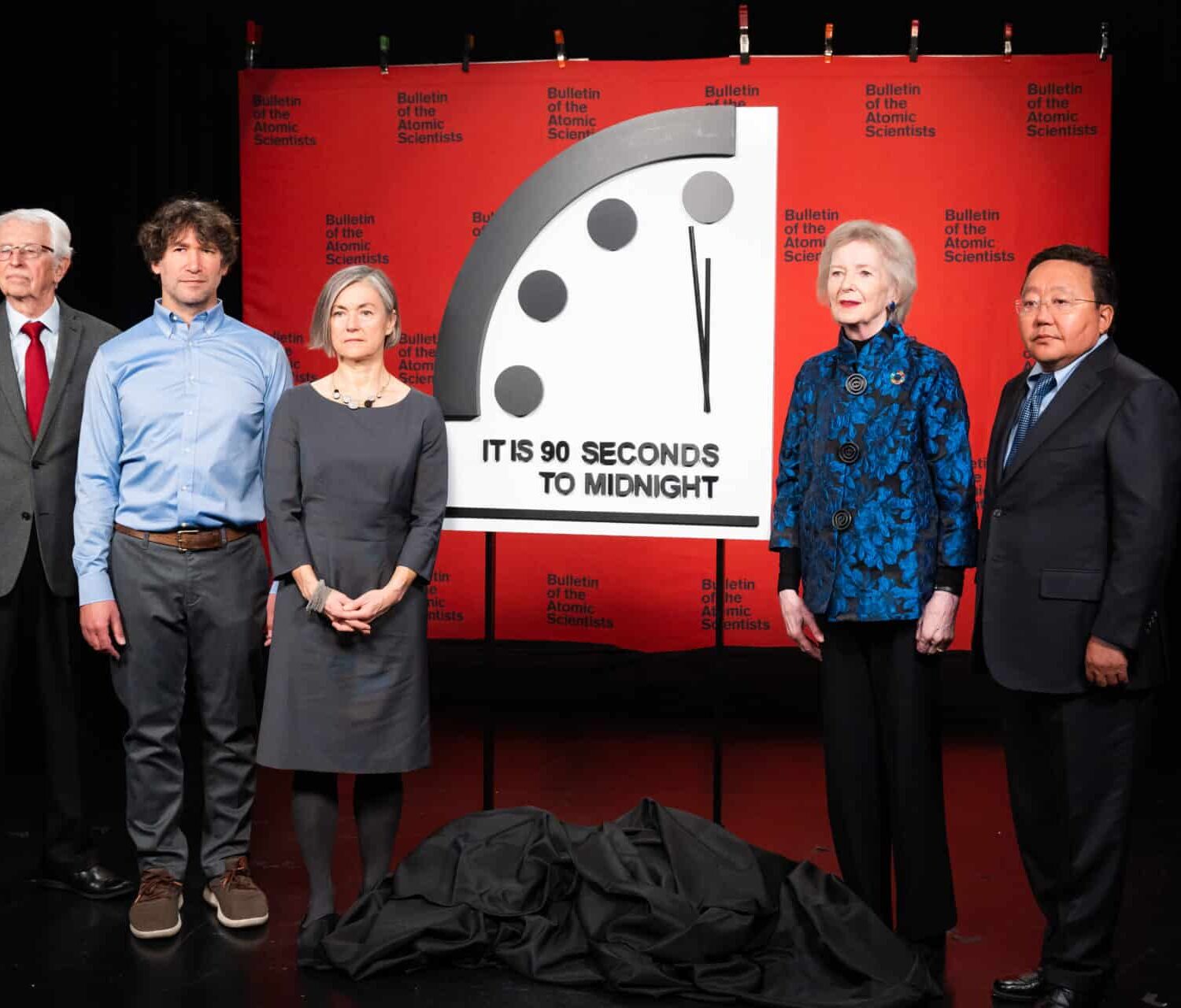
The Apocalypse Clock has been moved forward again and now marks 85 seconds at midnight, the symbolic point that represents a global catastrophe. The announcement was published by the Bulletin of the Atomic Scientists, which periodically updates the indicator to reflect the existential risk level for humanity. The new value further reduces the distance from midnight compared to the previous year, when the hands were firm at 89 seconds: it is the highest alert level ever recorded.
The Apocalypse Clock is not a scientific tool in the strict sense, but more a metaphor developed to communicate in a understandable way the gravity of global threats. It was introduced in 1947 by a group of scientists involved in the Manhattan Project, gathered around the Bulletin, a magazine founded in 1945 also with the contribution of Albert Einstein. Originally, attention was almost exclusively directed at nuclear risk; over time, however, the analysis perimeter has expanded by including factors such as climate change, pandemics, biotechnology and, more recently, the development and use of artificial intelligence.
The decision to bring the watch to 85 seconds from midnight was motivated by a total deterioration of geopolitical context and international cooperation. According to the Bulletin, the main world powers – including Russia, China and the United States – have accentuated conflict and nationalist attitudes in recent years, reducing the space for multilateral agreements on disarmament, climate and global security. This scenario, experts explain, increases the likelihood of military escalation and makes it more difficult to deal with issues requiring coordinated answers, such as global warming or regulation of emerging technologies.
In the statement that accompanies the update, the Science and Security Board of the Bulletin explicitly speaks of a “global leadership failure” and points out that many governments have ignored previous warnings. According to the group of experts, delaying necessary interventions does not reduce the risks but amplifies them, especially while nuclear proliferation remains a threat, extreme weather events become more frequent and misuse of advanced technological tools can have difficult to control consequences.
The Clock of the Apocalypse, however, specify its promoters, does not want to be just an alarm signal. It is also thought of as an instrument of pressure on public opinion and political decision-makers, to remember that the margins of intervention still exist. In the course of its history the hands were also moved backwards, as occurred in the nineties after the end of the Cold War.
The 2026 update was streamed by a commission of seven members, including Filipino journalist Maria Ressa, Nobel Peace Prize in 2021, and Alexandra Bell, president and editor of the Bulletin of the Atomic Scientists. During the presentation it was reiterated that the clock does not provide forecasts, but summarizes the collective judgment of scientists and experts on the direction undertaken by the world and the urgency to reverse the course.
L’articolo The Clock of Revelation never so close to midnight proviene da IlNewyorkese.