Recently I was asked to question the role of yogic practice in the lives of women who have gone through experiences of physical or psychological violence, people in which inevitably a fracture has been created where the most dangerous doubt arises: to deserve, in some way, all that evil, not worth enough to be entitled only to love and respect. Identifying this fracture is often the most complex part of the healing process.
This has given me a way to make some reflections that have to do with trauma, small or large, a trauma is a trauma and each individual faces it in his own way trying to “survive”. But I am convinced that yoga can provide an exceptionally valid tool for healing and change and can teach you to take care of yourself in the most overall sense.
I realized first of all about my body: when I started practicing yoga I couldn’t even touch my feet; today my flexibility is something I never imagined possible, especially considering that I had surgery on the spine 8 years ago. But the most significant transformation was not physical. Without me imposing it, effortlessly or rational decisions, my body began to spontaneously head towards healthier choices: I stopped smoking, I stopped eating meat and fish. I just couldn’t feel the need.
It was then that I realized that yoga not only acts on the body, but on something much deeper.
In the incessant chaos of cities like New York, where the daily rhythm often overwhelms that of the beat of our heart, the body learns to resist more than to listen.
Yoga then becomes a true salvation, because it brings back those who practice a deep connection with themselves. It brings out critical points, doubts, sufferings. It is not a painless way, and it is important to say it clearly. But finding the fracture generated by trauma is the first step towards salvation: if I can see something, I can fight it; if I don’t see it, no. From there you can start the construction of care and love for yourself, a path that with practice happens naturally and absolutely moving.
Those who have suffered violence or control often lose confidence in their bodies and perceptions. With yoga trust becomes a concrete practice: without self-confidence many asanas can absolutely not be taken. But work does not stop on the physical plane. Working with the body, changes extend elsewhere. That’s why we don’t talk about sports, but discipline and that’s why we need to talk about chakras.
Chakras are points of convergence of energy that create a deep connection between mind and body. If properly stimulated, they activate or, in some cases, reactivate. In women who have suffered violence, the chakra that suffers most of trauma is often the second, Svadhisthana, the sacred chakra, linked to guilt, physical pleasure and relationship with their own body. It is an energy center closely connected to the opening of the hips, an area where the body tends to accumulate deep tensions, often unaware. Working on this area allows you to melt blocks that are not only muscle, but emotional and identity.
It is not less important to work on the fourth chakra which is compromised in these cases. Anahata is the heart chakra, connected to the openings of the chest, and is closely connected with the ability to love and love. After violence, the chest tends to close in a protective way, as if the body tries to defend a vulnerable area and as if the weight of what happened serious on our shoulders. Bringing openness into this area means slowly rebuilding the possibility of trust, letting oneself go through love, recognizing one’s own affective value and opening oneself to the universe.
They are concepts that in words may seem abstract, but which, once experimented on their skin, leave speechless.
Yoga is often thought to be self-centered. In a way it is true, and it is a positive thing. How can you be well in the world if you are not well with yourself? This applies to all, the change starts from here: from me, from my balance, from trust in my abilities and in my value. I am the center of my world. This is yoga: a long, perhaps infinite journey, which provides tools to deal with everything that in life can hinder our path, with only one certainty — can only go better.
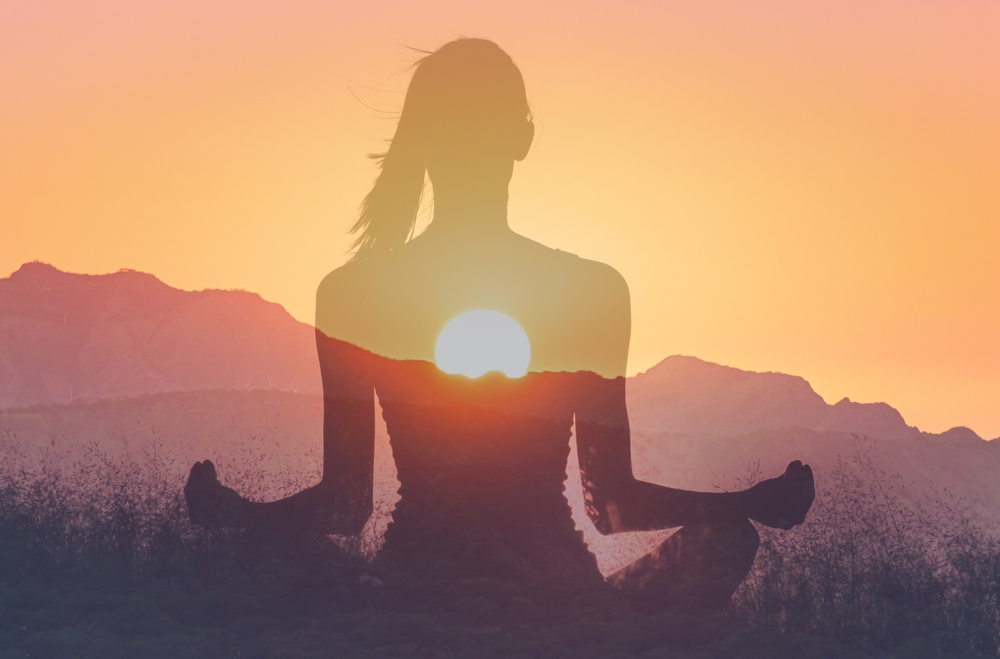
As an additional element of yogic practice, there is no mention of meditation. In the final relaxation part I think it is of fundamental importance, because that is where the fruits sown during physical practice are collected. It is a space of sedimentation, in which what has been moved from the body can find a form, a sense, a direction, can take root.
Meditation can scare because in silence you lose control over the path of the mind, which we often try to direct to known territories and which we believe safe. This is a form of denial. To pretend that everything goes well, ignoring what would be dealt with instead, does not put safe from anything.
It’s like being convinced that behind a closed door there’s nothing that can hurt. Keeping it closed doesn’t mean being protected. If behind that door there is something that can hurt, it will anyway, perhaps at the least predictable moment. During meditation it is not possible to know what will emerge. Even in guided meditations, the mind can surprise us and take us to delicate territories, until we find ourselves in tears. It’s not necessarily bad. Sorrows should not be ignored: they must re-emerge in order to be faced with courage, in a protected environment, knowing that the path can be difficult and not painless.
Before complex practices, however, there is something fundamental: learning how to breathe.
This applies to all students, indistinctly. Breathing must be the first great goal of a yogi, because it is the breath to dictate the rhythm of every practice. Only by really understanding its importance you can get from yoga the completeness you can offer. It is no coincidence that in each asana one enters inhaling or exhaling, if each movement is linked to a precise phase of the breath. And there is a reason if it is essential to learn how to fill all the lungs and not only a small part.
At birth the breath is spontaneously diaphragm; growing it we lose and, more stressed, the higher and superficial, involving only the upper part of the lungs. It is easy to notice: the shoulders rise to every inspire.
Reconnecting with yourself means starting from here. A slow and deep breath that first involves the lower part of the lungs, inflating the abdomen, then the chest and only eventually the upper part. This is the complete yogic breathing, Purna Pranayama. Before greetings to the sun and positions to head down, we breathe.
Building a safe interior space is fundamental everywhere, living in Times Square or in a small country. Yoga can be taught, but at some point it becomes an autonomous teacher. There is no need for explanation: many things are understood by themselves. It’s no coincidence if anyone starts practicing, as soon as they can, unroll the mat at home.
Words are cheap. The body knows. He just forgot. Slowly remembers, slowly purifies, slowly heals and returns to perfection that it was. Maybe not in this existence, but sooner or later you get there.
L’articolo Starting from breath proviene da IlNewyorkese.