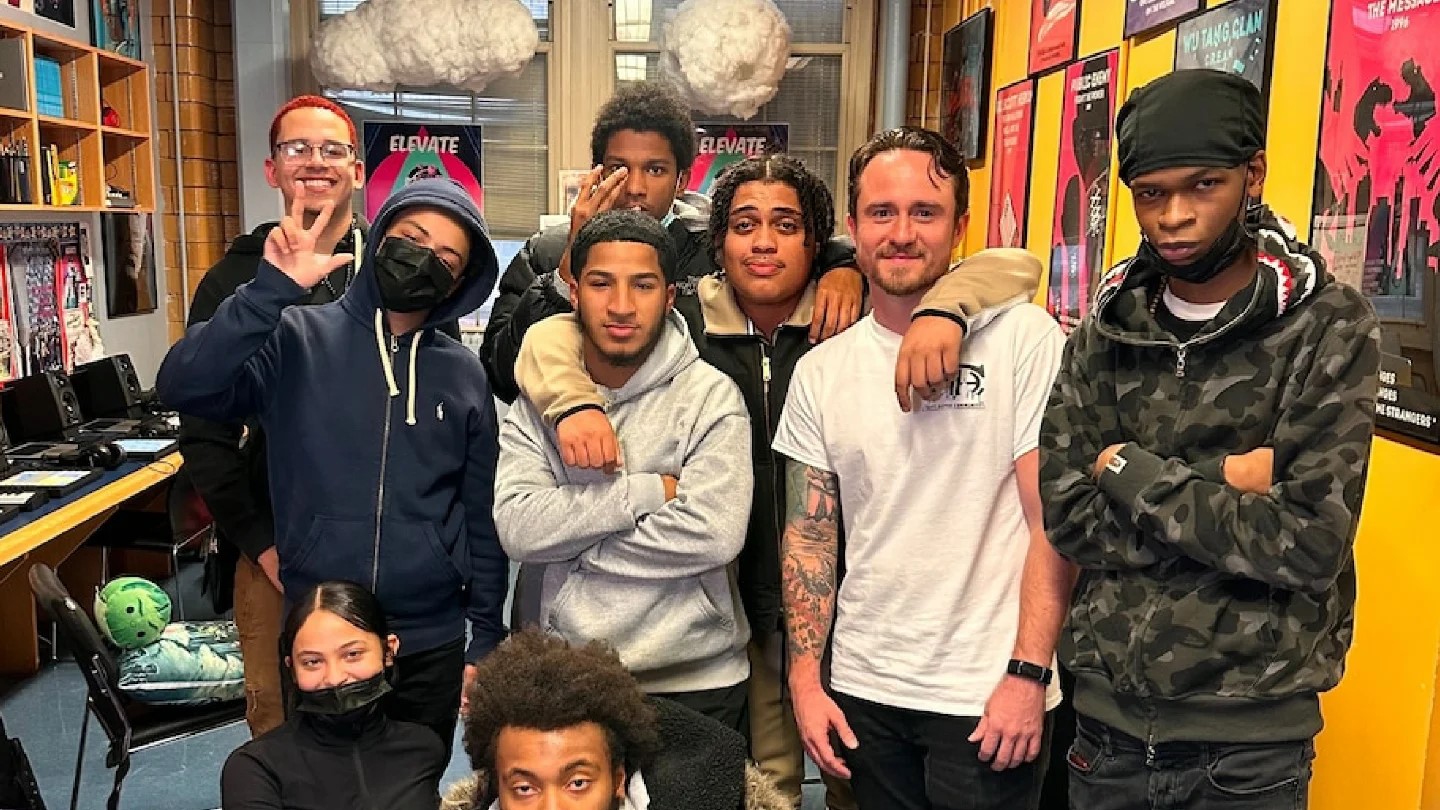
During a geometry lesson at the Bronx School of Hip Hop, the teacher Yasmin Silvera showed students a video of Johnny Dang, the Vietnamese-American jeweler who became famous for crickets, teeth decorations covered with diamonds worn by many rappers. Then he distributed lines and compasses, asking the class to reproduce some of the geometric shapes used in Dang jewelry. The exercise concerned the construction of a square, one of the topics foreseen by the school program, but presented through an object that students already knew.
It is one of the ways the Bronx School of Hip Hop, the New York Public High School that opened in September in the neighborhood of Claremont, in the Bronx. New York had told the project in May, when the city’s education department announced plans to build an entire school program around hip hop culture. Now that the lessons are beginning, you can better understand how this method is applied and what the students think about it.
The subjects are basically the same as other American high schools: mathematics, English, science, history and physical education. Changes the way they are faced. Geometric courses are associated with DJing, while English courses at emceeing, writing and interpreting rap texts. Teachers use these references to explain concepts that are still part of the ordinary program, with verifications and learning objectives similar to those of other public schools.
In English lessons, for example, teacher Michael Alba Lamb decided to address the history of the Bronx through two rather challenging books: The Power Broker, the biography of the controversial urbanist Robert Moses written by Robert Caro and who earned him the Pulitzer, and Can’t Stop Won’t Stop, Jeff Chang’s essay on the birth and spread of hip hop. In the classroom, students read some passages dedicated to the construction of the Cross Bronx Expressway, the highway wanted by Moses that crosses the district and that during its construction led to the demolition of numerous residential buildings and the displacement of thousands of people, marking a radical change of what was once a multicultural neighborhood with a high rate of well-being and which later became the famous Bronx all over the world. The road, moreover, passes not far from the school and many boys still live in the neighborhoods affected by the urban transformations of those years.
Lamb asked the class to write some sentences about the consequences of the construction of the highway, using the texts read to support their arguments. During the discussion different interpretations also emerged. A student linked the road to the removal of African American and Latin American communities, while a companion questioned some passages of this explanation, asking what was the relationship between the construction of the highway and the transfer of white families to the suburbs. The goal of the exercise was to learn how to formulate a thesis and support it with evidence, but the theme also allowed to face the economic and social conditions in which hip hop would begin to develop in the 1970s. For boys who grew up in the Bronx, the history of the highway is about places they attend daily.
This method comes from the work of Christopher Emdin, professor of pedagogy at Columbia University and among the promoters of the school, who for years has been studying how to use the cultural experiences of students in teaching. Emdin argues that many skills developed outside the classrooms, such as writing verses, producing music or organizing a performance, can be used to introduce more complex school topics. The Bronx school is the first attempt to apply this approach to an entire public higher education institution.
Principal Jason Reyes had already experienced something like this during his teaching career. Grown up in the Soundview neighborhood, in the Bronx, he started writing rap texts when he attended middle school. Years later, he became a professor, used the structure of the stanzas of sixteen jokes to explain the fractions, asking students to break the verses and identify the numerical relationships between the different parts. According to Reyes, this approach had helped improve participation in the lessons and results of his students.
In the new school he sought especially teachers willing to use the interests of students during daily work. The programme also includes less conventional activities. Every Friday, during the lunch break, the Freestyle Fridays are held, sessions where the boys can alternate with the microphone and improvise verses in front of the comrades. The principal occasionally participates in performances.
One of the students, Jalen White, was particularly reserved at the beginning of the year. After a few weeks he began to participate in freestyle sessions, performing in front of his companions with a text dedicated to his personal growth and the popularity he was trying to build on TikTok. The performances are welcomed by other students with encouragement and applause, even when those approaching the microphone have little experience and is not at the level of others who preceded it. In general, this is a typical feature of the so-called cypher, that is, meetings between freestyler – or breaker, for breakdance meetings – which take the typical shape of the circle.
Not all members want to work in music. Ezequiel Garces, for example, loves to DJ but would like to become firefighter. His favorite subject is biology, where he studied the functioning of the respiratory system. He told us to appreciate especially the availability of teachers to follow students individually when they encounter difficulties. Rahmell White, fifteen years old, would like to open a record label and is already thinking about making a compilation with his new companions. Before enrolling, he explained, he was not particularly excited about the school.
The involvement of children is one of the first aspects observed by teachers. Two months after the opening, the school attendance exceeded 95 percent, according to the data reported in the first weeks of activity. It is an encouraging result, especially considering that several students have arrived with difficulty in basic subjects, some follow support programs and others are still learning English.
Of course it is still early to determine whether the method also functions on the learning plan. A greater participation in the lessons can help students to follow the program, but does not guarantee an improvement of the results alone. The school will have to deal with the same criteria as other public institutions in New York, from standardized tests to the number of students who will be able to obtain the diploma.
The question is particularly important in the Bronx, where many schools have to deal with economic and social difficulties affecting school courses. The Reyes project was born from an attempt to improve the relationship of teenagers with education, especially for those who have developed a certain disinterest towards school activities.
In the following years the Bronx School of Hip Hop will also introduce technical and professional courses, with certifications in the use of programs for audio production, video editing and digital graphics. The first class, which entered in September, will be flanked by new students every year, until they complete the upper cycle.
The article But then, how does the Bronx hip hop school work? It’s from IlNewyorkese.