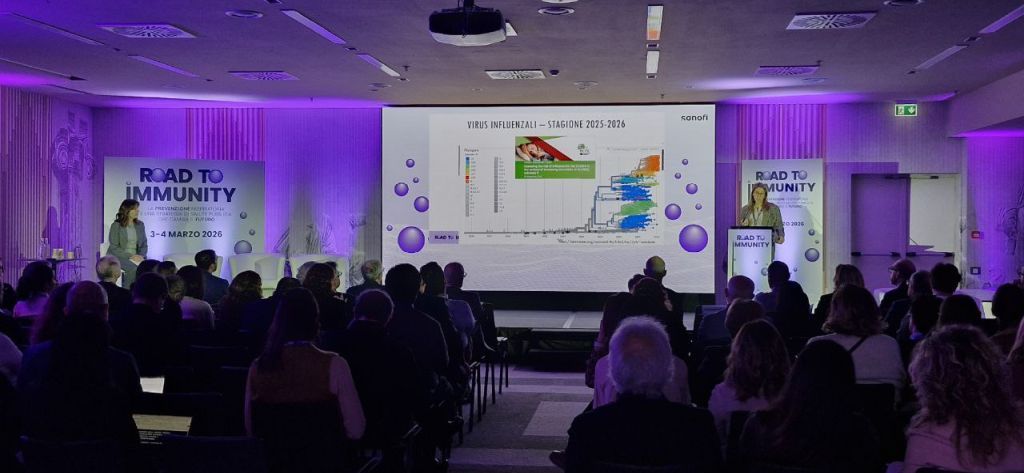
ROMA (ITALPRESS) – Prevention of respiratory diseases as an investment throughout life, from childhood to adulthood to the elderly: it is the focus of “Road to Immunity”, the event promoted by Sanofi and dedicated to the role of prevention strategies in respiratory diseases. Two days of comparison between institutions, scientific, clinical and public health experts in Rome to take stock of the evolution of the epidemiological scenario and the new solutions available, from the most innovative vaccines to the long-term monoclonal antibodies. The main focus of the event was the approach that aims to reduce the clinical burden of infections, but also to optimize resources and strengthen the sustainability of the National Health Service. The first day was dedicated to the sincitial respiratory virus (RSV), which has always been the main cause of hospitalization in children under two years. Neonathologists, pediatricians, hygienicists and healthcare economists discussed how new immunization strategies can change the natural history of the disease, reducing hospitalization and pressure on health services. The arrival of long-acting monoclonal antibodies has opened more protection in the first months of life, a particularly vulnerable phase, changing the paradigm of immunization. On the other hand, the second day expanded its gaze to adults and elderly people, focusing on influence and other respiratory viruses. The link between influence and complications, not only lungs in patients with respiratory comorbidity but also cardiovasculars was particularly at the heart of the debate, also following the presentation of the evidence of the FLUNITY-HD study. The study, published on The Lancet, has demonstrated, in particular as the high-dose flu vaccine specially developed for elderly patients is capable of superior protection than the standard over 65. “It has long been known the close relationship between influenza virus infection and cardiovascular diseases. Above all, there is a significant increase in myocardial infarction, cerebral stroke, myocarditis, but above all, hospitalizations increase by heart failure. This is a very big burden on our health system, in every season”, explained Massimo Volpe, president of the Italian Society for cardiovascular prevention. According to Volpe, cardiovascular complications related to influence “can lead to serious disability or even death” and make it necessary to strengthen preventive strategies. The vaccination recommendation in high-risk or cardiopathic subjects, underlined, “can determine an advantage in terms of prevention of influenza and cardiovascular complications, but also a reduction in the severity of the disease and hospitalizations for heart attack and heart failure.” In addition to the influence, attention was focused on RSV and metapneumovirus in adult and elder. “They are viruses known especially for pathologies in children, less in adult, but have a very important impact in people with chronic pathologies, especially respiratory and cardiovascular, and in the elderly, because age per se is a risk factor,” said Stefania Maggi of the Cnr- Institute of neuroscience in Padua. The main implication is pneumonia, with prolonged hospitalization and relapses on the functional, physical and cognitive state, as well as the exacerbation of concomitant diseases. In this context, Maggi added, the possibility of co-administration or combined vaccines “is fundamental”, even in light of still low vaccination shells. “To take advantage of a single patient encounter to protect it from multiple respiratory infections is one of the main objectives of geriatrics.” Not only influence and RSV. “We have apparently forgotten about Covid, but the Covid did not disappear,” recalled Emanuele Montomoli, professor of Hygiene and preventive medicine at the University of Siena. The Sars-CoV-2, explained, continues to circulate all year round and the impact remains significant in fragile subjects. For Montomoli, they serve “new, safer and easier products to use by doctors of general medicine”, able to increase the acceptability of vaccination. Among the most promising technologies is the recombinant Dna, already used in other vaccination areas, which allows easier management even in medical studies thanks to 4 degrees conservation. “After the Covid emergency, with which very high abductions were reached – almost 65% of the elderly – the data of the latest anti- flu vaccination campaigns from 2020 onwards show a slight decline – said Enrico Di Rosa, president of the Italian Society of Preventive Medicine and Public Health (SItI) -. Paradoxically there is an increase in the number of vaccinations in all age groups and a decrease, instead, of the older age group, that is, people who should benefit from vaccination.” The challenge of vaccinations is therefore increasingly played on two fronts, on the one hand we must strengthen communication, relaunch an institutional communication, sober, able to reassure about the safety of vaccination and on the other emphasize the advantages, especially for the elderly population and for the vulnerable people who have other diseases”, explaining that “it is an excellent protection not so much against the possibility of taking an extraordinary influence, but above all protecting themselves In a context marked by demographic and epidemiological challenges, respiratory prevention is a strategic lever for health protection at every stage of life. Reducing shelters, complications and disability means not only protecting the most fragile, but also ensuring sustainability to the healthcare system over the long term.
– photo xi2/Italpress –(ITALPRESS).