
As we know from yesterday, the constitutional confirmatory referendum of 22 and 23 March on the reform of justice has produced a rather net figure: in Italy it has won the No, with 53,23% of votes against 46,77% of Yes; considering also abroad, the total turnout has stopped at 55,70%, while remaining in the national borders has returned a great 58,93%, one of the highest data of recent years. Returning to the result, outside the borders the picture is overturned: in the Estero district the Yes prevailed with 56,34%, while the No stopped at 43,66%. It is a discard that does not change the final outcome, but confirms once again that the vote of Italians resident outside Italy tends to have a political geography other than the internal one.
In the North and Central American division, which includes the United States, Canada, Mexico and the Caribbean and Central American countries, registered voters were 481,988. The voters were 108,203, equal to 22,45%: it is a significantly lower figure than the overall national turnout, but it is part of the average foreign turnout, which varies between 23 and 31% depending on the consultations. The null cards were 8,367, the white 551, while the contests were 5.
On the basis of the result, however, the political indication is clear: even in this area prevailed the Yes, with about 60% of the consents, against 40% of the No. It is a net waste, in contrast to the Italian figure, where the reform was rejected. North America and Central America align themselves with the general trend of foreign constituency, in which the Yes exceeded 56%, while in Italy it stopped under half.
The behaviour of the electorate abroad is not uniform. If in the Americas and other extra-European divisions the Yes prevailed, in Europe won the No, partly replicating the internal orientation. This element indicates that differences are not only dependent on geographical distance, but also on the composition of Italian communities in different countries. We’ll be there soon.
To understand this difference, we must return to the introduction of the vote abroad. The current system was born under Law 459 of 2001, which established the Foreign constituency and introduced the vote by correspondence for Italians enrolled in the AIRE. The first large-scale application came with the 2006 political elections, when for the first time Italians resident outside the country elected their representatives in Parliament. On that occasion, the seats assigned abroad were decisive for the majority in the Senate, contributing to the victory of the Union led by Romano Prodi with a very reduced waste. It was the first signal of the political weight of this voter, who is often mentioned among the possible key factors to overturn the ballots.
This is mainly due to two factors: the electoral basin, which consists of almost five and a half million voters, enough to overturn any result even by calculating the average turnout, which ends up bringing to the vote anyway about one and a half million voters; and the fact that the results of the vote abroad arrive ever later, when in principle the national result seems clear: in case of little discard they are decided that they can result highly.
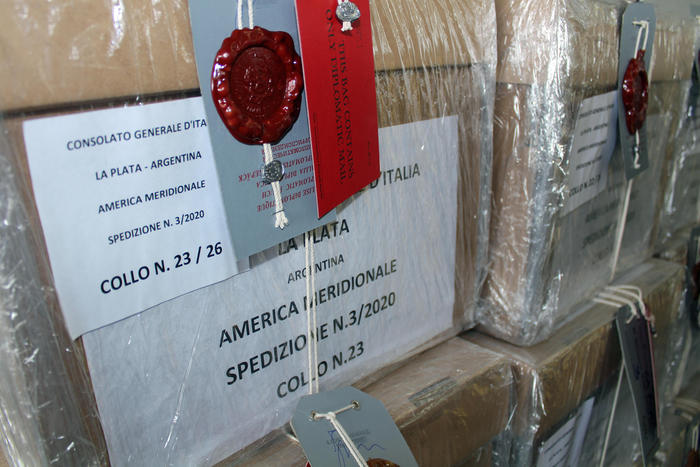
The delay of the ballot is due to a purely technical reason: the vote of foreign citizens happens by correspondence in the weeks preceding the vote and the envelopes with the votes are collected and displaced in five places for the ballot: Milan, Bologna, Florence, Rome and Naples. The vote abroad, taking place by correspondence, is a very fragile system and subject to broils, therefore a more accurate verification system is provided: a code is associated with each vote that corresponds to that of the elector. Before entering the card, the voters must ensure that the code contained in the plico actually corresponds to a single voter. The procedure is therefore very slow.
Another constant on foreign circumscriptions to understand the trends of vote is the different composition of Italian communities in the various areas of the world. In the Americas, and in particular in North America, the Italian presence is historically more stratified, with communities rooted for generations and a political participation less linked to the Italian daily debate. In Europe, however, more recent mobility prevails, made of workers and students who maintain a more direct link with national policy. This difference is often reflected in the results: the Americas tend to express positions more favorable to change, while Europe is closer to internal electoral behaviour.
However, some structural issues remain. The correspondence vote, while formally extending the audience of voters, is exposed to recurring problems as well as to the already mentioned risk of broils: postal delays, unupdated addresses, geographical dispersion and a share of null cards higher than Italy. The figure of turnout in North and Central America – just over 22% – sums up these limits well. For years there has been discussion of possible reforms of the system, including the introduction of alternative voting modes, but for now there does not seem to be an intervention on the horizon.
L’articolo Referendum, abroad the result is overturned but does not change the fate of the reform proviene da IlNewyorkese.