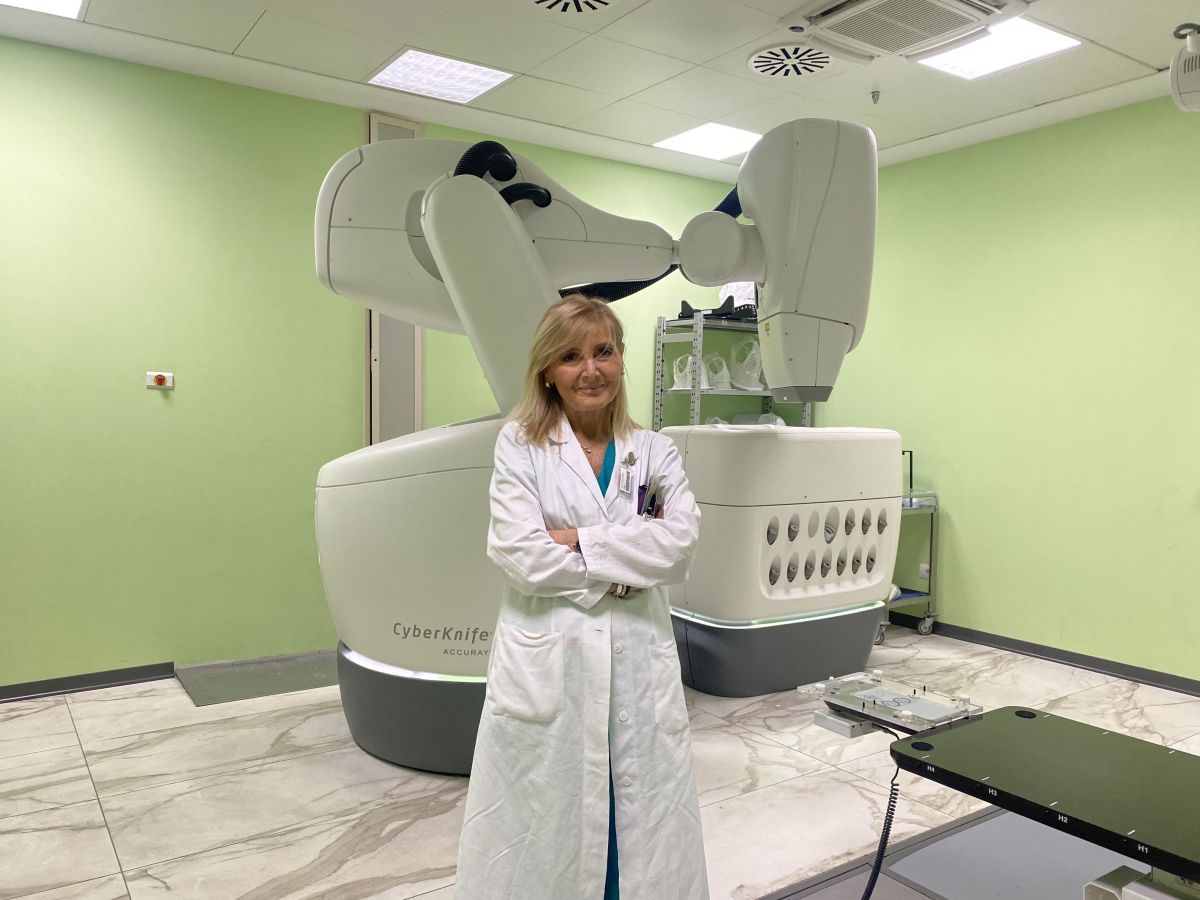
MILAN (ITALPRESS) – The Radiotherapy Unit of San Raffaele in Milan treats tumors in all body districts, including encephalus, head-neck, lung, breast, pancreas, liver, gastrointestinal apparatus, urological, gynecological and hematological apparatus. “The concept of using radiotherapy as the only treatment has evolved, especially in recent years, thanks to increasingly sophisticated and more accurate technologies that centers can use. But the most innovative aspect is the use of radiotherapy, in particular with stereotoxic mode, in replacement of surgery”, explains Professor Nadia Di Muzio, head of the Radiotherapy Unit of the IRCCCS Hospital San Raffaele in Milan and ordinary Radiotherapy at the Vita-Salute San Raffaele University. “This is already a consolidated reality for prostate cancer and is widely demonstrated in early stage lung cancers. More and more scientific evidence supports the use of this mode also for breast cancer and kidney cancer. It is possible to use radiotherapy even in some subgroups of patients with bladder cancer at an early stage, but one of the most frequent applications of stereotaxic radiotherapy concerns patients with metastases. Radiotherapy can in fact have a healing effect for lung metastases, bone, encephalics, lymph nodes, hepatics and can be used before or after chemotherapy treatments, or as an alternative to other therapeutic options depending on the pathology of origin.” San Raffaele is equipped with advanced technologies such as CyberKnife and Tomotherapy. Professor Di Muzio points out that “Tomotherapy is an innovative equipment that we had first in Europe in 2004. The innovation consists of having an integrated TAC to the treatment machine, a TAC that allows to control the positioning of the patient and its internal organs and therefore to verify that the treatment is administered with extreme precision.” In addition, “the mode of delivery of the dose of this equipment allows to radiate even very complex targets: It is possible to treat both extended volumes, such as in total body, and very limited areas, for example in prostate cancers.” While CyberKnife adds to this level of accuracy the ability to follow the lesions in motion and therefore to adapt the margins in an extremely consistent manner to their shape.” This allows “reducing treatment times and, at the same time, obtaining results in terms of healing and reducing extremely good toxicity”. “The technological level we have thanks to these equipment – continues the primary of Radiotherapy Unit – allowed us to gradually reduce the number of sessions: in some oncological situations it is possible to carry out treatment in a single session, the so-called radio surgery. This mode is already active in our institute for the radical treatment of prostate cancers and for some brain injury, and is also applied in primitive and secondary and hepatitis lung nodules. Moreover, many metastases can be treated in a single session – at the hencephalic, bone, lung, liver or lymph node level – with an obvious advantage for patients, who can go to the hospital and receive only one treatment. In addition to economic savings, these approaches provide better clinical outcomes and minimal toxicity.” Finally, the possibility of providing treatment in a single session is also exploited in the non-oncological field. “Today there are pathologies such as Parkinson, the essential tremor, the neurinomas of the acustic but also some psychiatric conditions that can be addressed with radiotherapy and also in these cases the session is single”, concludes Professor Di Muzio.-photo IRCCS Ospedale San Raffaele (ITALPRESS).