ROMA (ITALPRESS) – What are the risks of cosmetic surgery, what is the incidence and how do we prevent it? Why is there also a risk of pulmonary embolism? We asked Skerdi Faria, anestesist-reanimator, PhD in Hospitaller Infections and founder of the Albanian clinic KEIT Day Hospital.
“Lung embolism is the sudden obstruction of one or more pulmonary arteries, usually caused by a blood clot that forms in the deep venous system, more frequently in the lower limbs, and subsequently migrates towards the pulmonary circle. It is a feared complication because it can evolve quickly and unpredictable, compromising the respiratory and cardiovascular function. For this reason, in surgery we work on risk assessment protocols and prophylaxis,” says Faria.
“Esthetic surgery – he explains – remains to all effect surgery, with anesthetic, physiological and tromboembolic implications that must be carefully considered. The large international databases show that tromboembolic events are statistically rare, but not non-existent, and that the risk tends to increase in the presence of combined procedures, long-term interventions or when operating on certain bodily districts. It is precisely this awareness that imposes rigorous protocols and an accurate selection of patients.”.
But what is the overall incidence of venous thromboembolic events in aesthetic surgery? “It is around 0.09%. In combined procedures it rises to about 0.20%, while in individual procedures it drops to about 0.04% – Faria responds -. Interventions on face and breast have lower rates; on the body and in surgical combinations the risk increases slightly. They are rare events, but quite significant to require stringent protocols.” However, risk “’bassò never means ‘zerò. Without knowing the individual factors of the patient – such as BMI, smoking, hormonal therapy, family history of thrombosis, duration of intervention and mobility in the post-operative – it is not possible to draw conclusions on the individual case”.
What are the factors that most often lead to these events in the post-op? “The main risk factors include high BMI, advanced age, smoking, use of contraceptives or hormonal therapies, family history of thrombosis, duration of intervention, prolonged immobilization and combined procedures or on bodily districts at risk. The presence of one or more of these elements makes it essential to adopt stringent prevention and monitoring protocols,” says Faria.
The risk – it is good to explain – does not end when you leave the operating room… “Exact. Scientific literature and international guidelines recall that a significant share of tromboembolic events can occur even after the dismissal. For this reason, the patient’s education phase and a careful follow-up are fundamental elements to ensure post-operative safety,” the doctor points out.
An important factor in this context is prevention: “The main mechanical measures include graduated compression elastic socks and intermittent pneumatic pumps – explains Faria. They promote venous return and reduce the risk of thrombosis, especially in long procedures or in risky patients, always according to strict protocols. Pharmacologic prophylaxis is an important tool, but it must always be managed with balance, balancing the thrombotic risk with that of bleeding. International guidelines and major scientific reports emphasize the importance of a layering of personalized risk: there is no valid solution for all, and every decision must be based on a careful and individual clinical evaluation. At KEIT Day Hospital the prevention of tromboembolic events is a central element of patient safety. We adopt comprehensive and up-to-date protocols according to European standards: individual pre-operative risk assessment, systematic use of compressed socks and anti-trombotic pumps, early mobilization and, when indicated, pharmacological prophylaxis. In more than 22,000 interventions, we recorded only one suspected case, promptly identified thanks to the ecodoppler and successfully managed. This shows how structured and multidisciplinary strategy can significantly reduce complications, even in the most complex scenarios.”.
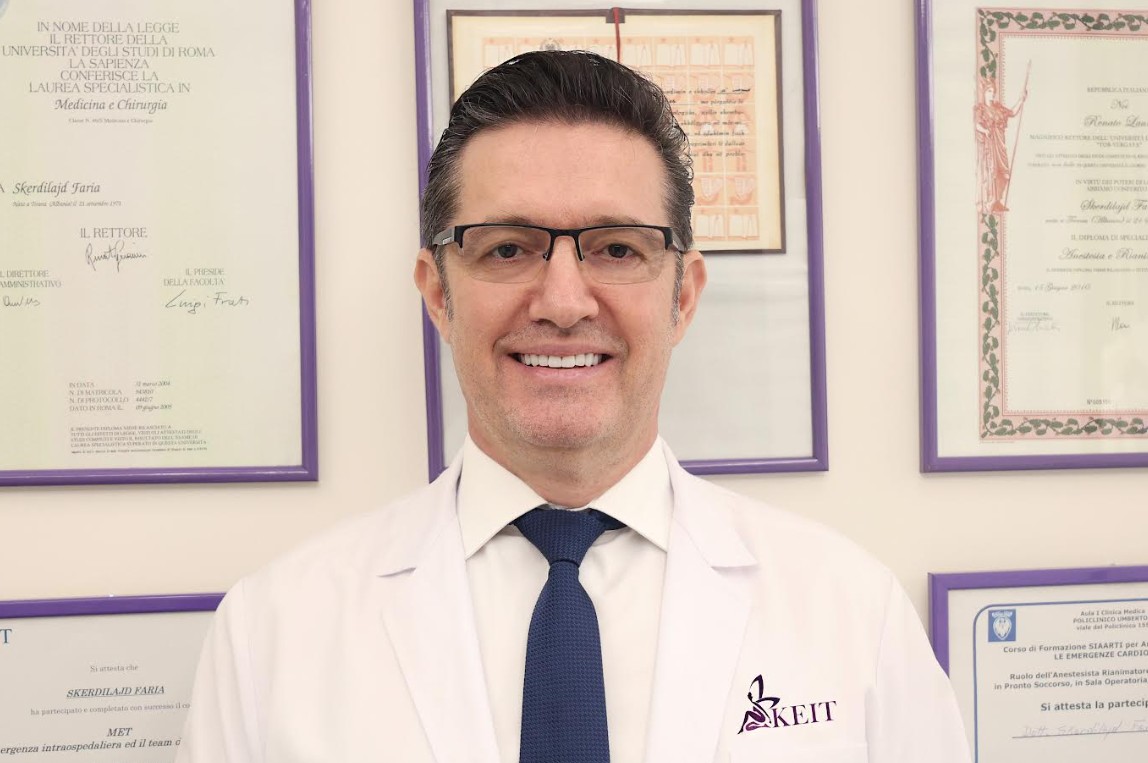
– In the photo Skerdi Faria (source KEIT) –
(ITALPRESS).