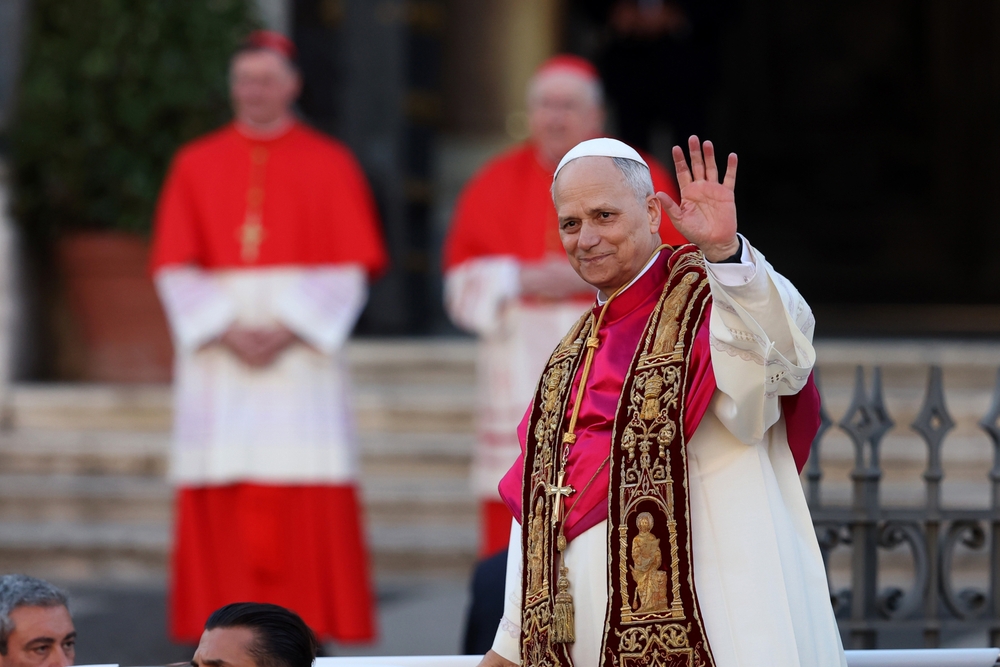
Vatican City. With an unprecedented gesture in the history of the Church, Pope Leo XIV presented this morning in the Synod Hall his first encyclical, Magnifica humanitas, dedicated to the “custody of the human person in the time of Artificial Intelligence”. A document that addresses with depth and foresight the challenges and opportunities of one of the most revolutionary technologies of our times, inviting to a symbolic and concrete disarmament of AI to guide it towards the common good. The encyclical can be considered an update of the Social Doctrine of the Church.
Like his illustrious predecessor Leo XIII, who in 1891 faced the industrial revolution with the encyclical Rerum Novarum, Pope Leo XIV addresses the “civilization of love” and invites the Church and humanity to reflect on the “new things” that shape our present and future. If it was to respond to the poverty and injustices generated by the industrial revolution, today the challenge is represented by Artificial Intelligence, whose potential for transformation extends in many areas of everyday life, from health to safety, from war to communication.
L’astronauta statunitense Eugene Cernan a bordo del rover che guidò sulla Luna nel 1972 | via NASA
In his speech in the Synod Hall, the Pope firmly stressed that Artificial Intelligence requires “disarmed”. “I know, the word is strong”, he admitted, “but it was deliberately chosen because this moment needs words capable of attracting attention, awakening consciences and indicating ways to follow for humanity.” The encyclical highlights how AI, if used without scruples, can become an instrument of domination, exclusion or even death, threatening the respect of human dignity and peace.
Pope Leo XIV recalls the Church’s experience in promoting nuclear disarmament, stressing that technology, like atomic energy, must be at the service of all humanity and the common good. “The decisions on technology must never be separated from consciousness and responsibility,” the Pontiff said, inviting a shared and conscious ethical approach.
The Pope invites not to stop at disarmament, but to move to the phase of construction. Recalling his experiences in Peru, where in 2017 he witnessed the devastating floods of El Niño, he pointed out that “reconstructing not only means repairing what was destroyed, but restoring ties, strengthening trust and awakening hope.” “No one can reconstruct alone,” he said, underlining the importance of collective, inclusive and solidarity.
Only through an integral and shared vision, he concluded, Artificial Intelligence can be oriented towards the good of all humanity, avoiding that it becomes an instrument of exclusion and power for few privileged.
The encyclical is part of a long tradition of Church commitment to peace and social justice. Pope Leo XIV recalled that the Church, while not possessing specific technical answers, can offer “a wisdom on the human” that helps to discern the path to follow. Each person, he said, is unique, irreplaceable and aware, capable of seeking God and taking care of our common home.
The Pontiff also opened the dialogue with hi-tech experts, including Christopher Olah, co-founder of Anthropic, thanking them for accepting the invitation to walk together. “In the name of the Church – he said – I also accept your invitation to find a new path for humanity.”.
La vista dei propulsori dello Space Shuttle Discovery all’interno dell’hangar spaziale James S. McDonnel al Steven F. Udvar-Hazy Center, National Air and Space Museum, in Virginia | via Shutterstock
With this encyclical, Pope Leo XIV launches a universal appeal so that all, institutions, scientists, citizens and religious, are committed to “to listen to each other” and “to build a construction site of our time” based on hope, responsibility and solidarity. The “civilization of love” proclaimed by St. Paul VI and St. John Paul II is configured as the compass to guide the development of Artificial Intelligence ethically and humanly. The message of Magnifica humanitas is an invitation not to lose sight of the highest goal: to use technologies, even the most innovative, to build a more just, more fraternal and more respectful world of the dignity of each person. Only in this way, the Pope concludes, can we really achieve that “major humanity” of which we are all called to be custodians.
L’articolo Pope Leo XIV presents the encyclical Magnifica humanitas: using AI to build a more just world comes from IlNewyorkese.
Artemis nasce anche dal tentativo di correggere alcuni di questi problemi. L’intenzione rispetto ad Apollo, però, è di costruire una presenza umana stabile intorno e poi sulla Luna, con l’obiettivo successivo di preparare missioni verso Marte. Il programma coinvolge l’Agenzia Spaziale Europea e altri partner internazionali, e si avvale anche dell’aiuto di Blue Origin e SpaceX, rispettivamente le due agenzie spaziali private di Jeff Bezos, il proprietario di Amazon, ed Elon Musk, il proprietario – tra le altre cose – di Tesla. Artemis III, la missione in cui volerà Parmitano, serve proprio a provare questa nuova architettura: la capsula Orion della NASA dovrà agganciarsi in orbita con sistemi sviluppati da aziende diverse, prima che lo stesso schema venga usato più lontano dalla Terra.
Anche se la volontà politica sembra più decisa, non significa che tornare sulla Luna sia diventato semplice. Artemis resta un programma costoso, dipendente dai bilanci pubblici, dalle scelte politiche americane e dai ritardi dei partner privati. La differenza rispetto agli anni Sessanta è che oggi non si tratta solo di arrivare prima di qualcun altro. Si tratta di decidere che cosa fare della Luna una volta tornati: se usarla come laboratorio scientifico, come base per missioni più lontane o come nuovo territorio in cui estendere interessi economici e politici. Per oggi, comunque, possiamo concentrarci sul festeggiare la selezione di Parmitano.
L’articolo Perché stiamo tornando sulla Luna adesso, dopo 50 anni proviene da IlNewyorkese.