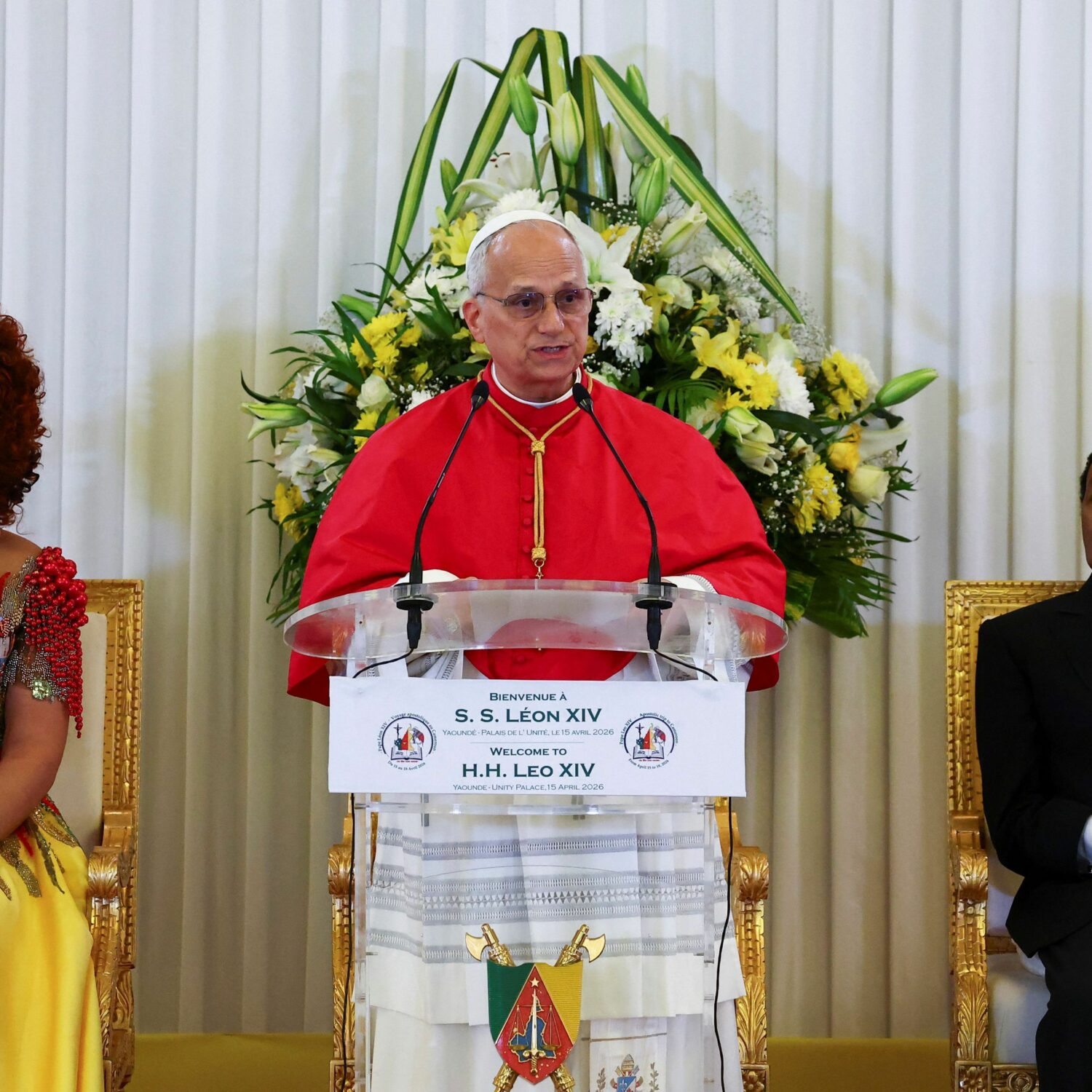
In recent days, Pope Leo XIV was in Cameroon, one of the main stages of his apostolic journey to Africa, which also brought him to Algeria, Angola and Guinea. A moment of great importance, during which the Pontiff addressed a clear and incisive message to the local population, recovering and relaunching a fundamental principle of the social doctrine of the Church: the right not to emigrate and the responsibility to serve his country.
At the Catholic University of Yaoundé, Pope Leo XIV strongly pointed out that, in the face of the growing migration trend, it is important to rediscover the value of investing in its own territory and in its future, instead of considering the “otherve” as the only way of salvation and personal realization. “In the face of the understandable migration trend, which can lead to believe that elsewhere you can easily find a better future, I invite you first to respond with a burning desire to serve your country and to turn to the benefit of your fellow citizens the knowledge you are acquiring here,” said the Pope, inviting young people and African communities to devote themselves consciously to the good of their land.
The Pope then pointed out that “serving one’s country means devoting oneself with a lucid mind and conscience to the common good of the whole people: of the majority, of minorities and of their mutual harmony”. A call that brings back to the centre of ecclesial discourse a principle that has deep roots in the social doctrine of the Church: the value of contributing to the development and prosperity of its nation, avoiding seeing migration as the only solution to socio-economic difficulties.
Leo XIV’s intervention fits into a line of thought already supported by his predecessors. Pope John Paul II had repeatedly stressed that “the primary right of man is to live in his own homeland”, while Pope Benedict XVI had reiterated that “before the right to emigrate, the right not to emigrate must be reaffirmed, that is to be in condition to remain in his own land”. Both Popes emphasised the responsibility of creating conditions of dignity and development in countries of origin, so that forced or economic migration could be reduced to a minimum, thus preserving local communities and cultures.
However, this balanced vision differs clearly from some recent trends, such as those expressed by Pope Francis. The Argentine Pope has often focused on the unconditional welcome and on the importance of a positive narrative of migration as an inevitable and beneficial phenomenon, although accompanied by criticism of the restrictive policies of Western countries. His attention focused on mercy and integration, sometimes at the expense of a more realistic and rooted message in the responsibility of peoples to build their own future.
The call of Leo XIV thus represents a return to a more conservative and traditional vision, which sees in service to its own land a moral duty and an indispensable element for the stability and development of African countries. His proposal invites us to consider charity not only as assistance to migrants, but also as a commitment to improving internal conditions, making it more desirable and feasible to stay at home.
The Pope’s message in Cameroon marks an important turning point in the speech on migration, proposing a balance between compassion and realism, between acceptance and responsibility. A message that could represent a return to the roots of the Church’s social doctrine, offering a more sustainable and shared perspective to address the challenges of migration in the African continent and beyond.
The article Pope Leo XIV in Cameroon: “To serve your own land” reaffirms the right not to emigrate comes from IlNewyorkese.