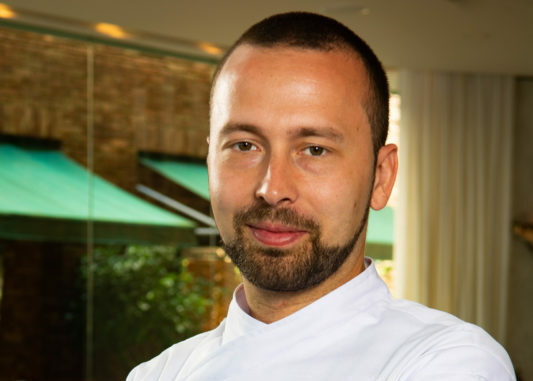
Born in Empoli and raised between Gambassi Terme and Val d’Elsa, Nicola Fedeli entered the kitchen at fifteen years, forming in the Tuscan brigades and then in star restaurants such as Il Vicario in Certaldo Alto, Restaurant La Torre del Castello del Nero and Belmond Castello di Casole. After experiences between Italy, North Europe and Brazil, in July 2021 he was chosen as Executive Chef of the Fasano restaurant in New York, where today he leads one of the most refined Italian cuisines in the United States, with a philosophy based on discipline, elegance and deep respect for the raw material. We interviewed him for IlNewyorkese.
We start from the beginning: What was the path that led you to become a chef? And what were the training experiences that really marked you?
I come from a family of farmers, a world where cooking was not a job but a daily necessity. My grandmother cooked for all the farm workers: wood oven, homemade bread, huge roasts, the whole family gathered on Sunday. It is there that everything was born: in the earth, in the flavors that were not recipes, but life. When I had to choose the school path, the decision was natural: Hotel school. I studied at the Bernardo Buontalenti in Florence, and already at fifteen years I worked in summer. The first real impact was those that mark you: enter a starry restaurant, the Vicar’s Osteria in Certaldo Alto. There I realized this would not be an easy job, but a total job. The two key figures of my formation were Michele Targi and Daniele Sera. From Michele I learned the basics, the solid ones, without shortcuts: technical, cleaning, discipline. Daniele Sera, with whom I opened the Belmond Castello di Casole, instead gave me refinement, modernity, administrative management. It is from them that my kitchen is born: classical, Italian, but elegant, without excess of modernity. There have been many stages, but the call that changed my life came from chef Luca Gozzani of the Fasano group. From there began one of the greatest adventures: Rio de Janeiro.
Your career has touched very different realities: Tuscany, North Italy, Brazil, now New York. Rio de Janeiro seems to have played a fundamental role—why? And what did it mean to you to live there?
Rio was everything: difficulty, growth, clash with a different culture and, at the same time, a great lesson in life. I left from scratch: I quit everything and made weapons and luggage to move to Brazil. And there I discovered a complicated reality. The staff is difficult to find and catering is a daily challenge but it is a wonderful geographic and human city. The sea, the climate, the philosophy of life: “no fim tudo dá certain”, in the end everything settles. They learned to live lightly even in difficulties. We Europeans cannot do this. Paradoxically, Rio was my salvation. If I came directly from Italy to New York, I would have exploded. The Brazilian experience gave me the mental tools to hold the toughest city in the world. After three years, with dedication and constancy, I brought the restaurant to gear, and it was exactly the result that convinced the group to send me to open Fasano New York.
Today you are one of the most recognized Italian chefs in the United States. What are the awards you hold most?
I am honored to be Alma Brand Ambassador of the international school founded by Gualtiero Marchesi, a recognition that strengthens my commitment to the diffusion of Italian gastronomic culture in the world. I am also Ambassador of Taste, member of Euro-Toques Italy, and I have had the privilege to collaborate in official initiatives to enhance Italian cuisine in prestigious venues such as UN and UNESCO. These roles are not only titles: represent concrete tools to promote true Italian cuisine abroad, to educate authentic taste and to defend our tradition from distorted or Americanized interpretations. My mission always remains the same: to make Italy known through its flavors, its history and its gastronomic excellence.
What do you really feel about distinguishing yourself from other chefs? What principles would you never betray in the kitchen?
The answer is simple: I never made myself Americanize. Over the years many have tried to change me—in flavors, in techniques, in combinations—but it never worked. I know the land, the fatigue, the dirty hands. I come from a family who really worked the land, and from there I don’t move. In my restaurant there are no fashion contaminations that drain our kitchen. Not for contempt, but because I want to offer something authentic, distinguishing myself from that American-italo that often loses its roots. Between being interpreter, innovator or traditional ambassador, I choose the third option: Ambassador of tradition. Because my mission is to tell Italy through its authentic flavors, with respect for history and passion for every dish I bring on the table.
Your personal history is marked by many sacrifices. What did this job really teach you?
From 15 to 40 years I have worked twice as hard as a common worker: 12, fourteen hours a day, six days a week. At 20 years, while my peers built a social life and went to university, I was in the kitchen. Then came the important work experiences, the ones that mark you.
New York is the most difficult city in the world for human relations: Nobody has time, no space. Stress burns: I have seen colleagues surrender after great goals, others fall into alcohol, some even take away life. It needs a huge mental force to resist.
The truth is that the real investment of life is freedom. And this profession asks you every minute. I always say to the children of the hotel schools: it is not a job for everyone. We need discipline, patience, resistance. But above all you have to learn to cook really, with your hands, with your head, with your heart—not just to know how to assemble dishes. Because only so you can bring Italian cuisine to the world, authentic and without compromise.
Looking forward: what dreams for the future? And what would you like to leave as a professional legacy?
My most intimate dream is to return one day to my olive grove of Gambassi Terme: plants I would like to make finally productive to create my oil. Return to the earth, to the first love, to what really forms you. There is also the possibility, one day, to manage the hotel restaurant of my wife’s family in San Candido. An idea that exists, but still all to explore. And then there is a new project for New York: produce panettoni here. Bring an authentic Italian product to the heart of the United States, telling our tradition through real flavors. My legacy? I’d like the kids to really get back to cooking. Not social media dishes, but food that speaks of home, memories, grandmothers and childhood. The memory of taste is more powerful than any special effect: It’s what makes people come back to the table and leaves a mark over time.
The article Nicola Fedeli: «My kitchen is born from the earth and in New York is freedom and tradition» comes from IlNewyorkese.