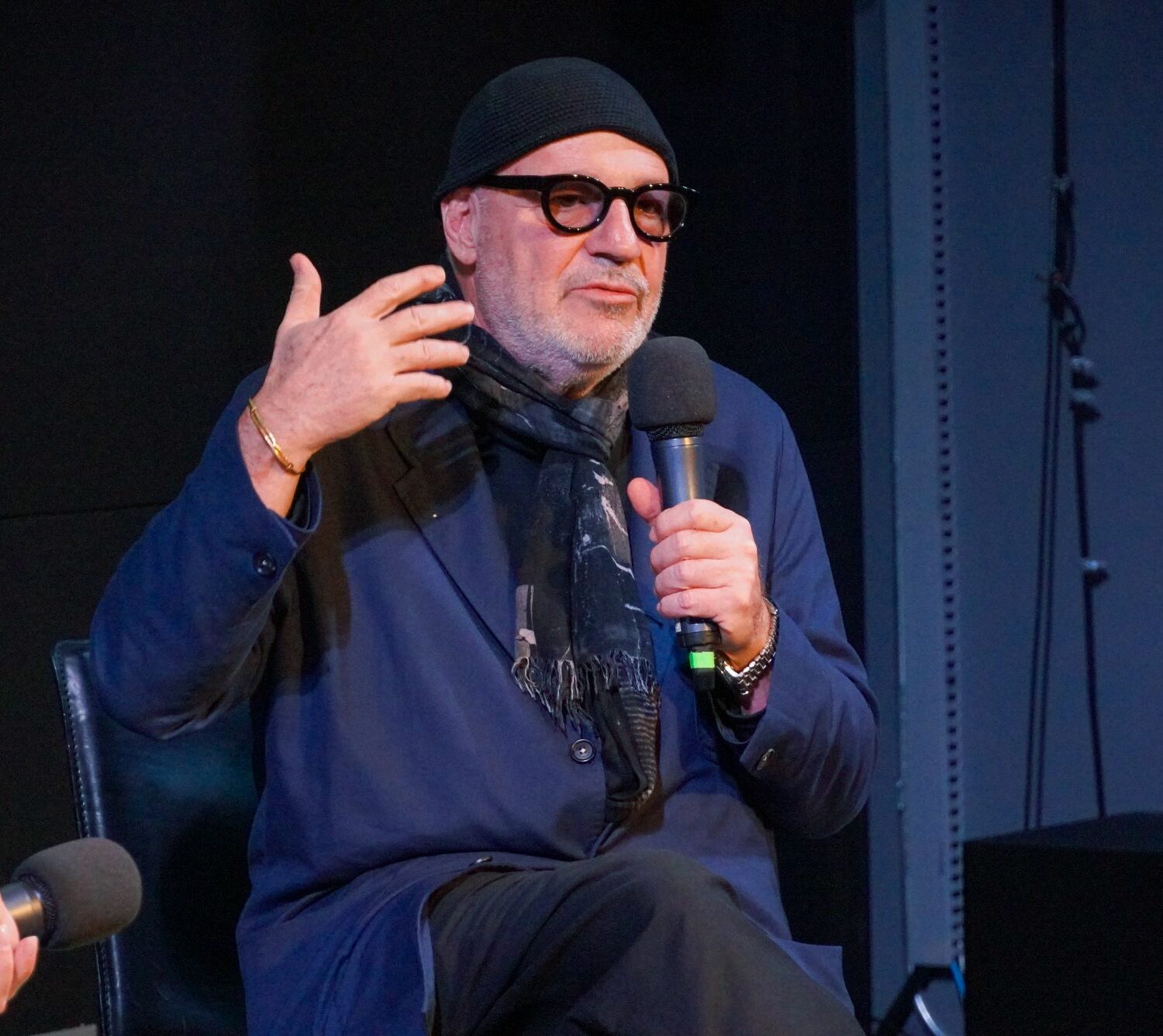
“If tomorrow you turn off the plug, we must remain able to do things alone. It is the difference between a tool you use and a prosthesis from which you depend”. For thirty-five years in the digital world, which today looks from the accelerated perspective of New York, Marco Camisani Calzolari has clear ideas. Known Face of Striscia la Notizia, professor, advisor and member of the Committee for the National Strategy for Artificial Intelligence 2026-2028, is the founder of Cyberhumanism, a philosophy that overturns the dominant perspective to center the human being. The real challenge today is no longer to understand what technology can do, but to decide how much we are willing to delegarle. Starting with critical thinking, which risks atrophy if we stop exercising it. As it explains, it is not about renouncing artificial intelligence, but learning to use it without becoming dependent.
When did you realize that artificial intelligence would not be an innovation like the others, but something capable of changing our behaviors?
Artificial intelligence, in its recent evolution that made it accessible to all, is an important new leap. But for those who work from within, these passages look more like a continuous evolution than sudden jumps. On the other hand, AI comes from afar: its origins date back to the fifties. The real turning point, the one in which you understand that we no longer talk about simple technology, comes when social behavior changes. Today people ask the car before a colleague, a doctor or a friend. First the technology gave us tools that we were driving; now she is driving us and working in our place. The great cultural change is when a person begins to say: “I’ve been told by artificial intelligence”, with the same tone of authority with which he used to say: “An expert told me.” This is the true symbol of the moment we are living.
She defines the traditional “cognitive health” search links, because they forced us to compare different sources. What do we lose when AI delivers a synthesis directly?
This is a crucial knot. Today people are looking for Google and often content with the synthesis generated at the top of the page, or ask directly to the chat. Once the search links required an effort: they were complex, contained inaccuracies or falseness and it was up to us to distinguish the true from false. Today the machine is thinking of providing us with a pre-packaged truth. The problem is that this answer does not come from a neutral or sentient entity, but from the training and choices of a few large private companies, able to direct the opinion of billions of people. By delegating research, synthesis and reprocessing to AI, we risk atrophiing critical thinking. Critical thinking is like a muscle: if you do not train it, it weakens. We have already done this with other technologies: we no longer remember the numbers by memory because there is the column, we no longer know how to orientate ourselves because there is the navigator. They are great, they are extraordinary innovations, but it is undeniable that it is a cognitive function less to operate.
Is this a problem especially for young generations?
Yes, and it’s huge. If you don’t train a young skill, you can’t just find it when you need it as an adult. It’s like pretending to run a marathon without ever racing: you have to struggle before.
Will we ever come back and do things alone?
No, inventions cannot be misinvented. We didn’t go back with cars to start riding again. What we must do is change society so that technology does not dominate change, but is dominated by us. With the car we did exactly this: we did not ban it, we regulated it by introducing the road code, speed limits, point driver’s license and emissions standards. With digital, we have to do the same thing.
Only in this case the problem is not physical but cognitive.
That’s right. And the consequence is not simply that we become less brilliant because we do not train the brain. The real risk is to become creduloni: to accept for good plausible answers without having more tools to verify them, losing at the same time originality and creativity.
Can artificial intelligence also become an ally of human creativity?
It depends on the use. It can be an extraordinary tool if you use it as an interlocutor to confront you. If I have to choose a title, design an image or develop a concept, I can use it to broaden the vision: on the other hand I have a huge amount of knowledge to start looking for ideas. Human creativity, moreover, comes from contamination: a musician listens to a lot of music and then composes something of his own, metabolising his influences. The risk of AI is homologation, because mathematical models tend by their nature towards the average, towards the most probable response. This is why we must never settle for the first result: we must learn to ask complex questions, to challenge the machine. It can become a tool that feeds our uniqueness, but only if we do not use it passively. The difference lies here: do not get crushed by technology, but know how to dominate it.
You also use AI as an independent agent. What allows you to do concretely?
It gives me “superpowers”. I almost never use it as a simple chat, but as an independent agent. I have a system that performs operations instead of me: for me it is together a platform of study and operation. When you can build in a few minutes an application that you need at that precise moment, we are facing an unprecedented leap of productivity. But I delegate execution, not judgment: the goal I decide, and every result I control it before using it. It only works like that. If you can fly, it’s a Ferrari, but without a license you’ll kill yourself.
You founded Cyberhumanism. What does it mean, in practical terms, to put the human being at the centre of the AI era?
It is first of all a choice of field: to put people’s needs before technical solutions. We must not start from the question “What can this technology do?”, but from “What does the human person need?” If technology is useful to that need, well come. It also means rejecting both technophobia and blind technology. Today we witness excessive polarization. We have already seen enthusiasm on the finite nothingness in nothing: the metaverse that had to revolutionize our lives, cryptocurrencies as the daily single currency, the NFTs sold as the ultimate breakthrough. We must maintain the right way, guided by competence. And above all remember who we are talking to: a software, not a human being. The responsibility of the choices remains ours: the car does not have a criminal record and does not respond to his actions. Technology is good when it gives you time; but if tomorrow you turn off the plug, we have to stay able to do things alone. It’s the difference between a tool you use and a prosthesis you depend on.
You are part of the National Strategy for Artificial Intelligence Update Committee 2026-2028. What is his role in this institutional table?
After the first Committee, which has worked on Strategy 2024-2026, a new one has been established with a profile linked to the strategic choices of the country, consisting of representatives of ministries, institutions and the academic world. My task is to bring to the table the concrete impact of technology on society: on families, on workers, on children and on enterprises. I take care of the protection of people and the transparency of systems. On specific details, as understandable, the decree establishes the bond of confidentiality and the secret of office.
How difficult is it to balance citizens’ protection without curbing innovation? Who is this task to?
It’s government. The problem is that once the phenomena happened near us and were territorially adjustable; today you approve a law in Italy and a second later you get a digital service across the world, accessible to anyone. Protecting people requires that those who govern understand technology thoroughly. If you don’t understand the technical structure, you can’t expect the implications. Italy is taking steps on this, but it is a global game. On investments in border models Europe is now pursuing the United States, and on next generation robotics China runs faster than all. They are industrial knots that need to accelerate, and the strategy also serves this.
Who decides what information the AI should show and what should it summarize? Is there a risk of invisible censorship?
I would not speak of classical censorship, but of concentration of power in private hands. Until yesterday, when Google responded with links, there was a database below where the original information was traceable. Generative AI works differently: it takes an empty box, inserts a huge amount of data and transforms them into mathematical vectors and formulas. Inside that box no longer exists the original recoverable data. When the machine responds, it generates a new text based on probability. This makes it extremely difficult to verify why he provided an answer instead of another one. And that this power is managed by a few big corporations is a huge political theme.
What part of the work is likely to be replaced by artificial intelligence today?
It is a visible phenomenon. AI is exceptional in automatizing repetitive tasks that require a minimum of processing, such as preparing a presentation or synthesising a document. The problem is that those execution tasks were historically the entrance door for young people in the labour market: internships, entry level roles. They were the gyms where you learned the job. Today a company can wonder what sense it has to pay an intern for a week on a job that a software agent does in a few minutes. The decision-making, strategic, ethical and cultural part must remain in the hands of man; but the automation of execution is likely to burn the first step of the professional scale for the new generations.
More autonomy means less control. How far can we trust AI agents?
To a certain point, and never blind. As probability systems, they generate answers that no one has programmed at the table. If these co-operative models of agents can operate on files, send commands and, in the future, move robotic bodies, operational autonomy increases exponentially. You can’t predict every single action. For this reason the center of gravity must remain man: we cannot delegate key decisions on our lives to an algorithm and call us out.
If the so-called “Singularity” comes, that is, an intelligence greater than the human one, what would happen?
Opinions are divided: there are those who believe that we will never have conscious or sentient machines, and those who notice that by speed, quantity of knowledge and memory AI has already passed us in many areas. Personally I do not believe in a Singularity in the scientific sense of the term. The real problem, however, exists also without Singularity: if you delegate control to something less intelligent than me only for laziness or comfort, that element will still take over. If we allow an algorithm to decide alone who gets a mortgage, who has to be operated or who has priority to the emergency, we have given up our sovereignty. And it is a temptation that there is already.
You’ve been in this story for 35 years. What’s the time you realized you chose the right job?
When no one wanted the web in Italy. I went to the companies to explain that I needed a site and looked at me like I sold smoke. Those who arrive today see a sector made up of billions and stars; I have seen it born in the midst of total skepticism. There I learned the thing I still use now: when everyone tells you that technology is not needed, and when everyone tells you that it will solve everything, they are giving you the same information. They don’t understand.
She lives in New York. What do you see from there that you do not see from Italy?
Speed. Here the AI is already ordinary administration: in offices, in hospitals, in companies. In Europe we are still discussing whether this is the case, here we are discussing how. The difference is posture: here the error is expected in the account, from us it is a fault. But I keep an Italian thing, the doubt. Here the doubts exchange it for slowness, and that’s exactly what will save us.
You have two children. How do you tell them about artificial intelligence?
I’m asking. The question I ask at home is not “have you used AI?”, is “and what do you think?” If you can answer, you used it well; if you can’t answer, you just copied it, and you can see it immediately. Parents always say the same thing: the ban is around you in ten minutes, the question is not.
Have you ever made a mistake by trusting AI?
Sure, and who says no doesn’t really use it. I got perfect answers in the form and wrong in the substance, which is the most dangerous thing: when it is written badly you notice, when it is written well you trust. From there I have a fixed rule: the more the answer I like, the more control. The AI cares when it’s convincing.
What does Marco Camisani Calzolari do when he turns it off?
I drive without navigator, for example, and it is maintenance more than laying. If so many things I do pass through a system that works for me, I have to keep some spaces where I decide and I’m wrong. The day I’m no longer able to get lost in a city, I lost something about me, not the road.
Who accuses you of being alarmist, what does he say?
That I never asked to turn anything off. I use AI every day: I work in it, I build systems, and for this reason I know where it breaks. The alarmist talks about it without ever using it, and the enthusiastic as well: I am the same person with two different moods.
New York Mayor Zohran Mamdani banned AI in public schools until the third grade. She lives there: is it the right way?
In the meantime, let’s make it clear what he really did, because the news is spinning. He did not prohibit artificial intelligence: he put a one-year moratorium on tools for students up to the eighth class, about 600,000 boys, while teachers continue to use it to prepare lessons. And she banned chatbots from the company at every age. On this last point I agree without reserve: a software that simulates a friend, a boy, does not need. On the rest I say that a year of moratorium is only valid if you use it to form teachers, otherwise it is a postponement. The real hole is there: a few boys had a teacher who explained how to use AI. And the AI at school comes in anyway, from the phone they have in their pockets.
The alarms have multiplied: the recent Fellow letter of the Royal Society, the warnings of Hinton, the United Nations asking for global rules. How do you read them?
With respect and cold head. Those signatures are very serious people, medaglie Fields and Nobel Prize winners: who liquidates them as exaggerations makes a mistake. But I remember two things. The first is that the deadlines we have already heard, and who fixes them usually then moves them. The second is that in May the chiefs of the main laboratories reviewed their own prophecies at the end of the work. The real risk of catastrophicism is that it shifts your gaze: while we discuss the end of the world, there is a twenty-three-year-old who struggles to find the first job, because the tasks with which you entered are taking them a software. That’s where you have to look now.
Then we ask him directly: will humanity disappear?
If he disappears, he’ll be by proxy, not by a conscious machine attack. The film that worries me is more boring than Hollywood: a society that stops deciding, checking, wrong, and in return gets comfort. No one is extinguished; one becomes irrelevant a piece at a time, remaining convinced to be in charge. For this reason I continue to say the same phrase: I am afraid of the human being acting like a car much more than the machine that imitates the human being.
If you had to choose one thing to defend from artificial intelligence, between creativity, critical thinking and the ability to report, what would you choose?
I’d put curiosity first. Curiosity is the spark that keeps all other human qualities alive: that is what drives you to ask a question instead of contenting with the first answer. Without curiosity, critical thinking does not even start. And together with curiosity I reveal the value of error. The mistake is the exact moment when we really learn. Moreover, the machines also learn so: a model is trained by correcting its errors, adjusting the shot. We should relearn, even culturally, to appreciate the mistake as the biggest gym of our humanity.
Photographs by Alessandro Gianferrahttps://www.instagram.com/alessandrogianferraphoto/
L’articolo Marco Camisani Calzolari e l’AI: «a tool, not a prosthesis» proviene da IlNewyorkese.