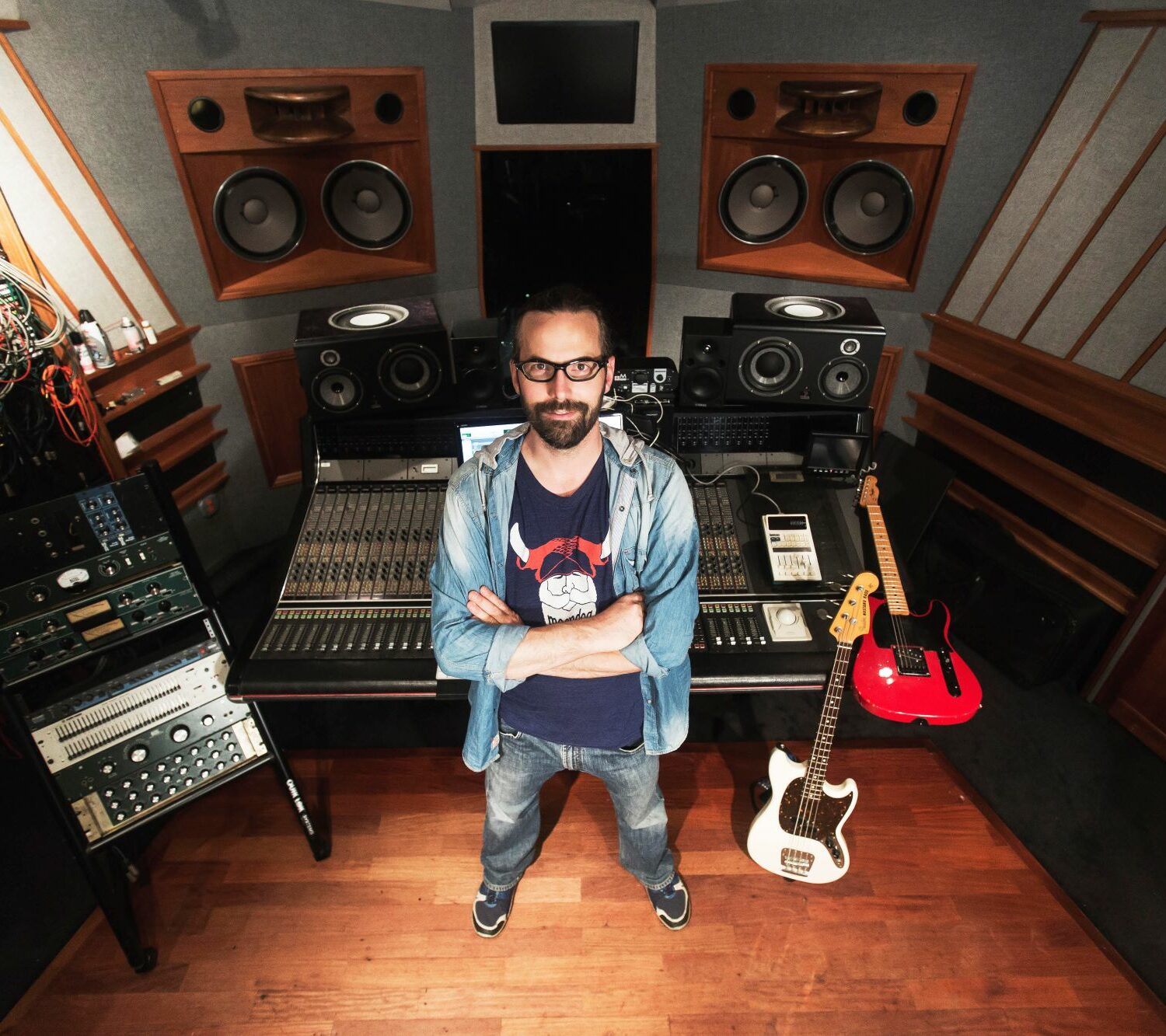
In over twenty-five years of career in New York, Marc Urselli has built a path that has led him from the infinite shifts from intern to EastSide Sound to become one of the most respected sound engineers and producers of the international scene. Three Grammy Awards, collaborations with international names including Lou Reed, U2, and Nick Cave, and today leading two studios — the historic EastSide Sound and the brand new Audio Confidential, a stone’s throw from Madison Square Garden. In this interview, Urselli traces the sacrifices of the beginning, its connection with the city, the impact of digital music and the challenges that artificial intelligence poses to the future of musical production.
You grew up in Italy, opened your first studio in the basement of the house as a young man, and then in 1999 you moved to New York to find your place in the world of music production. What were the highlights of this transition, and what memories of that early intern period at EastSide Sound?
I have so many memories of that time, beautiful and ugly… Seeing coming important and famous artists when you are 20 years old becomes a strong motivation and inspiration. Artists passing through EastSide Sound were people I never dreamed of seeing work closely, so the opportunity to be in their presence was unique. I remember once I was in the studio, a producer was working on a record when he got a call: was Laurie Anderson asking him to work with her. I thought: “Who knows how it feels to receive such a phone call”… almost 10 years later it happened to me, and I received the same call.
But of course the route was long and difficult. In those days, I was sleeping very little and, in order to make myself worth and notice in the studio, I was doing 18-hour shifts. There was often no time to go home to sleep and take a shower, so I stayed on the studio couch: it ended at 2 or 3 at night and the next day it started at 8. From my house to the studio it took more than an hour of public transport. At the time I lived in a basement in New Jersey that flooded every time it rained, so I slept on an inflatable air mattress floating when the water entered the basement..
I wasn’t paid and I was there just to learn. And since I had no salary, I lived savings and money that I earned in Italy by doing some web design and websites (it was the beginning of the Internet age, when everyone wanted to make a site and I was a self-taught programmer). I used to live by checking out every expense to make the bills square and eating really bad. It was not a healthy life at all, but I made all those sacrifices because I was determined to stay and learn the craft, and above all decided not to ask for money at home not to weigh on the shoulders of my parents. I’m proud I did.
Since you started with the 4 track on cassette in Italy, to the use of Pro Tools and mixer recallable today, how would you describe the technical evolution of the last twenty years? How did digital change your approach — both in study and live?
Digital has changed everything. In some ways better, for others worse. Live, for example, it’s nice to take behind a digital mixer that has all the effects, compressors etc., without having to have dozens of analog racks to do the same thing: everything has become more compact and efficient. Even in the studio it is, but there evolution has created a lot of laziness.
Without entering too much in the quality differences between analog and digital, the advent of digital has created a thousand more possibilities than before did not exist, but also ruined the music industry a bit because it has puzzled the musicians. Today they no longer have the same desire and determination to invest the time that was dedicated to their art. Artificial intelligence will give the last blow of grace to this situation, and will remain in a few to still make true music.
Today you drive EastSide Sound, one of New York’s historic studios, living between the Big Apple and London. How would you describe your relationship with New York and how this city influenced your work?
Actually, I’m the chief engineer of EastSide Sound, the oldest recording studio in New York, but I’m also the owner of the newest studio in the city: Audio Confidential, my studio, which opened in mid-July, in Chelsea. After more than 25 years I closed the circle and opened my own studio again, just like in the 1990s in Italy.
My relationship with New York is pure love and energy. New York is the hottest city in the world: It gives me inspiration, energy, invention, charge and ideas all the time. The people of New York are fantastic and super smart, artists are very good, of a higher level than the world average, and the smartest people on the planet sooner or later come to NYC to confront the rest of the world. It is the cultural capital of the world, and who does not know or understand it, simply there has never been or never spent enough time there. It is not enough to come to tourists: once you live you will open a new world!
What prompted you to open a new studio in New York right now?
I like to produce records and be part of the creative process of the genesis of an album. However, to work as a producer at a disk you often need to have your space, where you don’t pay at hours and you’re not always worried about the clock. That was the main reason.
I created and opened Audio Confidential because I wanted a studio where I could be free and independent. There are also other reasons: I had a vintage NEVE counter that was no longer used and it seemed a waste of keeping it in unused storage. Finally, I wanted to give the opportunity to emerging artists or with less economic chances of working with me in a more favorable situation.
EastSide Sound is a beautiful studio, which I love, but costs a lot because it is one of the biggest and most famous in New York. Now I have a cheaper option for those who cannot afford EastSide Sound, while those who want more space, more iso booths and/or a bigger piano can continue recording with me there.
How do you see the future of professional music production in New York in the next 5-10 years, and what will be your role in this panorama?
I’ll keep making records until I die. That’s obvious. Artificial intelligence, however, is coming to full swing and will destroy the musical scene, and not only: our lives too. There will be less and less musicians, less phoenix. The people who do my job will become like the few calzolai of Florence still remained, making leather shoes by hand for few: our customers will be those who appreciate the quality and who if they can afford it.
The rest of the audience will listen to bad music generated by AI for the profit of multinationals like Spotify, which of music is not interested at all (in fact they pay almost nothing to musicians, but they earn billions and reinvest them in weapons). We are destroying ourselves, and the end is approaching while everyone laughs without understanding what we are doing and the risks we run.
But I have no children (by choice) and I live in the present, so I continue to enjoy life as best I can look at life through the lens of music, and I continue to create art, because — along with love and personal relationships — it is the only true thing that remains and where I believe.
L’articolo Marc Urselli: from the league to the Grammys, between New York and the AI challenge comes from IlNewyorkese.