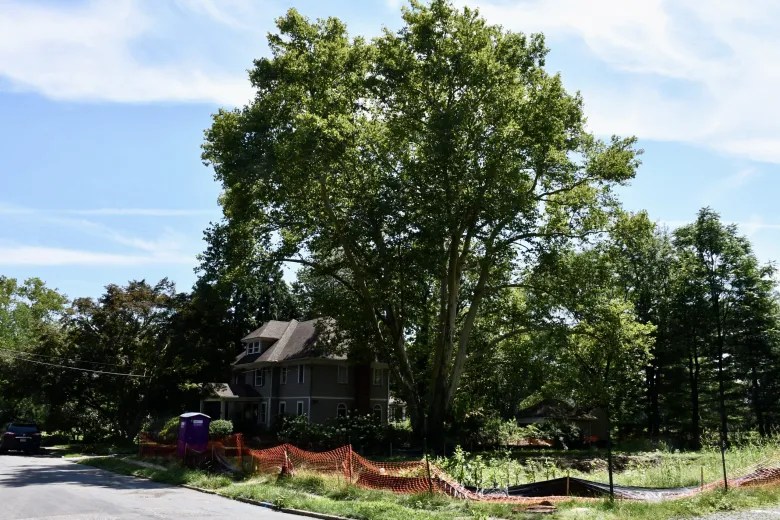
In Maplewood, a town in New Jersey about 30 kilometers from Manhattan, there is a land on which almost nothing has happened for a few months. The house that occupied the lot, at 62 Pierson Road, was demolished, in its place remained a large hole and weeds. In the middle of the ground there is still the reason for the block to the works: a London platano with a trunk about 1.8 meters wide and a foliage that reaches almost 30 meters high. According to an estimate of the arborist of the municipality could be 271 years old, although its exact age was not verified by counting the rings of the trunk. Other evaluations place it more generally between 200 and 300 years.
The landowner, the builder Anthony Nardone, wants to lower it because it is located where two single-family houses should be built. The municipality denied his permission and at the beginning of August rejected his appeal. Since then the story has risen of interest: almost 1,900 people have signed a petition to save the tree, residents have organized public meetings and Nardone lawyers have predicted the possibility of bringing the case to court.
The story began months earlier. Nardone had purchased the property in 2025 from the Waeschle family and obtained from the Maplewood Planning Board permission to divide the lot into two. Real estate records show a $1.3 million sale. The old house was then demolished, but to realize the project needed another authorization, this time to knock down the platano. In May Ellen Seidman, who lives next to the ground, saw the excavators work near the roots and called the commune. The inspectors arrived and a fence was mounted around the tree.
According to the order of Maplewood on the trees, to break down on a private property any tree with a trunk of at least 12 inches in diameter, about 30 cm, serves a permit. Pierson Road measures about 72 inches. The same ordinance distinguishes between different categories of trees, and this distinction has become the center of the dispute.
A tree of that size certainly falls into the category of the specimens, particularly large specimens. In some cases the regulation allows them to be lowered when they prevent the construction of an already authorized building project. The rules are much more rigid for trees classified as ‘historical’ or ‘rare’: they can be removed only if they are sick or represent a significant danger to people or properties. Pierson Road platinum had not been formally declared historical before Nardone’s request. The commune, however, argues that it can be considered ‘rare’, a qualification which according to the regulation can be attributed by the director of public works or by his delegate.
It is precisely on this passage that the lawyers of the builder dispute the decision. Their argument is that Nardone bought the land and obtained the approval of the subdivision on the basis of rules that allowed it to build the two houses, and that the municipality could not subsequently use the particular importance of the tree to prevent the project. On August 3, Mayor Victor DeLuca and Counselor Nancy Adams, the two members of the Township Committee responsible for examining the appeal, gave reason to the municipal abortionist and confirmed the denial. According to the local regulation their decision concludes the administrative procedure.
Even the age of the tree is not certain. Richard Wolowicz, the arborist who examined him, estimated 271 years above all on the basis of size and height. To establish age with greater precision, a sample should be taken from the trunk. The figure is therefore an estimate, although made by a professional. On the other hand, there is a more easily verifiable element: the platanus is exceptionally large.
In 2025, Ellen Seidman had contacted the Big Tree Conservation Program in New Jersey, which since the 1930s has registered the largest trees in the state. An official of the program had replied that the London platinum then recorded as “champion” in New Jersey had a trunk of 58 inches, much less than 72 measured in Maplewood. The new tree could therefore be the greatest known specimen of its species in the state. However, official registration requires the owner’s consent and verification on the spot, and Nardone did not authorize it.
The London Platean, Platanus × acerifolia, is a tree particularly associated with cities. It is probably a hybrid between the eastern platanus and the American sycomoro and was planted in large numbers in European cities since the 18th century, especially because it tolerates well pollution, compact soils, wind and temperatures very different. It can exceed thirty meters and develop very large buds. It is precisely this ability to survive in urban environments that made him very common in London and gave him the name with which he is known today.
Meanwhile, the Waeschle family, who owned the property before Nardone, accused some neighbors of having motives from the classic NIMBY movement, that is to oppose development especially because it happens near their homes. Elizabeth Waeschle Vetter said that she and her fourteen brothers sold the house and destined the proceeds to the assistance expenses of the younger sister, who is disabled, and that therefore the family will not gain anything from future construction. The registers and necrology of the previous owner confirm that the family includes fifteen children and that the property was sold in 2025.
Residents in favour of the conservation of the tree argue that the problem concerns above all its environmental value. Seidman also expressed the fear that lowering it could make water flow worse in an area already subject to flooding. It is true in general that very large trees intercept the rain, absorb water and reduce surface ruscellament: they are some of the benefits also indicated by the New Jersey forest program. However, it is not clear that a study has been published that quantifies how the removal of this individual would affect the risk of flooding at Pierson Road.
L’articolo A Maplewood fights for a tree that might be 271 years old proviene da IlNewyorkese.