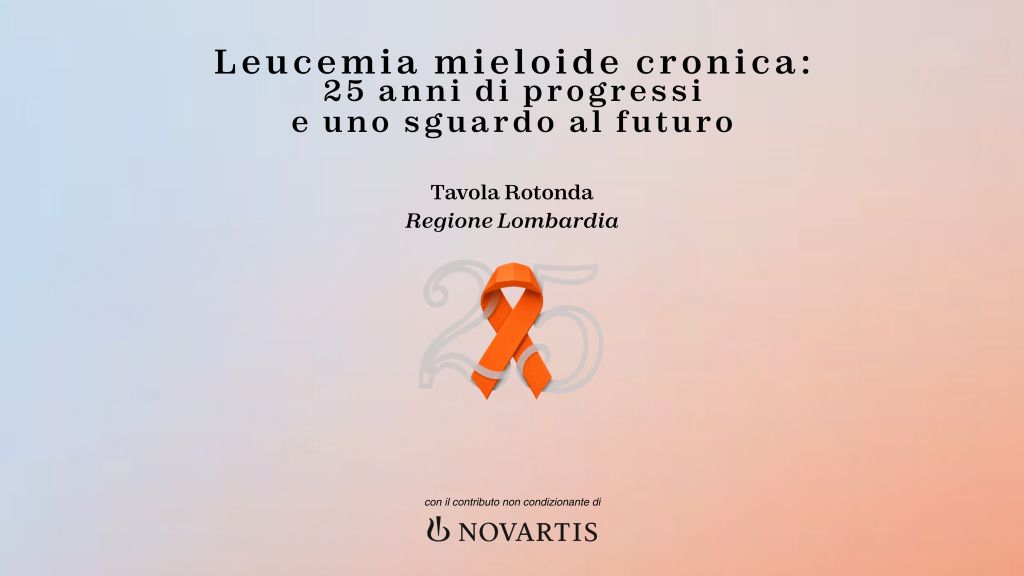
MILAN (ITALPRESS) – The care of patients with Leukemia Mieloide Cronica (LMC) in the context of the Lombardy Region was at the center of the Round Table “Cronic myeloid leukemia: 25 years of progress and a look to the future”, realized with the non-consistent contribution of Novartis, which was held in Milan. The meeting brought together institutions, clinics and patient representatives to deepen access to therapeutic innovation and the organization of treatment paths within the Lombarda Ematological Network (REL). The comparison is part of the regional phase of the project, following the national path that led to the drafting of a Alliance Paper, a vision document and address for the management of the LMC in the next ten years. Starting from national priorities, the Roundtable has deepened the Lombardy experience, with particular attention to the application of the regional address document dedicated to the LMC, the continuity of care and the quality of life of patients over the long term. In Lombardy, LMC’s takeover of adulthood is governed by a specific address document, drawn up under the REL and approved by the Regional Council on 1 December 2025. The document identifies shared criteria for the main stages of the path, from the initial evaluation and from the diagnosis to the choice of treatment, to the monitoring of response and follow-up. The same deliberation articulates the hematological network in centers with three levels of welfare complexity, enhancing the collaboration between structures with different skills. “For those who live with chronic pathology such as chronic myeloid leukemia it is important to be able to count on a continuous grip and access the most appropriate therapies. A greater collaboration between specialist centres and territorial services can facilitate patient orientation and accompany them in the different stages of the journey. Comparison with patient professionals and associations helps to understand what aspects of care require greater attention,” said Carlo Borghetti, member of the Health Commission of the Regional Council of Lombardy. “The takeover of chronic myeloid leukemia requires specific hematological skills and a direct link with laboratories that can provide standardized results in adequate times – explained Alessandra Iurlo, hematologist at the IRCCS Foundation Cà Granda – General Hospital of Milan -. In the Lombarda Ematological Network the collaboration between the centers has allowed to share data and experiences. For the patient it is important to maintain the same clinical reference over time, also to support adherence to therapy. In addition, regional addresses must be updated periodically to take into account the development of therapies and the need to adapt the treatment to the characteristics of each patient.” On the organizational level, the comparison has deepened the connection between hematological centers, laboratories and territorial services. The homogeneous application of regional addresses is particularly important in the management of a pathology requiring regular checks over time. In this context, the REL document proposes indicators to assess the regularity of molecular monitoring and reporting times, useful to verify the continuity of the path in the various welfare contexts. Twenty-five years after the introduction of tyrosine inhibitors, the therapeutic evolution has changed the objectives of the LMC takeover. To achieve deep and lasting molecular responses, improving the quality of life and, for eligible patients, the possibility of free remission from treatment are today central aspects of clinical management. The therapeutic choice therefore requires to consider from the firstbut therapeutic line the effectiveness, tolerance and clinical profile of the patient, with an evaluation of the response at intervals defined according to the individual case. “In our experience, another aspect on which we can work is the organization of checks before the visit, so that the specialist already has the necessary elements to guide the route. It is important to be able to also count on professionals of other specialties, such as cardiology, when the patient’s conditions require a dedicated evaluation”, said Mariella D’Adda, hematologist of ASST Civil Spedali of Brescia. The Round Table has therefore deepened the importance of a multidisciplinary takeover, but also the role of the dialogue between clinical and patient in the evaluation of treatment tolerance. Undesirable effects, even if mild, can have consequences on daily activities when protracting over time, affecting the quality of life of patients. “Conviving with chronic myeloid leukemia also means facing difficulties that may concern work and daily activities. For patients it is important to have a stable clinical reference, to be able to talk about the effects of therapy and to be able to access psychological and nutritional support. With the questionnaires collected in the centers of the Lombard Ematological Network we asked directly to patients how they feel followed and what aspects of the takeover can be improved”, said Nicoletta Re, Vice President of AIP LMC – Italian Association Patients with Leukemia Mieloide Cronica. The comparison therefore recalled the importance of consolidating the application of the address document dedicated to the LMC within the Lombarda Ematological Network and updating the PDTAs on the basis of therapeutic evolution. The sharing of gripping criteria, path monitoring and patient needs detection can help ensure greater homogeneity in access to the most appropriate therapies for the patient’s clinical profile and long-term care continuity.
– photo press office Esperia Advocacy –(ITALPRESS).