Where does the inspiration of a designer come from? From a fabric, from a color, from an artwork looked at by chance?
The halls of “Sculpting the Senses”, the exhibition of Iris van Herpen at the Brooklyn Museum, seem to suggest a different, more complex answer. Here inspiration is the fruit of years passed to observe with patience the world, leaving nature, biology, anatomy, technology and perception to mescoline one another to become haute couture.
Van Herpen has long been considered one of the most original voices of contemporary fashion. Merit of the cutting-edge technologies it uses, of course, but above all the way it manages to mix the most classic couture crafts with materials that seem out of a research laboratory. In the exhibition the detail and the overall vision alternate continuously, the micro and the macro, and with them the themes that have always accompanied his work: the body in space, identity and possible futures of a world in constant transformation.
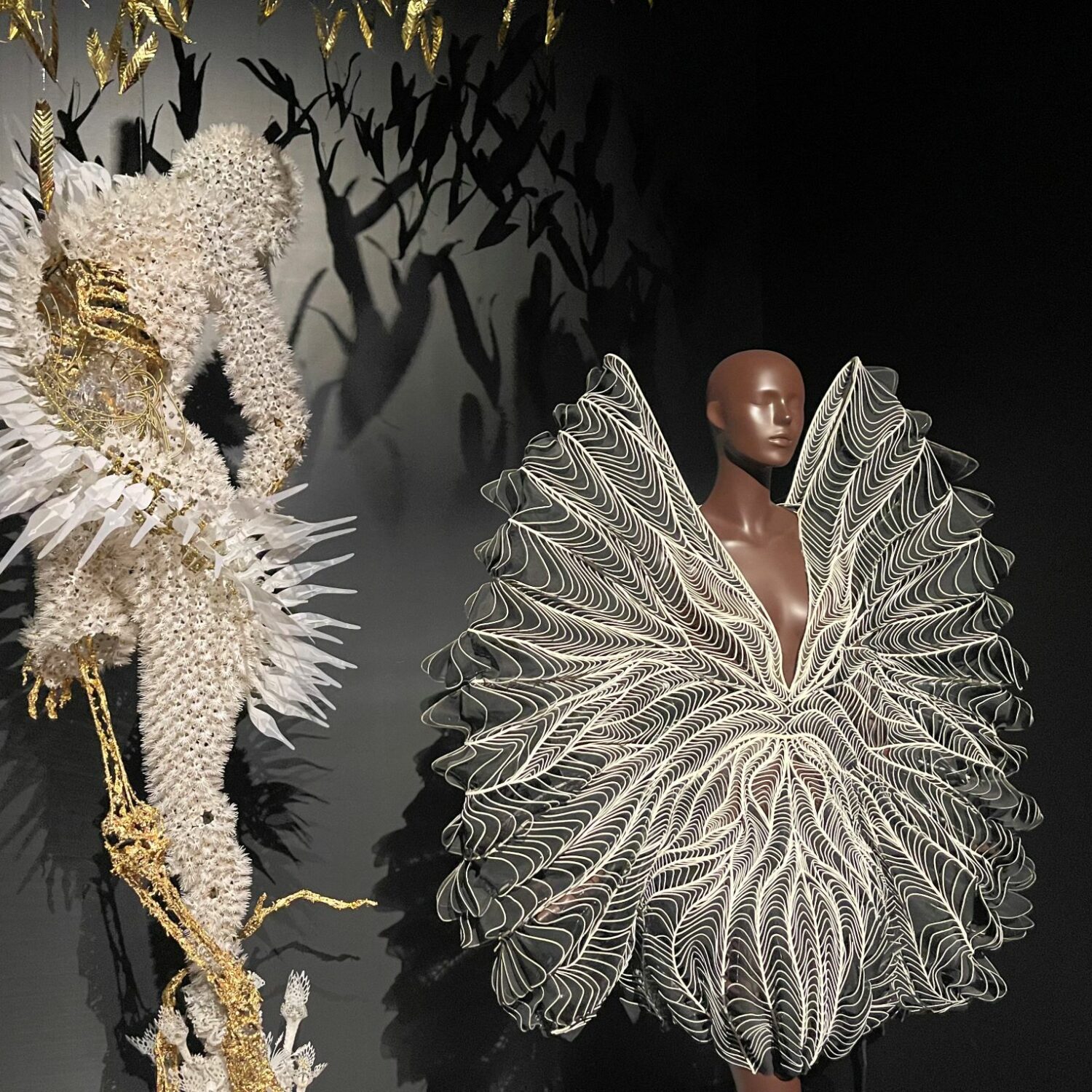
Behind each dress there is a history of research. Van Herpen doesn’t just draw clothes. See, study, let yourself be guided by natural phenomena that often escape the human eye, and then translate them into something that you can wear. The microscopic geometries of the radiolars, the ocean abyss, the architecture of the hives, even the images arrived from the telescope James Webb: every scientific discovery becomes a starting point for her. It is not a question of copying nature, but of interpreting it, of making it dialogue with technological innovation, without losing the artisanal savoir-faire that remains the heart of its work.
The exhibition begins with water, an element that returns to many of its collections, on all “Crystallization” of 2010. Drops, waves, ice, fog, marine currents: everything takes shape through blown glass, thermoformed Plexiglas, 3D printing, laser cutting, but also ancient techniques such as “suminagashi”, the Japanese art of water and ink marble, capable of generating always different textures, never identical to themselves. The result is clothes that seem to have not yet completely solidified, as if matter continues to move.
Following that flow, it descends ideally into the depths of the ocean, a world that remains largely unexplored, populated by forms of life remained invisible for centuries, until scientific research allowed us to look inside. Van Herpen observes this submerged universe with the same spirit as Herman Oscar Mueller, the master glassmaker of the twentieth century whose glass models first made visible marine organisms and biological structures otherwise imperceptible. Like him, the designer also tries to make tangible what normally escapes, turning it into high fashion.
Plancton unicellular, coral reefs, jellyfish: these are the ideas from which light silhouettes arise, three-dimensional textures, suspended work between biology and pure imagination. In “Sensory Seas”, the 2020 collection, clothes really seem to emerge from the seabed, returning the water movement and the complexity of an ecosystem that few have ever seen close.
Van Herpen’s attention to nature, however, does not stop at the sea. The hidden architectures that regulate life on Earth are fascinating: the geometries of radiolars, the prismatic cells of the hives, the mechanisms of morphogenesis, those biological processes, often invisible, which determine how an organism takes shape. It is in this territory that the designer finds his most personal language, what allows her to transform science into something close to visual poetry.
Ernst Haeckel is a name that often comes back when we talk about the work of Van Herpen: biologist of the nineteenth century, famous for his detailed illustrations of microscopic organisms. It is looking at his designs that the designer found a whole vocabulary of almost invisible shapes, then become raw material for new silhouettes, new materials, new constructions. Once again the gesture is the same: bring to light what normally remains hidden, and do so through the language of high tailoring.
This scientific curiosity is accompanied by an environmental sensitivity that over the years has become increasingly explicit. It is the case of “Earthrise” of 2021, where the plastic recovered from the oceans becomes fabric, light and bright. For this collection Van Herpen worked with the artist Rogan Brown on a filigree structure inspired by corals, a way to demonstrate that even what seems destined to become rejection can find a second life.
From here the path enters the human body. One of the most fascinating sections of the exhibition is that dedicated to anatomy: skeletons, muscle bands, connective tissues become instruments of study, starting points for new forms. The clothes follow these internal architectures until they become real exoskeletals, able to make visible what you normally can observe only with diagnostics for images.
If the body is matter, perception is experience. Through transparent, reflective surfaces and three-dimensional processing, Van Herpen wonders how the senses build what we call reality. Study synesthesia, hypnosis, altered states of consciousness, and draws clothes that change appearance depending on light, movement, the point from which you look at them. Fashion stops being only image and becomes 360 degree experience – view, space, emotion together. In the penultimate hall of the exhibition, not by chance, the space loses every conventional coordinate, spreads in every direction, as if it had no boundaries.
The last section looks ahead. In a society increasingly shaped by digital environments, Van Herpen wonders where the boundary between nature and artifice passes today, and what it means to have a body in a world that we would define, for convenience, post-human. His most recent silhouettes arise from what she herself calls “line of life”: organic structures that only scientific research has made visible, and that fashion now tries to translate into form.
Collections such as “Escapism” (2011), “Voltage” (2013) and “Syntopia” (2018) tell well this tension never resolved between organic and artificial. Digital modelling, laser cutting, laminated materials, artisan craft: everything coexistes, and garments that seem to grow more than being sewn. The dress no longer dresses the body, extends it, transforms it, tries to imagine its evolution.
What makes “Sculpting the Senses” an exhibition out of the ordinary is its ability to show how creativity really arises: from the encounter between disciplines that seem to have nothing in common. Biologists, physicists, architects, engineers, artists, artisans all enter the same creative process, what Van Herpen calls “craftolution”, the fusion between the manufacturing excellence of couture and the possibilities opened by the latest technologies.
Out of the museum is the idea that true luxury is not in the finished dress, but in the thought that generated it. Every creation of Van Herpen is a meeting point between the precision of science, the complexity of nature, technological innovation and a profoundly human sensibility. And perhaps this contamination continues to make its work a language capable of speaking about our relationship with the body, with the planet, with what will come.
More than just a celebration of one of today’s most visionary designers, “Sculpting the Senses” is an invitation to look at fashion with different eyes, to remember that behind each silhouette there is always a universe made of observation, research and attempts.
It is there, in the encounter between several disciplines that create creations that are authentic works, able to make visible the invisible.
L’articolo Iris van Herpen at the Brooklyn Museum: the fashion that arises from the encounter between science, nature and imagination comes from IlNewyorkese.