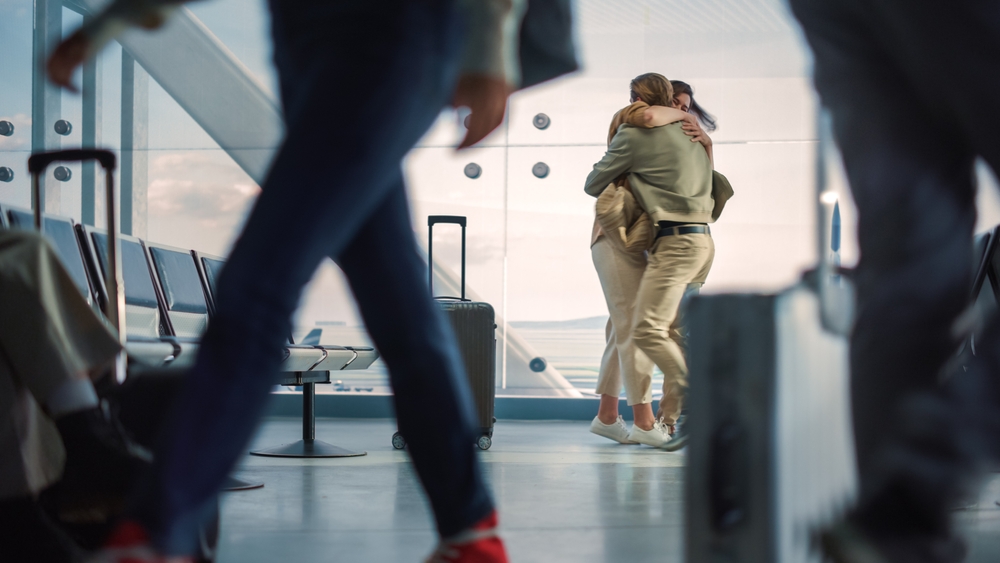
For the first time in more than 20 years, a practice has returned to some US airports that seemed to be permanently archived after September 11, 2001: access to gates even for those who should not fly. Several facilities are in fact introducing “guest pass” programs that allow non-passers to pass TSA controls and access the terminal operating areas, including boarding areas.
The last stop to join was the Oakland San Francisco Bay Airport (OAK), but the list is stretching rapidly. In Philadelphia (PHL) the “Wingmate Pass” is active, in Detroit (DTW) the “Destination Pass”, while New Orleans (MSY), Seattle-Tacoma (SEA) and Orlando (MCO) have introduced similar programs with dedicated names. Similar initiatives are also present in Kansas City, San Diego, Cleveland and San Antonio. At the moment, however, the airports of the area of New York – JFK, LaGuardia and Newark – have not yet announced such passes on a structural basis.
However, the operation remains very different from pre-2001. Access is not free: it is necessary to apply online, usually through the airport site, with an advance that can reach up to seven days, although in some cases a quick approval is expected in the day. TSA performs a verification of personal data – legal name, date of birth and gender, avoiding discrepancies with what is reported on Real ID or passport – and, once the free way is obtained, a digital pass is released. Those who enter must, however, be subject to standard security controls, including limits on full liquids and screening procedures. But why did you decide to loosen the security protocols?
On the one hand, airports have become in the years real commercial poles, with chain restaurants known as Shake Shack or Wolfgang Puck, duty free shops and brands like Hudson News or Brookstone: expanding the public means increasing the spending potential. On the other hand, technological advances in safety systems – from advanced body scanners to biometric controls – have made access to people without air ticket more manageable.
Programs allow, for example, to accompany a family member to the gate or to accommodate someone at the plane’s exit, reducing the difficulties for older people or with limited mobility. It is a choice that responds to change in how American airports are rethinking their role: not only transit sites, but regulated public spaces, also open to those who do not travel.
Article In several US airports it is again possible to accompany someone to the gate comes from IlNewyorkese.