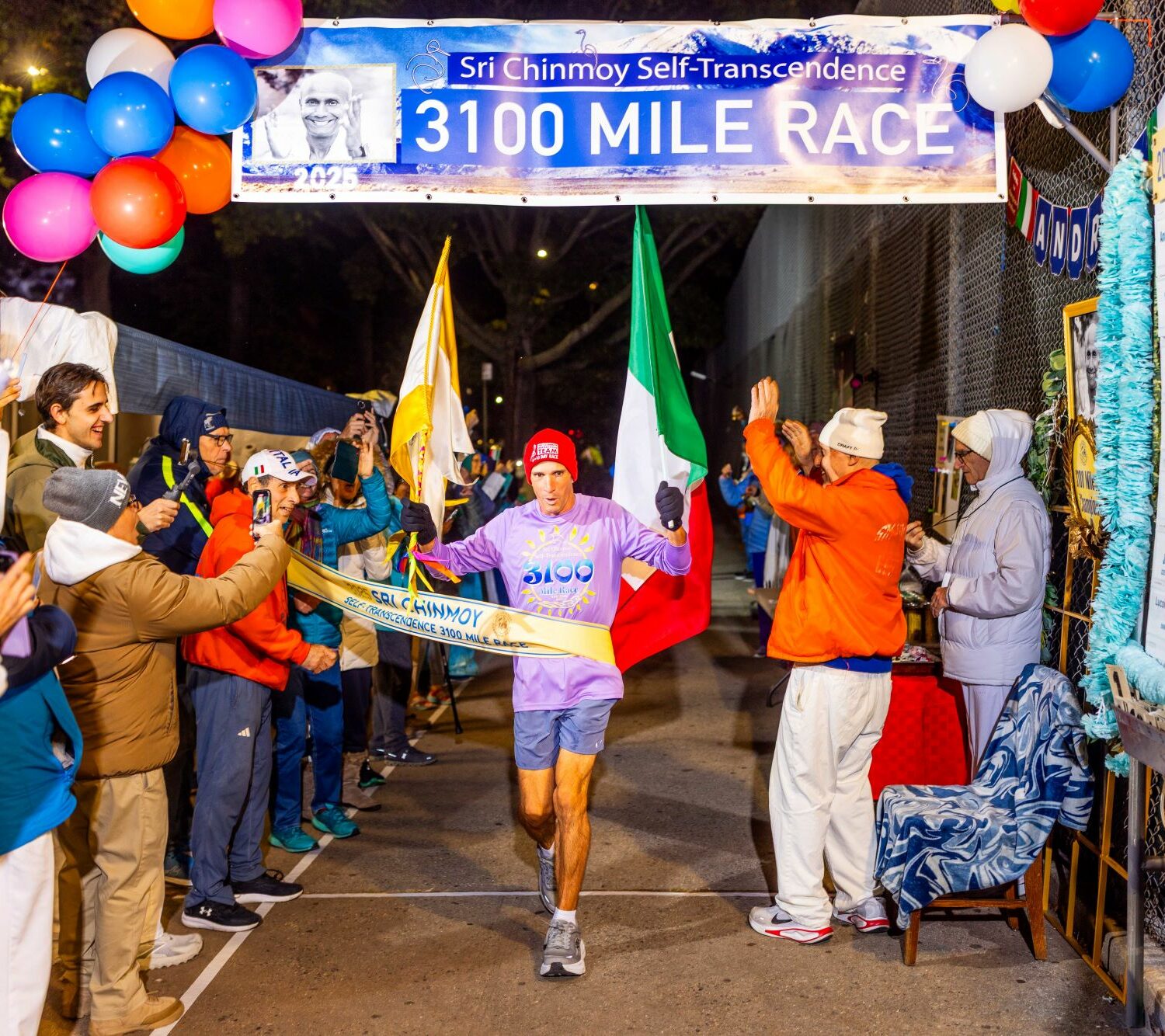
He ran for almost five thousand kilometers on the same urban circuit in New York, for forty-six consecutive days, and without being a professional athlete. Andrea Marcato, originally from Lughetto, near Venice, won for the sixth consecutive time the Self-Transcendence 3100 Mile Race, the longest road race in the world. The event, conceived by the spiritual master Sri Chinmoy and organized by his marathon team, takes place every year in the Queens district on a track of just over a kilometre to repeat thousands of times. Marcato, who lives abroad and has been dedicated to meditation and endurance for years, is today the only athlete in the world to have won six titles in a row, transforming his participation in a practice of discipline and awareness more than competition.
Andrea, you managed to win for the sixth consecutive time the longest race on the planet. What does this continuity mean to you? Is it more a physical, mental or spiritual challenge?
For me this continuity of success definitely has a higher value than the external placement. Surely it’s a good thing to figure out, even if I have to say I’m quite detached. I give much more value to the sense of inner satisfaction I feel during and at the end of the race. I like the challenge on the physical level, although I think that in such a race the mental factor is predominant. The spirit is simply the union between body and mind, it is that harmonious feeling that makes you cross the difficult moments with serenity and confidence.
Dealing with over 3,100 miles in New York, running for weeks on the same urban circuit, requires a discipline out of the ordinary. How do you build the mental force necessary to face such an extreme test day after day?
“Gutta cavat lapidem”. The ancient Latins said that, day after day, the drop digs the stone.
The mental force needed to deal with such extreme evidence I built it over the years. In 2006, I ran my first 12-hour ultra marathon. From that race onwards I was passionate about endurance racing, trying to increase the distance gradually. Twelve years later, in 2018 I ran my first multi-days event, a 10-day race held in New York, Flushing Meadows Park. The discipline to move forward I find it in meditative practice. For years I have been trying to wake up early and calm my mind before starting the day. I go deep and try to listen to myself. I want to clarify what I really want. I try to be as organized as possible. The more I understand what to do and the more dedication I can put in that direction, limiting daily distractions and impediments.
Every year your time improves or maintains. How has your approach to physical and mental preparation changed compared to your first participation?
It’s not like that. Actually, my sixth edition was the slowest and most problematic.
In the second edition I made my PB in 42 days, while this year I closed the race in 46 days. Surely many things have changed since the first participation. After the first year it took me more than 6 months to recover, it was a shock to my body. After the second and third edition I noticed that I recovered faster and after 2 months I started competing on other events. Physical preparation has varied considerably. Over the years I have greatly increased the races played in a single year and drastically decreased weekly training. I also included long swimming sessions, some crossfit training in the gym and dynamic stretching sessions. Let’s say that, races aside, I try to find alternative training methods that maintain the physical form, without impacting the joints more’ than necessary.
Mental preparation is definitely a factor in continuous evolution. There is still a lot to work..
The “Self-Transcendence Race” comes from a spiritual vision: overcome their inner limits rather than compete with others. How much does this inner dimension weigh for you compared to pure athletic performance?
The “Self-Transcendence Race” was born from a spiritual vision of Sri Chinmoy, which inaugurated the first edition in 1997. His philosophy shortened meditative practice with the dynamism of sport. The inner and outer world are not necessarily in contrast, on the contrary they integrate with each other. Obviously this race is a test of the physical and mental limits of human abilities and is considered “the Mount Everest of Ultradistants”.
As I said before, I try to be detached from the external result. Personally, the inner dimension has infinitely more importance than purely athletic performance.
This does not mean however, that I do not try to give the best of me. This edition of 2025 was my slowest race, but also the one that gave me more satisfaction. When things go well, it’s easy to smile and be happy. It’s when you face unexpected difficulties instead… that’s where character is formed, that’s where you show what you really are capable of, that’s where you have to transcend yourself.
Many athletes use various mental tools before approaching an important race. A repetitive mantra, a repeated tradition, a scaramanti gesture. Do you use methods of this kind?
Not necessarily. I’m just trying to distract my mind and put it in a drawer. I try so to say, to “push the heart beyond the obstacle”. The only tradition I have repeated during the various editions is my visit to the General Consulate of Italy in New York, after the race. I established a friendship with the Consul Di Michele and his staff. They always welcomed me with warmth and generosity. They are very special people, up to their institutional offices.
After six consecutive victories, what still drives you back to New York? Is it the desire to improve you, the connection with the race community or something deeper?
The question includes my answer. After six consecutive editions, what drives me back to New York is a blending of what you just mentioned. Surely I try to improve myself on the outside, this is undeniable. Then there is inner search. I see the long-distance race as an opportunity to go deep into myself. I want to try to understand my inner mechanisms and hope to evolve into an ever better person, beyond external circumstances. Then there is also the sense of familiarity and friendship that I have established over the years with the community of the race, which I will never be able to thank enough for the support and spirit of service that has been shown to me in every edition.
Article In a few run as much as Andrea Marcato comes from IlNewyorkese.