ROMA (ITALPRESS) – Italy is facing a crucial challenge for the future of the National Health Service (SSN). With a National Health Plan held at 2006-2008 and an extension of the Health Pact 2019-2021 that does not address epidemiological-demograph problems and post-pandemia problems, the SSN serves an updated strategic vision to address territorial, social and access to care. In 2024, about one out of ten people (9.9%) gave up specialist visits or exams due to long waiting lists (6.8%) and economic difficulties (5.3%), a growing phenomenon compared to 2023 (7.5%) and pre-pandemic period (6.3% in 2019). Among national health planning acts “sectoral”, waiting for approval and extension, Regional Health Plans in sparse order, more or less up-to-date, serves a unitary national programme framework that makes synthesis, put order and draws the SSN route for the next few years indicating also the way to reduce inequalities. According to the Observatory activated by Salutequità there are regional and local experiences that prove – in different areas – anticipators of answers to widespread needs throughout the country and which represent interesting “incubators of innovation”.
A complex and complex framework on which the Report presented at the 3rd Health Summit – integrates those presented and discussed at previous editions: The ten levers for equity; Sustainability levers – focus on national and regional health planning. “Our report highlights a complex and fragmented picture of health planning in Italy – comments Tonino Aceti, President of Healthquity – characterized by territorial, social and economic inequalities that compromise equity and timeliness in access to health services. The lack of a new National Health Plan, the last one dates back to twenty years ago and that is to say, 2006-2008 despite being a performance provided by the Law, along with the disomogeneity of the Regional Health Plans demonstrate a lack of strategic, unitary vision and coordination between institutional levels of government of the SSN. The need to launch a new National Health Plan has been talking about it for years – Aceti continued – so much that it is mentioned as one of the strategic actions to be implemented also in the last two Acts of Address of the Minister of Health, those relating to the years 2024 and 2025′′′′′.
“To date, however, no text has yet been published in the Conference of Regions. But writing a text is not enough – he adds. Who will approve it and with what timing? The Parliament or the Government together with the Regions? Will a participation of all stakeholders be guaranteed, starting from the Associations of patients and citizens? Will it be attached to specific and bound resources for its implementation and a clear timetable? Will it be the subject of a stringent monitoring? Will it be a social and health plan or once again only health care? Will it be instrument for ordinary maintenance or to implement a transformative approach of the SSN? Investing in 2026 over 142 billion euros without a clear and forward-looking vision of the SSN and a true and loyal institutional collaboration of the State-Regions would be a lost opportunity to modernize and strengthen our Public Health Service. Notwithstanding the pre-pandemic period also the other planning tool, namely the Health Pact 2029-2021, which has been extending for Law for several years,” said Aceti.
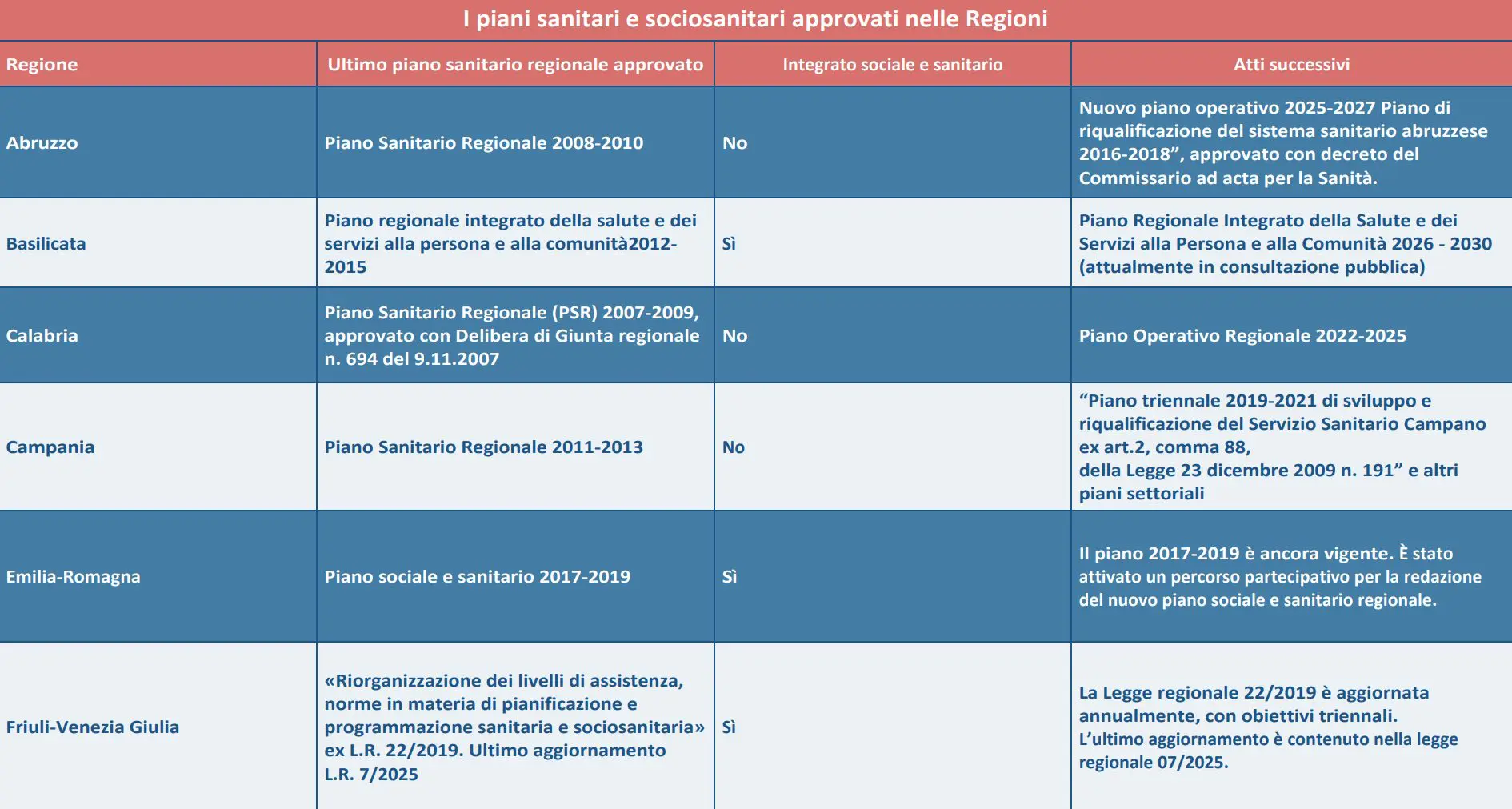
Reconnaissance on the Health Plans of the Regions and Autonomous Provinces of Health shows that: 10 Regions have an integrated social health plan; 16 Regions have an approved Health or Social Plan before pandemic; 4 Regions are at work for updating: Basilicata and Piedmont are engaged in the approval process of their new regional plan. Umbria is working on updating its regional health plan. Emilia-Romagna has activated a participatory course for the preparation of the new social and regional health plan; Abruzzo and Apulia have worked on regional operational programmes (POR) 2025-2027; Calabria and Molise respectively to those of 2022-2025 and 2023-2025; Molise is working on the new POR 2025-2027 (in public consultation); Friuli-Venezia Giulia is the only Region that provides, in order to fulfil its regional norm, an annual update of sociosanitary planning with regional law; the PA of Trento stands out for having realized a wider planning with a ten-year duration; for the construction and realization of the Plan for health of Trentino has activated a participated process; the Plan includes outcome indicators (linked to the 5 macro-objectives) for monitoring and public reporting of the Plan’s performance.
The National Health Plan, as provided for by law, is still in 2006-2008. The Health Pact 2019-2021 is extending by law “sine die”. Waiting for the State-Regions Conference the new National Plan of Government Expected 2025-2027, the new Pandemic Plan 2025-2029, the proposal for extension of the National vaccine plan 2023-2025 and the National mental health plan 2025-2030. Requested by the Ministry of Health the extension of the National Plan Prevention 2020-2025, but was not welcomed by the Regions who instead asked and found intended to start work tables for the drafting of the new plan before its expiry. Prorogation granted by the Regions for the National Piano Contrast Antibiotic Resistance 2022-2025 until 31 December 2026. From 2023 to today updated the new National Oncology Plan 2023-2027 and the National Disease Plan 7 years from the previous and the National Cronism Plan after 9 years though with observations and reliefs from the Conference of Regions on financing, transparency in the inclusion/exclusion of pathologies (e.g. psoriasis), etc.
Italy is more and more long-term (the centennials have increased by 30% in the last 10 years), multicultural (one person resident in 10 is foreign), but with increasingly fewer households (between just under 20 years -in 2043- 10.7 million people will live alone and 6.2 million will be elderly) and with more than one out of 5 at risk of poverty or social exclusion (predominantly in the south). Still little digital: in 2023 Italy is twenty-second place of the EU 27 ranking, with a distance of 20 percentage points from Spain (66.2%) and 14 percentage points from France (59.7%). It is the fifth country in the world for life expectancy at birth (83,5 years), but life expectancy in good health conditions is only 58,1, falling compared to 2023. Territorial inequalities are evident: life expectancy varies by about three years between the longest regions (PA Trento, 84.7 years) and the less long-term (Campania, 81.7 years). Higher mortality in the Mezzogiorno, especially for cardiovascular causes and diabetes. In 2021, avoidable mortality rates are above the national average in Campania, followed by Molise, Sicily, Puglia and Lazio.
The main causes of death are diseases of the circulatory system and tumors. Brain health is a growing priority: 7 million people with migraines, 12 million with sleep disorders, 1,2 million with dementia, 800,000 with stroke outcomes and 400,000 with Parkinson and one fifth of the population with psichyc disorders (e.g. anxiety, depression). Several pathologies have no recognition in national programming acts (e.g. psoriasis, headache, cardiomyopathies, etc.) or in LEA with inequalities in terms of health and social protection to which Parliament tries to give answers with proposals of law. The out of pocket health expenditure supported by families increased by approximately 9 billion euros between 2012 and 2024, reaching 41.299 billion euros. In 2024, 5% of households had problems reaching three or more essential services, including health services, with significant territorial differences: from 2.6% in the PA of Bolzano to 8.9% in Campania. Eight Regions do not guarantee the Essential Levels of Assistance, in particular in the area of district assistance and prevention, increasing inequalities in access to services.
An example is the oncological framework: clinical networks improve overall, but Calabria, Molise, Marche, Basilicata and Sardinia still fail to meet the internal demand of patients and have health mobility. Seven regions have not yet integrated the network with the territorial activity (Basilicata, Friuli-Venezia Giulia, Marche, PA Bolzano, Puglia, Sicily, Umbria) and for this reason Agenas has elaborated the “Guidelines on hospital-territorial integration in oncology” transmitted in the Conference of the Regions in 2024 and still in stand-by. For the oncologic screening organized in 2024, 17,9 million people were invited to undergo examinations, but only 7,3 million joined. The lowest values are for the cancer of the rectum colon, unique for both the male and female population: the cover is clearly lower than the recommended value of 50%, attesting to 33.3%, with a very accentuated North-South gradient.
We are at the top of the Union by national donation rate: 30.2 donors per million people (pmp), although with marked North South differences: Tuscany (49.4 pmp donors), Emilia-Romagna (45.5) and Veneto (44.7) are the most “generous” contrary to Molise 3,4; Basilicata 16,7; Campania 21,2. It also improves plasma collection that exceeded 900 tons, but the demand for multipurpose immunoglobulins is +57% in the last 10 years and the level of self-sufficiency we have reached is 59%.
– photo table Health –
(ITALPRESS).