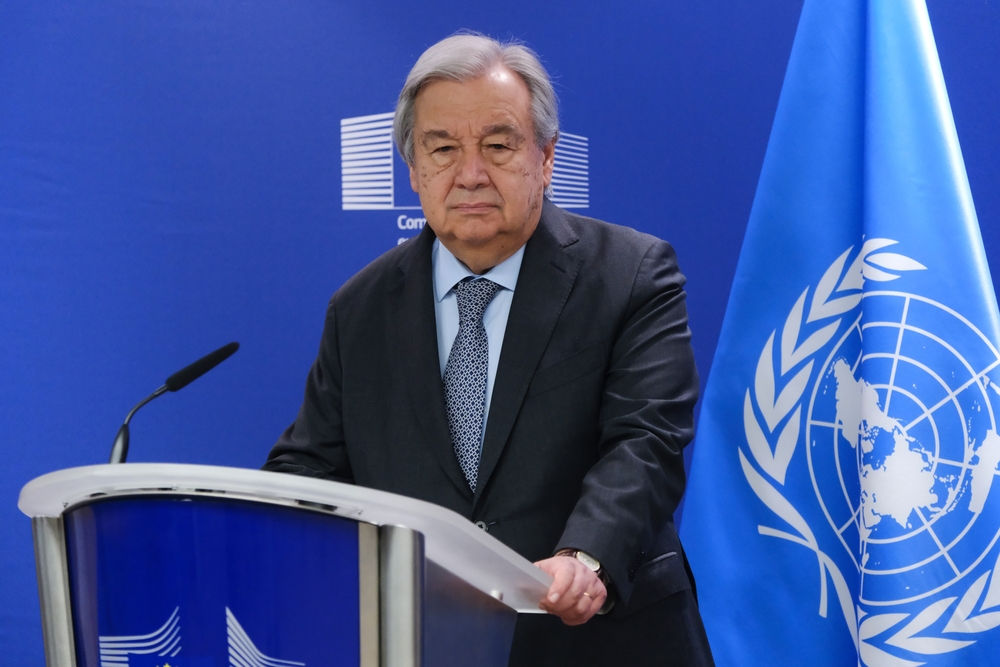
On 26 August, António Guterres presented the results of the review of UN peace operations, requested by the Member States in the Futuro Pact. The report, already circulated to all Member States, proposes a rethink of how the UN conceives and uses peace missions, after eighty years in which the approaches evolved together with the changing of conflicts.
Guterres opened his speech recalling the historical contribution of the UN missions, from Cambodia to Salvador, from East Timor to the Central African Republic, as well as diplomatic work on the border dispute between Cameroon and Nigeria, resolved thanks to the good offices of the United Nations and a special political mission that led to the demarcation of the border.
The Secretary-General then outlined the context in which the revision is inserted: the number of conflicts in the world has reached the highest level since 1945, with more deaths linked to fighting in the last five years than in the previous twenty-five. Among the factors mentioned above, the increasing use of military drones, the perspective of autonomous lethal weapons based on artificial intelligence, the involvement of transnational criminal networks, the renewed threat of nuclear weapons and an increasingly widespread climate of impunity, with conflicting parties violating international law. Guterres also reported that the share of conflicts resolved through a peace agreement is at the historical lowest of recent decades.
The report identifies seven reform axes. The first concerns a greater investment in preventive diplomacy and mediation, strengthening the good offices of the Secretary General and his envoys, as already happened in Colombia. The second is aimed at stronger partnerships with the host states, recalling that peace, Guterres said, cannot be brought from abroad but must be built from below. The third asks for more targeted and adaptable mandates to reality on the ground, with Guterres who specified: “we cannot maintain peace when there is no peace to maintain”, reasserting that peacekeeping operations should be deployed only in the presence of a peace agreement or at least of a ceasefire solid.
The other four axes concern a clearer division of the tasks between the peace missions and the rest of the UN system, a greater operational agility (including the acceleration of participation of women in all aspects of peace operations), greater cost efficiency and responsibility in staff conduct, and finally a better technological and operational readiness of missions.
Guterres paid tribute to UN personnel who had fallen during peace missions, citing the anniversary, celebrated last week, of the attack at the Hotel Canal in Baghdad in 2003, where 22 members of the UN Special Political Mission staff died in Iraq. He also welcomed the unanimous adoption of the Security Council Resolution 2823 (2026), calling for attacks on UN peace personnel to cease and to be called upon to respond, without exception.
Finally, the Secretary-General stressed the importance of partnerships between the UN and regional organisations, citing in particular that with the African Union, made possible by the Security Council Resolution 2719 (2023) on the foreseeable financing of peace support operations led by the African Union. Guterres closed the speech by inviting Member States to use the revision as a basis for adapting UN peace operations, and to invest concretely in peace.
The article Guterres presents to the General Assembly the revision of UN peace operations proviene da IlNewyorkese.