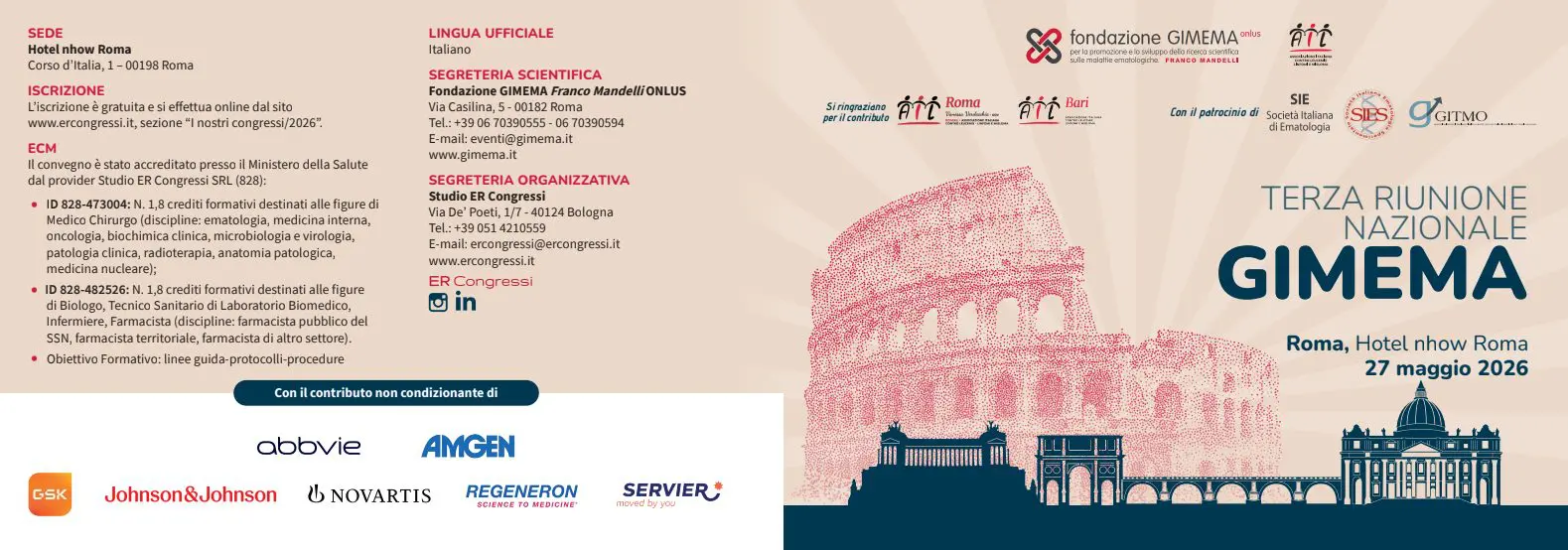
ROMA (ITALPRESS) – From the reduction of chemotherapy to the possibility of living without therapy: research is changing the prognosis of blood diseases. Presented, in Rome, during the Third National Meeting GIMEMA, promoted by Fondazione GIMEMA – Franco Mandelli Onlus, the most important updates of clinical and translational scientific research on blood diseases conducted in Italy by the main hematologists of the country. The event represents the moment of meeting and comparison of the Italian cooperative network dedicated to hematology, consisting of clinical centers, research laboratories and specialized structures distributed throughout the national territory.
“Emathology is experiencing an extraordinary transformation through the integration of biological research, precision medicine, immunotherapy and collaborative clinical studies,” says Marco Vignetti, president of the GIMEMA Foundation. “The goal today is not only to increase survival, but to improve the quality of life of patients, reducing toxicity, hospitalization and social impact of care.” On the occasion of the meeting, ample space was also dedicated to multiple myeloma and precision medicine. Among the most important strategic projects was presented MY-LabNet, the new national network of laboratories promoted by GIMEMA to standardize and make accessible throughout the Italian territory the evaluation of the minimal residual disease in the multiple myeloma, today considered one of the most important biomarkers to guide customized therapeutic decisions. The project is a crucial step towards an increasingly integrated medicine with advanced diagnostics: through MY-LabNet, highly specialized laboratories will be able to share uniform methodologies, technologies and evaluation criteria, guaranteeing patients a fairer access to the latest generation molecular analysis and promoting increasingly targeted and sustainable treatments.
The working groups, Working Party, of the main hematological pathologies, presented studies concluded, in progress and in the planning phase. Among the most important results presented emerges the multicentric ENABLE study which showed relevant results in patients with myeloproliferative neoplasms in the blast phase, one of the most aggressive forms of disease. The combination of chemotherapy and venetoclax has produced clinically significant and lasting responses even in fragile patients, not eligible for intensive treatment. Post-transplant survival exceeds 80%. Important results on acute leukemias. In high-risk acute myeloid leukemia, the AML1718 study reached full remission rates close to 80%. The protocol, based on venetoclax associated with standard chemotherapy, allowed more than 60% of patients to access allogenic transplantation. The results exceed those of the previous therapeutic strategies. Also presented is one of the largest Italian works on antimicrobial prophylaxis in patients with acute myeloid leukemia and promylocytic leukemia, developed by a multidisciplinary group of GIMEMA experts. The document updates national recommendations in the light of new therapies and the increase of resistant infections, introducing innovative indications on antifungals, antibiotics and vaccinations in the different therapeutic setting. For acute promylocytic leukemia, GIMEMA has confirmed a well-established result: today patients treated with chemo-free protocols based on ATRA and arsenic trioxide can achieve an expectation of life superimposed to that of the general population, confirming one of the most important therapeutic revolutions of modern hematology. The randomized ALL2820 study demonstrated, for the first time in the world, the superiority of a fully chemo-free strategy. The treatment combines ponatinib and blinatumomab and is more effective than traditional chemotherapy associated with imatinib. Data concern adult patients with positive Philadelphia acute lymphoblastic leukemia.
In addition to this international result, GIMEMA has also presented the new document of national consensus on the use of blinatumomab in the acute Philadelphia acute lymphoblastic leukemia negative of adult, with the aim of integrating in an increasingly effective way immunotherapy in therapeutic paths and reducing the intensity of chemotherapy especially in fragile patients. The European IMPACT-AML project, funded by the Horizon Europe programme, is still being implemented. Patients included are relapsed or refractory subjects, or patients in which acute myeloid leukemia is reappeared after an initial response to treatment or did not respond to standard treatments, representing a population with still unsatisfied clinical needs. The project provides for the creation of a shared European register and the conduct of a randomized clinical study to compare different therapeutic strategies in clinical practice. On the front of chronic myeloid leukemia, the first randomized Italian study (SUSTRENIM CML1415) was presented, which represents a cultural and clinical breakthrough: the goal is no longer just to control the disease, but to allow a growing number of patients to live without therapy, reducing side effects, cumulative toxicity and economic and social impact of long-term care. Instead, it aims to assess the effectiveness of asciminib, a new generation thyrosin-chinasis inhibitor, the PEARL study, conducted in Italy and Spain. The data collected will help to understand how the drug can increase the rate of molecular remissions and consequently the number of patients eligible for therapeutic suspension. In chronic lymphatic leukemia, it is of strategic importance the observational study CLL 2121, which has now collected the data of more than 10,000 patients treated in more than one hundred Italian hematology centers since 2010. GIMEMA designs, in this way, one of the largest European databases dedicated to the disease, allowing a photograph of how this pathology is treated throughout Italy. The initiatives of the Working Party of Immunotherapies mainly concern the most innovative cellular therapies, namely CAR-T.
The activated studies aim to analyse the effectiveness and safety of commercial CAR-T in the lymphatic leukemia of the child and adult and in multiple myeloma. With the new observational protocols, one of which will be activated shortly in cooperation with AIEOP, you will have the opportunity to collect valuable data from hospital medical practice on effectiveness, safety and duration of responses and to create one of the largest Italian platforms dedicated to advanced cell immunotherapies. And important news came also from the Working Party dedicated to the piastrinopenies. In particular, adult immune thrombocytopenia is working on the realization of one of the most important European databases dedicated to this pathology, fundamental to understand the evolution of the disease, monitor the effectiveness and safety of new therapies and evaluate the long-term effects of treatments in real clinical practice. To date it has exceeded the 1,000 patients involved, reaching 1,189 cases collected in 37 Italian centers. With regard to the quality of life of hematologic patients, the Working Party on this topic presented the results of one of the first studies in the world on the direct evaluation by patients of the precocious side effects of CAR-T therapies in aggressive lymphomas. The results have shown a significant discrepancy between the symptoms perceived by patients and those reported by clinicians, confirming the importance of integrating the patient-reported outcomes in hematological practice and in the management of the treatment path. For the scientific relevance of the results obtained, the study was accepted for publication on The Lancet Haematology.
Among other initiatives in the field of quality of life, also reported the special monograph of JNCI magazine, the prestigious magazine of the National Cancer Institute (NCI) American that will be dedicated to the patient-reported outcomes in hematology, curated by GIMEMA together with the MOFFIT Cancer Center. The data presented, was underlined during the meeting, ‘confirm the role of the GIMEMA Foundation as the main Italian infrastructure for independent research in hematology, capable of networking hospitals, universities, laboratories and research groups to quickly transfer scientific results to clinical practice. With 17,000 patients currently involved in studies, Italian cooperative research continues to contribute decisively to the development of more personalized, sustainable and targeted care for the real needs of people suffering from blood disease.
– photo poster event –
(ITALPRESS).