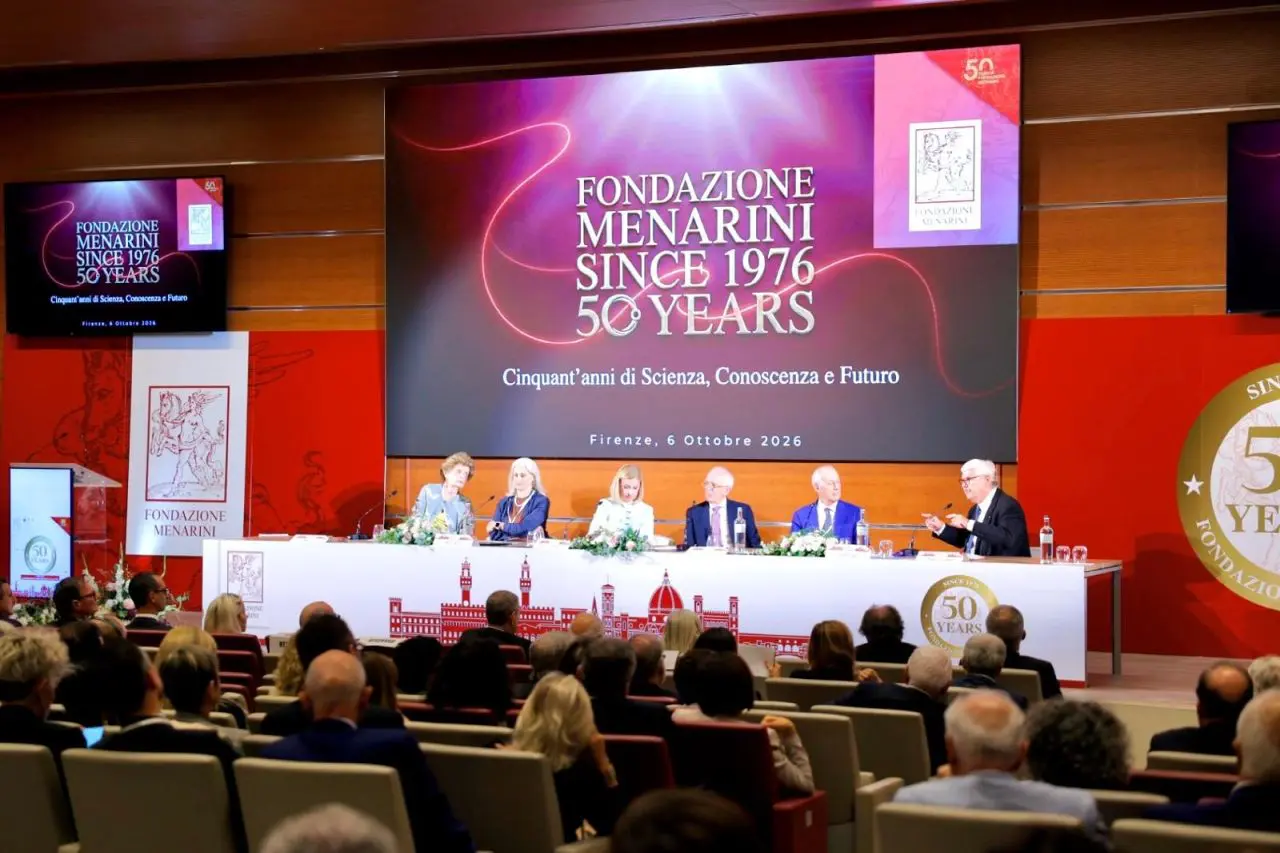
FIRENZE (ITALPRESS) – The Menarini Foundation celebrated this year fifty years of activity, a path that since 1976 accompanies the international scientific community in the spread of medical knowledge and in the promotion of health culture. Not a simple celebratory budget but a real journey with the protagonists who wrote the history of modern medicine through the stages that over the last 50 years have radically transformed the care of cardiovascular, respiratory and metabolic diseases, become curable. Three areas in which much of the global mortality load is concentrated and where research has allowed to save an incalculable number of lives worldwide, extending durability and quality of life. These are the discoveries illustrated by their own architects at the conference “Half a Century of Medicine. Looking Towards the Future”, in Florence on 5 and 6 October. The scientific work of the conference dedicated to the 50th anniversary closed with the institutional interventions of the political and academic authorities of Florence, Menarini Group and the Foundation and with the master reading of Louis J. Ignarro, Nobel Prize for Medicine, President of the Scientific Committee and co-president of the congress.
“These two days are not only a tribute to the past, but a bridge towards the next fifty years of medicine – says Stefano Del Prato, President of Fondazione Menarini -. The discoveries, advances in the medical field we talked about in Florence are not voices of a manual but the reason why, today, millions of people in the world live longer and better. Fifty years after its birth, the Menarini Foundation looks to the future with the same spirit that animated its creation: to support doctors, researchers and scholars through international congresses, scientific publications and educational projects with free access, with an ever greater commitment to the generations of new doctors, researchers and innovators.”
In fifty years of activity, the Menarini Foundation has promoted more than 800 international congresses on medical disciplines, in collaboration with the academic world and the main hospital facilities, involving more than 27 thousand speakers, with over 120,000 participants worldwide, contributing to the dissemination of knowledge that have concretely changed the daily clinical practice and, with it, the perspectives of life of patients.
“The events of Fondazione Menarini have represented for generations of doctors and researchers a fundamental point of reference for the professional updating and exchange of knowledge, helping to maintain the international scientific community in step with the latest discoveries. Menarini’s commitment to training and the involvement of young doctors,” says Del Prato.
An important chapter of this story is related to 1977, when, thanks to the support of the Foundation, Minuti was born, the first Italian magazine entirely dedicated to medical scientific information. Still today, in collaboration with the American Head of Family Physician, the magazine reaches over 100 thousand Italian doctors and health professionals, dealing with topics ranging from immunology to oncology, cardiology to neurology, to metabolic and lung diseases. With the advent of new technologies, the Foundation has renewed its commitment to dissemination, giving rise to House of Sciences, a digital platform designed as a meeting point for the international scientific community. The project, divided into several sections dedicated to scientific literature and to comparison among experts, was particularly valuable during the health emergency linked to COVID-19, when the Foundation responded promptly to the need for updated and reliable medical information, addressing itself notonly to the workers, but to anyone interested in having authoritative and safe information.
“In these five decades, the Menarini Foundation has carried out a constant and authoritative activity to promote scientific exchange, nourishing dialogue between clinical practice and academic world. A mission that continues to consolidate the role of reference point for the promotion and dissemination of medical-scientific knowledge in the world, continuing to conjure rigour in accessible research and dissemination”, concludes Louis J. Ignarro, Nobel Prize for Medicine, Chairman of the Scientific Committee of Fondazione Menarini and co-president of the congress.
The Menarini Foundation at the Congress “Half a Century of Medicine. Looking Towards The Future” organized with the University of Florence, traces half a century of achievements that have made half of chronic diseases curable and looks to the future.
Among the many themes addressed during the conference, also the introduction, more than 50 years ago, of coronary stenting, of transcatheter ablation for atrial fibrillation and of cardiac reSync therapy. Today, these tools save thousands of patients with heart attack, arrhythmia and heart failure. To tell them firsthand, in Florence, they were their protagonists: Josep Brugada who gave his voice to the syndrome that bears his name, ordinary of cardiology at the University of Barcelona; Ulrich Sigwart, pioneer of coronary stenting and professor emeritus of cardiology at the University of Geneva; Cecilia Linde, one of the artifacts of heart synchronization and President of the European Society of Cardiology. With them, Filippo Crea, elected President of the European Society of Cardiology that stated “The picture of cardiovascular risk is changing, in the future about half of cases of heart disease will be determined by factors other than classic ones, such as depression, social isolation and air pollution. We must therefore broaden our gaze: next to high pressure, cholesterol and smoke, prevention must increasingly consider mental health, social relations and air quality.”
Diseases once devoid of solutions – severe asthma, BPCO, pulmonary hypertension, bronchiectasia, pulmonary fibrosis – are today manageable thanks to targeted biological therapies and new diagnostic strategies. Bartolome Celli, professor of medicine at the Harvard Medical School in Boston, retraced fifty years of conquests in the respiratory field, while Alvar Agustì, professor of medicine at the University of Barcelona, Fernando Martinez professor of respiratory medicine at the University of Massachusetts and Gabor Kovacs, professor of respiratory medicine at the Medical Univeristy of Graz, presented the most recent developments in the treatment of diseases such as the few An important step towards precision medicine also for this disease”, says Leonardo Fabbri, a member of the scientific committee of Fondazione Menarini and professor emeritus of respiratory medicine at the University of Ferrara.
When the Menarini Foundation was born, obesity was not yet recognized as disease and type 2 diabetes had very little therapeutic options. Today research has opened the way to multi-target treatments and precision medicine. Michael Nauck, director of clinical research at the Department of Diabetes of the University of Ruhr in Bochum, and Stefano Del Prato, past-president of the European Forum on Diabetes, pointed out how the clinical practice “The molecules born to fight obesity have changed the way to cure metabolic diseasesall over the world. Now, new recent data suggest that their range of action could go further, not only protect heart and vessels but also severe infections. These results of great interest emerged in a study published in the British Medical Journal, in patients with type2 diabetes and cardiovascular disease, which showed a reduction of 36% admission for infections contracted outside the hospital and 60% infectious mortality. However, it is necessary for the reduction of recovery and mortality to hypothesize biological mechanisms that will be clarified with further studies,” says Del Prato.
– Menarini press office photos –
(ITALPRESS).