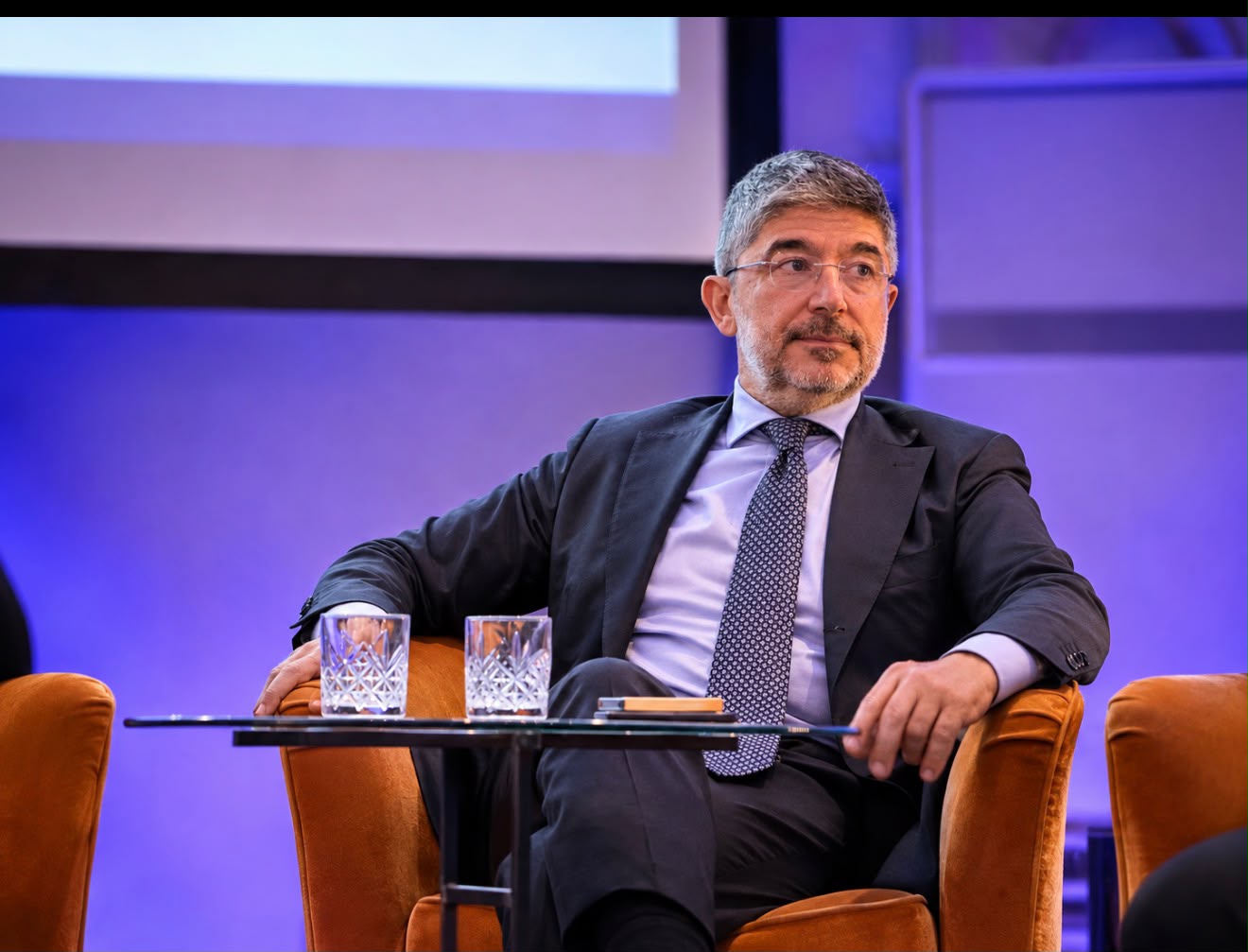
At the beginning of the 2000s, when he worked at the Italian embassy in Santiago del Chile, Fabrizio Lobasso witnessed an episode that he would recall many years later. An Italian delegation had arrived to sign a memorandum of understanding, a document with which two parties formalize the will to collaborate. A more experienced diplomat, however, suggested that it proceed differently: first start some project, organize exchanges and verify that the collaboration worked. Only then, possibly, put everything in writing.
Lobasso recounted the episode on November 11, during his speech at the Virtus Global Awards in Naples, an event that brings together representatives of institutions, enterprises and professionals to discuss innovation, legality and responsibility. The basis of reasoning could be summarized as follows: how can one understand whether the work of an institution is producing something useful?
The diplomat knows well the operation of the Italian administrative machine. He joined the Farnesina in 1997, was consul in Athens, ambassador to Sudan and held several positions related to relations with sub-Saharan Africa. Since January 2026 he has been Deputy Director-General for Growth and Promotion of Exports, with functions of central director for the Italian System and Investments.
His post is part of the reorganization of the Ministry of Foreign Affairs which entered into force at the beginning of the year, which was commissioned by Minister Antonio Tajani to strengthen the role of diplomacy in Italian economic promotion. The reform has established a general direction dedicated to growth and exports, with the aim of making more coordinated the services offered to companies working, or intend to work, on international markets.
It is an activity that involves subjects with very different competences: the ICE Agency, which deals with commercial promotion and business assistance, for example through international trade fairs and partner research; SACE, which mainly intervenes in the management and coverage of risks related to commercial operations; and SIMEST, which offers financial instruments for internationalization. To these are added Cassa Depositi e Prestiti, Union Camere, the diplomatic-consolar network and the entrepreneurial associations.
The point, clearly, is to make these tools work together. An enterprise that wants to enter a foreign market may need to identify a distributor, obtain funding and assess the risks of a commercial transaction. The presence of several specialized bodies offers different support possibilities, but also requires effective coordination.
It is on this aspect that a part of Lobasso’s intervention has been concentrated. For the diplomat, the responsibility of those who represent the institutions also concerns the ability to build relationships that produce verifiable results. Organizing a meeting or signing an agreement can be useful, but does not say much about what will happen later.
Lobasso has linked this principle to his experience in African countries, where he has worked for several years. In relations with the local interlocutors, he explained, it is important to ask first of all how they intend to carry out a project, instead of arriving with an already defined solution. Economic conditions, needs and working methods can be different from those imagined by those who propose a collaboration.
The question also concerns Italian companies seeking to establish themselves abroad. In the United States, for example, the quality of a product can be a competitive advantage, but it does not solve the problems related to distribution, market characteristics and consumer habits alone. A company must identify the right interlocutors and adapt its strategy to the country in which it wants to operate.
This attention to cultural differences has long been accompanied by the work of Lobasso. In 2017 he contributed to the creation of an intercultural diplomacy chair at the University of International Studies in Rome (UNINT). The approach starts from the idea that knowledge of economic institutions and systems is not enough, if the ability to understand the people with whom you work is lacking.
During the Neapolitan meeting, Lobasso also faced the relationship between public and private. Businesses need institutions capable of accompanying them in international markets, while economic diplomacy must know the operational difficulties of companies to guide their interventions. The collaboration therefore requires both parties to provide information, skills and tools.
It is a principle that also appears in the Action Plan for Export in high-potential extra-European markets, presented by the Farnesina in March 2025. The plan plans to accompany companies in the different stages of internationalisation, from market analysis to search for business opportunities, to risk management and access to financial instruments.
Towards the conclusion of his intervention, Lobasso recalled the aristotelian phronesis, the practical wisdom that allows to evaluate a situation and choose how to act. This is linked to the anecdote told at the beginning: an agreement can be necessary to define the commitments between two parties, but its signature does not mean at all that something has already been produced from that same collaboration.
In short, for an administration that has one of its own tasks to promote international economic exchanges, the number of organised meetings or signed documents may not be enough to understand whether a diplomatic mission has been effective. On the other hand, it is necessary to see what projects have been launched, what enterprises have benefited from it and if the relations built have been followed.
L’articolo First the projects, then the agreements: the diplomacy according to Fabrizio Lobasso comes from IlNewyorkese.