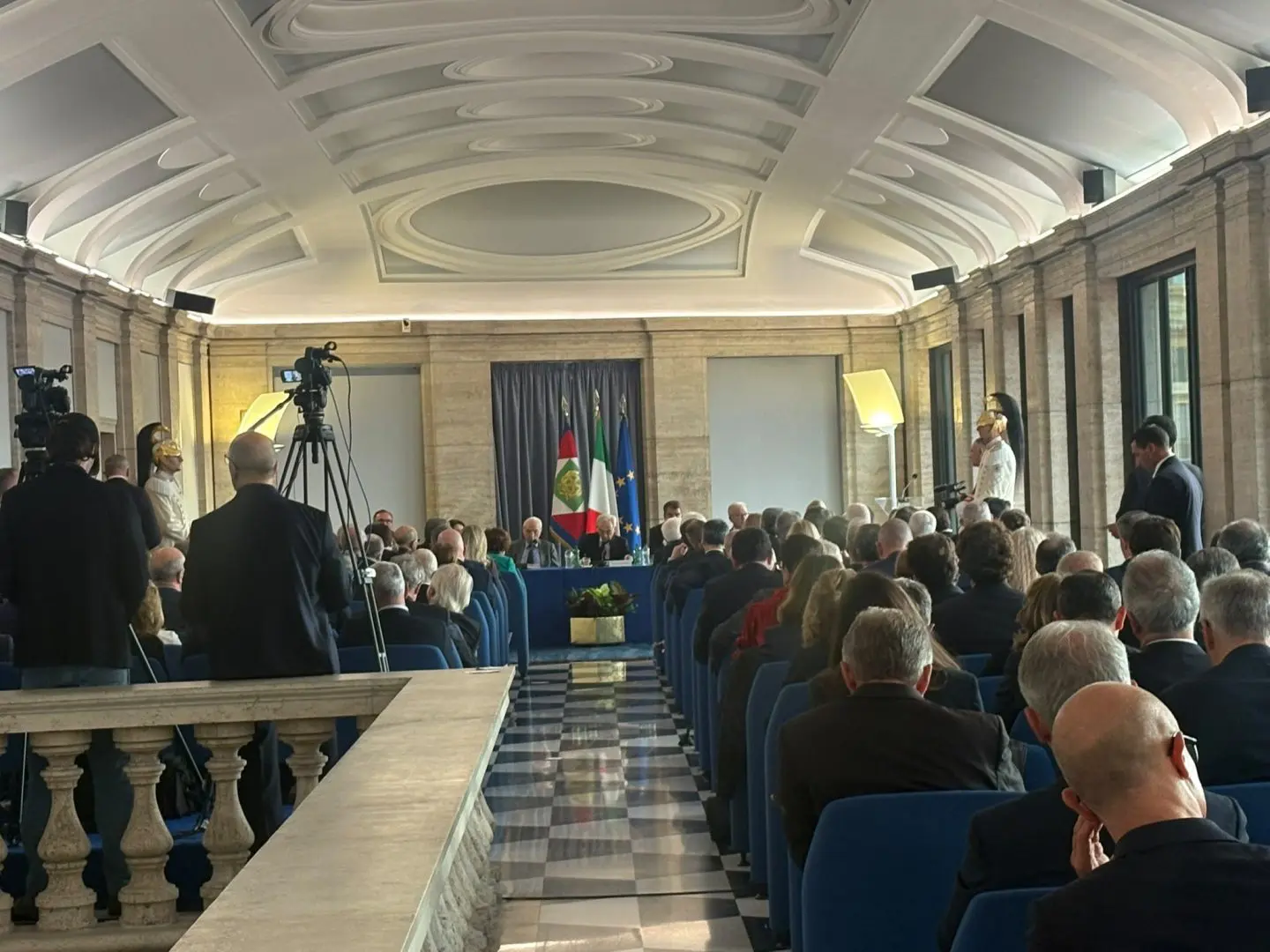
ROMA (ITALPRESS) – A liberal and democratic world order is in crisis and the international system based on multilateralism and the primacy of law is fading. An epochal change that is investing Europe called today to defend the principles around which it was built. But will Europe cope and adapt to this challenge? This is the guiding thread of the book by Giovanni Pitruzzella “Europe in transformation. Between geopolitical and democracy”, published by Mondadori and presented at the Consulta in the presence, among others, of the President of the Republic, Sergio Mattarella; of the President of the Constitutional Court, Giovanni Amoroso; of the President emeritus of the Constitutional Court, Giuliano Amato; of the Executive Vice-President of the European Commission, Raffaele Fitto; of the Undersecretary to the Presidency of the Council, Alfredo Mantovano.
“Europe is changing, it has lived a process of transformation assuming a geopolitical role, dealing with Trump’s duties, intervening to protect the energy market and has already intervened in the past to fight Covid. Europe has grown, its democratic legitimacy has to be increased, it has to do more in the essential fields: defence and competitiveness, but it must do less in other fields, leaving room for national democracies and must ensure a connection between its institutions and national ones. The method used for the Pnrr”, says Giovanni Pitruzzella, author of the book and judge of the Constitutional Court. “Europe must be closer to peoples, it cannot be the Europe of bureaucracies. The EU is necessary because in the face of current changes, only by aggregating states can ensure effective and efficient democracies, avoiding the democracy of impotence”, concludes Pitruzzella.
“‘Wake Europe’ is the beginning of Pitruzzella’s book. The analysis starts from a severe diagnosis, Europe faces an existential challenge and without a leap of productivity and innovation risks a slow and inexorable economic and geopolitical agony. Europe remained on the edge of the digital revolution and artificial intelligence. It is therefore necessary to simplify the rules, to lighten regulatory burdens, to complete the union of capital markets and to promote an integral European industrial policy for the areas of high technology,” says Giovanni Amoroso, President of the Constitutional Court.
The president emeritus of the Constitutional Court, Giuliano Amato, points out how in the book of Pitruzzella “we are subtracted from the beginning to that modus that I define ‘necrophile’ with which the growing literature on Europe deals with the difficulties in which they are found, both democracy and Europe, almost the resources to redeem themselves were not there. Ukraine would not exist if the EU had not supported it in these years, the financial means has put them Europe; the war of duties launched overseas is, in the breaking of alliances, the EU has made agreement with Mercosur and that with India. So, these are evidence of vitality you are giving, it is true that you lack something.”.
Raffaele Fitto, Executive Vice-President of the European Commission with delegation to the Coesion, notes that “this volume aims to open a public debate and I think that the complexity of the moment and the need to make the European debate public heritage go exactly in this dimension. From the point of view of the report of the actions put in place by the Commission, it seems to me to recognize both the strength and the results achieved. The only possible way to go “is an internal and external strengthening on the dual line of this recognition. We are in the middle of the debate on the future budget, but we have a budget of 2021-27 which must give answers and with a capacity for flexibility and adjustment we have come out of a rigidity to put in place a mechanism of flexibility. Another aspect” dealt with in the book “is the need for the role of cohesion policy to give answers to the territories and to face the serious demographic crisis”, concludes Fitto.
Alfredo Mantovano, undersecretary of the Council Presidency, points out that he “reasoned the author when he underlines the illusory character of a conception of European integration which denies differences. And he is still right when he says that at present there is no public sphere of its own European nature, since the practice and democratic sentiment live above all in the national dimension. They are in fact difficult to deny, although often neglected in the scientific debate – he concludes. If, in many countries of Europe, consensus is growing towards extremist movements, on the right and on the left, it is also the reflection of the insufficiency, unreasonable or opinable as you want, towards mechanisms that do not show particular efficiency and appear distant from daily needs.”.
IL VIDEO
-Photo xb1/Italpress-
(ITALPRESS).