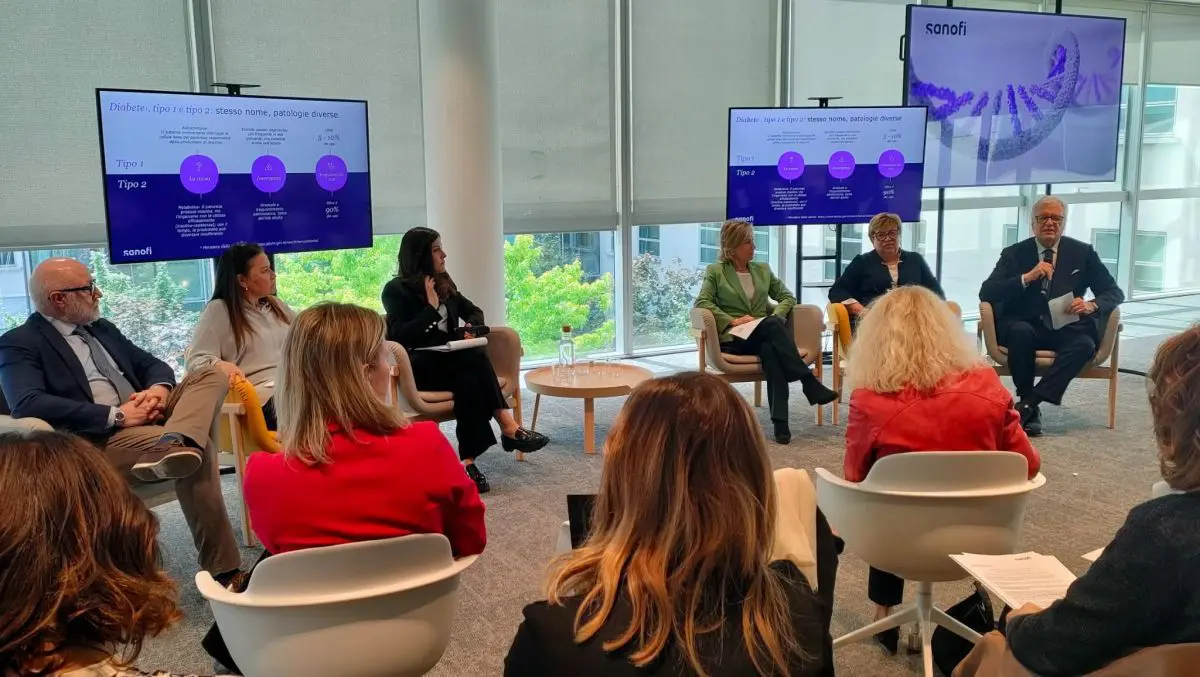
MILAN (ITALPRESS) – Type 1 diabetes continues to be one of the most known autoimmune chronic diseases, but only in appearance. In fact, if almost all Italians claim to have heard about it, the real understanding of the disease remains still fragile, partial and strongly conditioned by stereotypes and false myths. To offer us this photograph is the investigation “The knowledge of Italians about type 1 diabetes”, conducted by SWG for Sanofi, which has outlined a picture of perceptions often distant from the clinical reality. Only a little more than half of the Italians (53%) declares to feel really informed about diabetes, while just 1 person out of 10 manages to correctly distinguish type 1 diabetes from type 2.It is in this scenario that the comparison promoted during the event of Sanofi “Immunodiabethology: a new era for type 1 diabetes”, held at the headquarters of Sanofi Italia in Milan. They took part in the event: Professor Raffaella Buzzetti for the Italian Society of Diabetes (SID), Professor Salvatore De Cosmo for the Medici Diabetologi Association (AMD) and Professor Malgorzata Wasniewska for the Italian Society of Endocrinology and Pediatrica Diabetes (SIEDP), Fabiano Marra for Diabete Italy and Francesca Ulivi for the Italian Foundation Diabete (FID) One of the most critical aspects emerged during the comparison concerns the timing of diagnosis. Symptoms of type 1 diabetes – including intense thirst, increased urination, weight loss and marked fatigue – generally appear when the disease is already in an advanced stage, i.e. when insulin production is now compromised. This means that diagnosis often happens in emergency conditions, sometimes in the presence of acute complications such as diabetic ketoacidosis, a potentially dangerous condition that may require hospitalization and which may have fatal outcomes. To make the picture even more complex is the fact that a significant part of the population is not able to recognize these signals, helping to further delay the intervention. According to SWG data, in fact, 1 Italian out of 4 does not indicate any symptoms of type 1, diabetes while an additional 27% tends to confuse specific symptoms of pathology with unrelated manifestations. The theme of early diagnosis emerged as one of the central elements of comparison. The possibility of identifying the disease in the early stages, before the emergence of symptoms, today represents one of the main challenges but also one of the greatest opportunities for the scientific community. Intercepting type 1 diabetes in the predominate phase means being able to reduce the risk of sudden beginnings and acute complications, improving the life path of people and their families. And in this sense, in order to be able to intervene early, awareness plays a key role, especially with regard to risk factors for type 1 diabetes, which are mainly the following: having a first-degree family member, such as a parent, brother or sister or child with type 1 diabetes; having an autoimmune disease (e.g. celiac disease, autoimmune thyroiditis) or a family history of autoimmune diseases; having an altered glucose levels). Thus the comparison highlighted how type 1 diabetes is entering a new phase, not only from the scientific point of view, but also cultural. Overcoming false myths, improving the quality of information and promoting greater awareness are fundamental steps to accompany this change. The evolution of scientific knowledge, together with the development of early screening programmes and a greater ability to identify risk subjects, thus opens new perspectives tothe prevention and management of the disease. Among the most significant data emerges the weight of false myths still rooted in public opinion: 3 Italians out of 4 associate type 1 diabetes with pediatric age, feeding the idea of the so-called “diabetes of children”, although today it is known that the disease can rise at any age. At the same time, almost half of the population continues to believe that type 1 diabetes is related to incorrect, overweight or unhealthy lifestyles, thus confusing a complex autoimmune pathology with other forms of diabetes. The perception of the impact of pathology on everyday life is also strongly influenced by common places. Over half of the Italians believe that a person with type 1 diabetes can not eat sweets or consume alcohol, while almost 1 Italian on 4 question the possibility for a person suffering from diabetes to practice agonistic sports. At the same time, a significant part of the population tends instead to underestimate the necessary attentions for activities such as driving or facing air travel, a sign of still fragmentary and contradictory knowledge of the disease. Gilda Stivali, Medical Head General Medicines Sanofi, emphasizes: “We are facing a new era for type 1 diabetes that mainly passes from the progress of scientific research, but which needs a new way of interpreting and telling the disease. To do so, it is necessary to understand its immunological nature and work to increase awareness of risk factors and the importance of early diagnosis. Sanofi’s commitment is precisely in this direction: to contribute to the development of innovative therapeutic solutions that can change the path of the disease and effectively improve the life of the person. For Raffaella Buzzetti, President of the Italian Society of Diabetes (SID), ‘today we know that type 1 diabetes crosses several stages before clinically manifesting itself. This offers us the great opportunity to intervene before, when the disease is still silent. It is a profound change, which opens the way to new strategies of diagnosis and intervention, with a potential significant impact on the natural history of pathology. Salvatore De Cosmo, President of the Medici Diabetologi Association (AMD) states: “Deleting the difference between type 1 diabetes and type 2 diabetes is not a theoretical exercise, but a fundamental step to avoid errors of interpretation that may have consequences even on the clinical level. Type 1 diabetes is an autoimmune disease, with specific characteristics and well defined pathogenic mechanisms. Confondering it with other forms of diabetes means risking not recognizing it promptly. Malgorzata Wasniewska, President of the Italian Society of Endocrinology and Pediatric Diabetes (SIEDP), emphasizes that “among the alterations of glucidic metabolism, type 1 diabetes has a very high incidence in pediatric age but it can also manifest in adulthood, and represents a challenge for this population group. The beginning of the pathology, in fact, is still too often with diabetic ketoacidosis, a dangerous condition for life and which also represents a real trauma for children and their families Increasing awareness on pathology and symptoms is a fundamental step forward to help reduce as much as possible the critical failure of type 1′ diabetes.Fabiano Marra, President of Diabete Italy, states that «From the point of view This adds the weight of disinformationthat can generate sense of incomprehension and marginalization in communities. Improving awareness also means offering more concrete support to people living this condition and their families. Francesca Ulivi, Director General, Fondazione Italiana Diabete (FID), underlines: “For too long type 1 diabetes has been told only at the time of clinical onset, when the disease is manifested in an evident and often traumatic way for people and families. Today, however, we know that there is a previous, silent but identifiable phase, in which it is possible to intercept the pathology before the appearance of symptoms. This profoundly changes the perspective of people living with type 1 diabetes and their families, because it means being able to face the path with greater awareness, preparation and support. Talking about early diagnosis and screening does not only mean doing clinical prevention, but also reduce the psychological and emotional impact of a sudden emergence and foster a better quality of life in the long term. -photo f03/Italpress-(ITALPRESS).