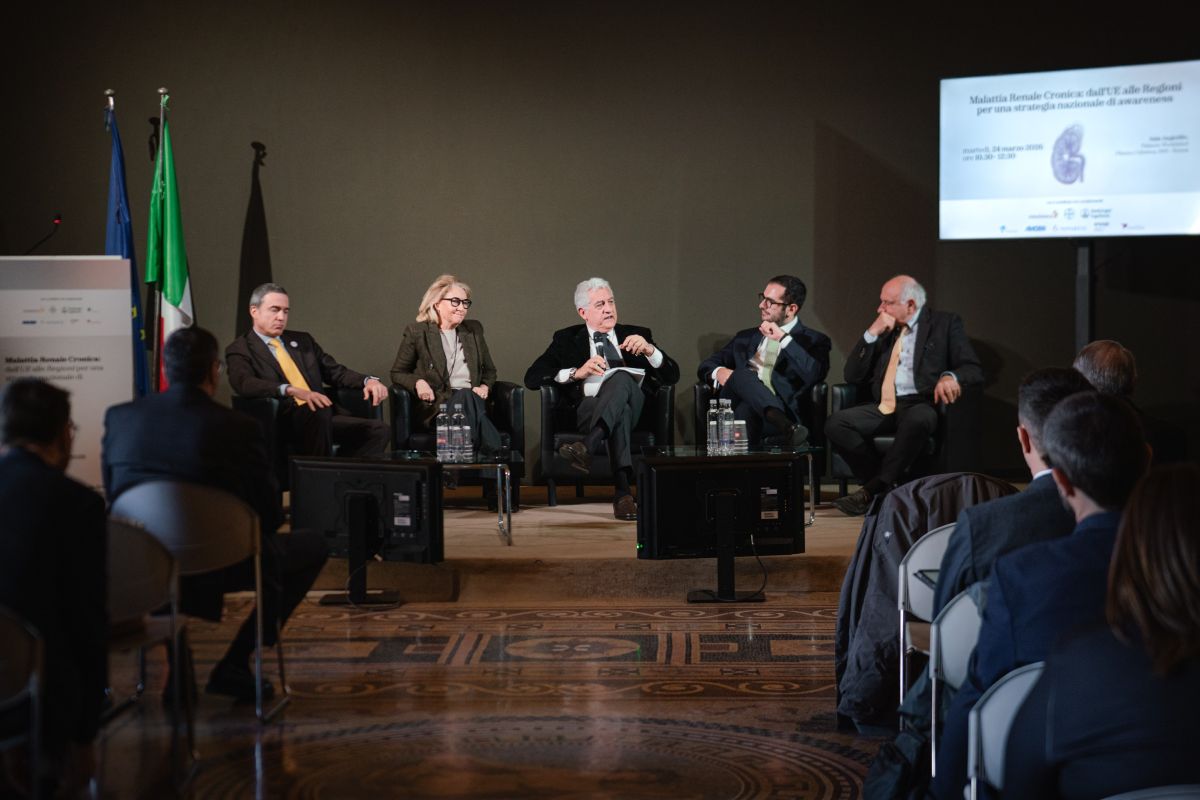
ROMA (ITALPRESS) – Strengthening early diagnosis, enhancing the role of territorial medicine and ensuring full implementation of taking paths today are the main priorities to effectively address chronic kidney disease (MRC), one of the most important challenges for public health. These themes at the centre of the institutional event promoted today in Rome, which brought together institutions, clinical experts and patient associations, with the aim of promoting a structured comparison on prevention, organization of regional services and sustainability of the healthcare system. In the course of the work, realized with the non-conditional contribution of AstraZeneca Italy, Bayer Italy, Boehringer Ingelheim, Otsuka Pharmaceuticals Italy, Novartis Italy, Amgen Italy, Dr. Schàr and Astellas Pharma, has clearly emerged the need to strengthen prevention policies and to intervene more quickly in the initial stages of the pathology. In this sense, Elena Murelli, Member of the 10th Commission of the Senate of the Republic, stressed that “the chronic kidney disease today represents one of the main challenges of public health, its wide spread and significant impact on the quality of life of patients and the sustainability of the National Health Service”. Hence the need to “strengthen the prevention policies on the territory and promote greater attention to risk factors, within an integrated approach”, enhancing in particular the role of the general medical doctor and the link with specialist. A specific focus was devoted to the regional context and the need to overcome a model still too centered on the individual hospital. In this perspective, Antonello Aurigemma, President of the Regional Council of Lazio, highlighted how “it is necessary to build policies that really adhere to the needs of the territory”, stressing that a significant share of access to the first aid concerns chronic patients who do not find adequate answers on the territory. “For this reason,” he said, “it is essential to invest structurally in territorial medicine and on the role of doctors of general medicine, strengthening the organization of the network and the taking paths”. The PPDTA represents, in this framework, a central tool to give order to welfare paths, while “prevention must be considered a long-term strategic investment”. The Lazio Region is therefore committed to supporting its implementation also through progressive models starting from individual ASLs. On the clinical-organizational level, the key role of integration between territory and specialist has been reaffirmed. Professor Luca De Nicola, President of the Italian Society of Nefrologia SIN, recalled the change of paradigm in place: “the management of pathology is now part of a model that sees the territory increasingly central, even in the light of the opportunities offered by the new therapies. However, the asymptomatic nature of the disease in the early stages makes early interception fundamental by general medicine. In this context, the PPDTA represents a fundamental tool to structure the grip and co-management of the chronic patient, and it is therefore essential that it be transposed and implemented in a homogeneous way by all regions, in order to ensure fairness and appropriateness in the treatment paths, in continuity with the work of comparison and the interlocutions started at a territorial level, in particular in the regions Lazio and Emilia-Romagna. In support of this model, pilot screening data were presented, the result of the collaboration between general medical doctors and SIN, conducted in the Metropolitan City of Naples, which confirm the potential of general medicine in early identification of pathology.” As highlightedfrom Gaetano Piccinocchi, National Treasurer Society of Doctors of General Medicine and Primary Care “on a population of more than 212,000 assisted were identified about 66,900 patients at risk, but less than half had complete clinical data”, demonstrating a wide margin of improvement in early diagnosis. The project, which involved 167 general medical doctors, is based on an integrated training model, operational tools and data monitoring. “The first results indicate that investing in the formation and organization of the territory is a concrete lever to reduce the progression of the disease and improve the takeover.” The meeting therefore confirmed the need for a shared commitment to strengthen prevention, integration between territory and specialist and taking care of patients with MRC. The comparison is the basis for the next operational developments at national and regional level. -photo press office Esperia Advocacy –(ITALPRESS).