Christmas morning in Capriana does not look like the Christmas morning of any other place I know. There is no nervous traffic of big cities, there is no vaguely theatrical air of solemn celebrations. On the other hand, there is a net silence, montano, quasi ostinato. It is in this silence that I entered the church of St. Bartholomew, knowing that I would have witnessed something that, in one way or another, would have asked to be told.
I wasn’t there either by duty or by commission, but by a form of fidelity difficult to explain: faithful to a story that has been accompanying me for years, that of Mary Sunday Lazzeri, the so-called Meneghina of Capriana. Two days before he calls me Giulio Picolli, my friend of New York, and tells me that, not even he knows the reason, but Monsignor Hilary Franco would celebrate Mass precisely in the village of the Valley of Fiemme that we two know very well now. I also knew she shouldn’t have been there. And already this was enough to introduce a sort of narrative tension, between what is expected and what really happens.
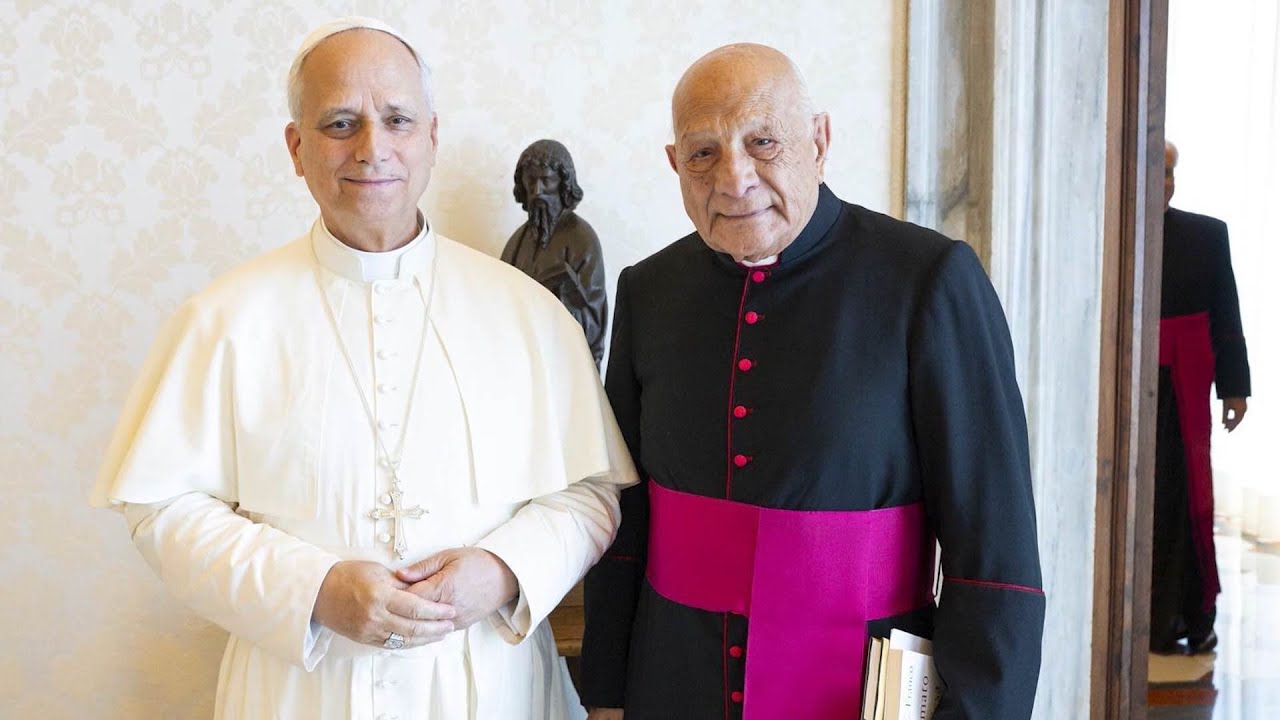
Monsignor Franco was born in the Bronx in 1933. It is one of those men whose words leave a mark in the heart of those who listen and already deserves a corner in the history of the Church of the twentieth century. Almost seventy years of priesthood, Rome, Washington, Moscow, New York. He served six popes, from John XXIII to Francis. Follower and curator of the work of the great Archbishop Fulton Sheen (1895-1979). He served as an advisor to the Permanent Mission of the Holy See to the United Nations. Power, diplomacy, faith tested in the places where faith seems to serve nothing. All this is true. All this is also written in his book “Six Popes: A Son of the Church Remembers”. But that morning, in front of the altar that guards the remains of a dead girl at twenty years in a village in Trentino, all this seemed suddenly secondary.
During the homily Monsignor Franco immediately said the phrase that immediately broke the ice, heating the souls: “I had no intention of being here today, but… Providence wanted me to be here.” It wasn’t an effect phrase. There was no fulfillment. There was a kind of surrender. As if he too, accustomed to reading the signs of the world, admits that some signs touch us. Like gifts, it’s hard not to accept them, is it?
Mons. Hilary spoke of Mary Sunday Lazzeri calling her several times “Virgin and Martyr”. He insisted on this last word, repeating it almost as hammer: “Marty, martyr, martyr, martyr, because he suffered a lot in his life”. He did not speak of martyrdom as we imagine, blood, persecution, lacerated flesh. He spoke of a martyrdom that leaves no spectacular images, only a duration: years of immobility, of pain, of voluntary hunger that was not suicide but offered, according to the faith of those who looked at it and still looks at it.
But for those who did not know her yet, who is exactly this Maria Domenica Lazzeri? Born in Capriana in 1815. At eighteen years he gets sick. He’s not gonna be okay. He lives lying, consumes his body almost to disappear. Doctors, bishops, curious, skeptical. On his body, prodigious and inexplicable signs. He died in 1848, at 33. It’s buried here. Stay here. Pope Francis declared her venerable in 2023. The beatification process is underway. But beyond the procedures, what remains is a question that does not stop disturbing: what sense does a life like this?
Monsignor Franco gave an answer that he did not claim to be definitive. She said Mary Sunday gave her life. That it was a gift of the Lord for her, but also for all of us. That we must not forget the sign he gave us. And above all he spoke of suffering, not as a value in himself, but as a possibility: the possibility of joining Christ, of transforming it into something that saves, which opens, that does not close itself.
While listening, I thought how easy it is to talk about suffering when it’s not yours. And how difficult it is to do it without falling into rhetoric. And yet, at that moment, I didn’t feel like I was manipulated. I had the feeling that someone was risking a word, knowing that it could seem unacceptable.
There was also Giulio in the church. He is an Italian-American entrepreneur, resident in New Jersey. A man who, until a few years ago, would never have imagined to be there, or at least to bind his life to that of an unknown 19th century mystique.
In 2020 he arrives at Capriana almost by chance. Or so he says. For ten years he has lived with a disease that finds no solution. After that visit, the disease begins to regress. Doctors can’t explain. He does not demand explanations. He decides to remain faithful to what happened.
Since then Giulio Picolli has become one of the main promoters of devotion to Meneghina in the United States. Founds the Amici della Meneghina USA Association. Patrocina and promotes the first biography in English of Maria Domenica Lazzeri, “The Gift. Life and wonders of Maria Domenica Lazzeri”, which I published for editions of the lighthouse, last April. It is my second book on this figure, after “The maintenance of the universe” of 2020. I wrote them not to convince, but to tell. Why telling is often the only honest way to approach a mystery.
At the end of the Mass, Giulio took the word. He was visibly moved. He thanked everyone. Thanked Monsignor Franco. He thanked the Venerable. He expressed the hope that he could soon reach the beatification. He didn’t speak as a leader, he didn’t speak as a benefactor. He spoke like a man who feels debited.
Coming out of the church, I thought that this year Christmas, in Capriana, has nothing to reassuring for me. It does not console the world as it is. He puts it in front of a radical question: What do we do with pain, ours and others? Monsignor Franco had also spoken of this, of the wounded world, of wars, of peace announced by angels. He quoted the motto chosen by Pope Leo XIV – who received it on July 3rd – “In Illo unum”. Unity as responsibility, not as a slogan.
I don’t know when Mary Sunday Lazzeri will be beatified. I don’t know if the words spoken that morning will follow. But I know that that morning I was there, and that something maybe happened. And as often happens, I can’t say exactly what. But I know it would have been a mistake not to tell.
L’articolo Christmas in Capriana proviene da IlNewyorkese.