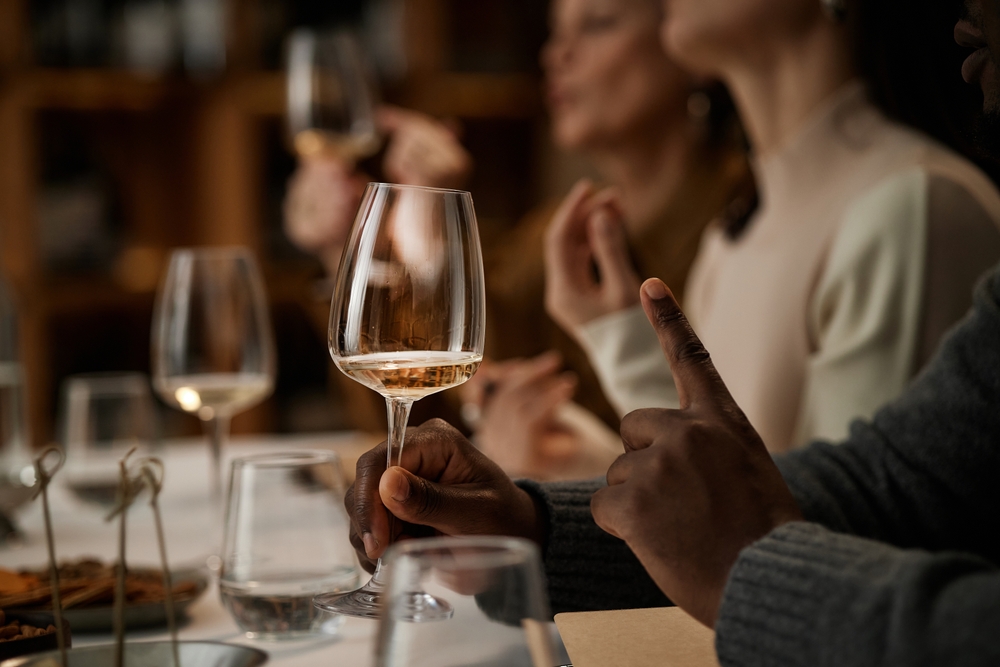
It is a very New York scene, although no one finds it particularly unusual. An equipped table, a full restaurant, the buzz of the room. A client enters with a bottle of wine under his arm. He doesn’t hide it. He doesn’t justify it. The laying on the table with the same naturalness with which the keys or the phone would be affixed.
The waiter’s got her, he’s watching her for a second, then he’s coming back with the glasses. The corkscrew makes his little metal snap. The bottle opens. Dinner can begin. In the United States this gesture has even a name: BYOB, Bring Your Own Bottle or, in the most informal version, Bring Your Own Booze. It is a practice widespread in American catering and tells a lot about the pragmatic way with which the country has built its relationship with wine.
At first glance it might seem like an eccentric habit, or perhaps an expedient to avoid embroidery of wine cards. In fact, its origins are much more practical. In many American states getting a license to sell alcohol is complex, expensive or limited in the number. In cities like New York or Philadelphia these licenses can become rare goods, often out of reach for smaller or just open restaurants.
The solution that many find is surprisingly simple: do not sell alcohol. But that doesn’t mean giving up wine, it means letting customers take it. Thus the BYOB was born: first as an administrative solution, then as a small gastronomic tradition.
Of course, the restaurant is not completely outside the bottle. When you bring your own wine it is common to pay a corkage fee, a fee covering the service: the glasses, the opening of the bottle, sometimes the bucket of ice. In more informal premises it can be a modest figure; in more structured restaurants it can become a rather visible voice in the account. It is a sort of symbolic toll that maintains the balance between those who bring wine from home and those who choose from the restaurant card.
As often happens in the United States when talking about alcohol, however, the rules change a lot from state to state. In New Jersey the Bring Your Own Bottle is extremely popular and many licensed restaurants openly encourage customers to bring their own wine. In California the practice exists but is less central, because getting a license is generally easier and most restaurants already have a well-developed wine card. In New York BYOB is present but more regulated and often accompanied by quite substantial corkage fees.
These differences are the result of a legislative system which, after the end of prohibition, left the individual states great autonomy in alcohol regulation. The result is a complex normative mosaic that still today influences even the way you drink a bottle at dinner.
Over time, BYOB has also taken on another dimension. For many wine lovers it has become a small ritual. You arrive at the restaurant with a special bottle: an old vintage, a rare label, something that would hardly appear on a wine card. Some locals have become points of reference precisely for this reason: interesting kitchens accompanied by the freedom to bring their own wine. In these cases, dinner almost takes the form of a collaboration. The restaurant offers food, service and atmosphere; the customer contributes with the bottle.
For those coming from Italy all this may seem slightly dissonant. In the Italian context bringing wine to the restaurant is still perceived as an ambiguous gesture, almost a small violation of the unwritten galaxy of catering. It is not necessarily forbidden, but culturally remains rare. The wine card, in Italy, is an integral part of the identity of the restaurant and often the result of an accurate selection.
In the United States the relationship with wine tends to be more elastic. BYOB is not always interpreted as a loss of control over the gastronomic experience, but as a form of flexibility that can make the table more informal and participated. So it can happen that a bottle crosses the city into someone’s purse, goes on a metro, steps from a restaurant kitchen and finally arrives on a table among friends…A small urban journey.
Because in America, sometimes, the best bottle is not the one in the wine paper but the one that comes with the customer.
Next time!
L’articolo Bring Your Own Bottle: the most American of table habits proviene da IlNewyorkese.