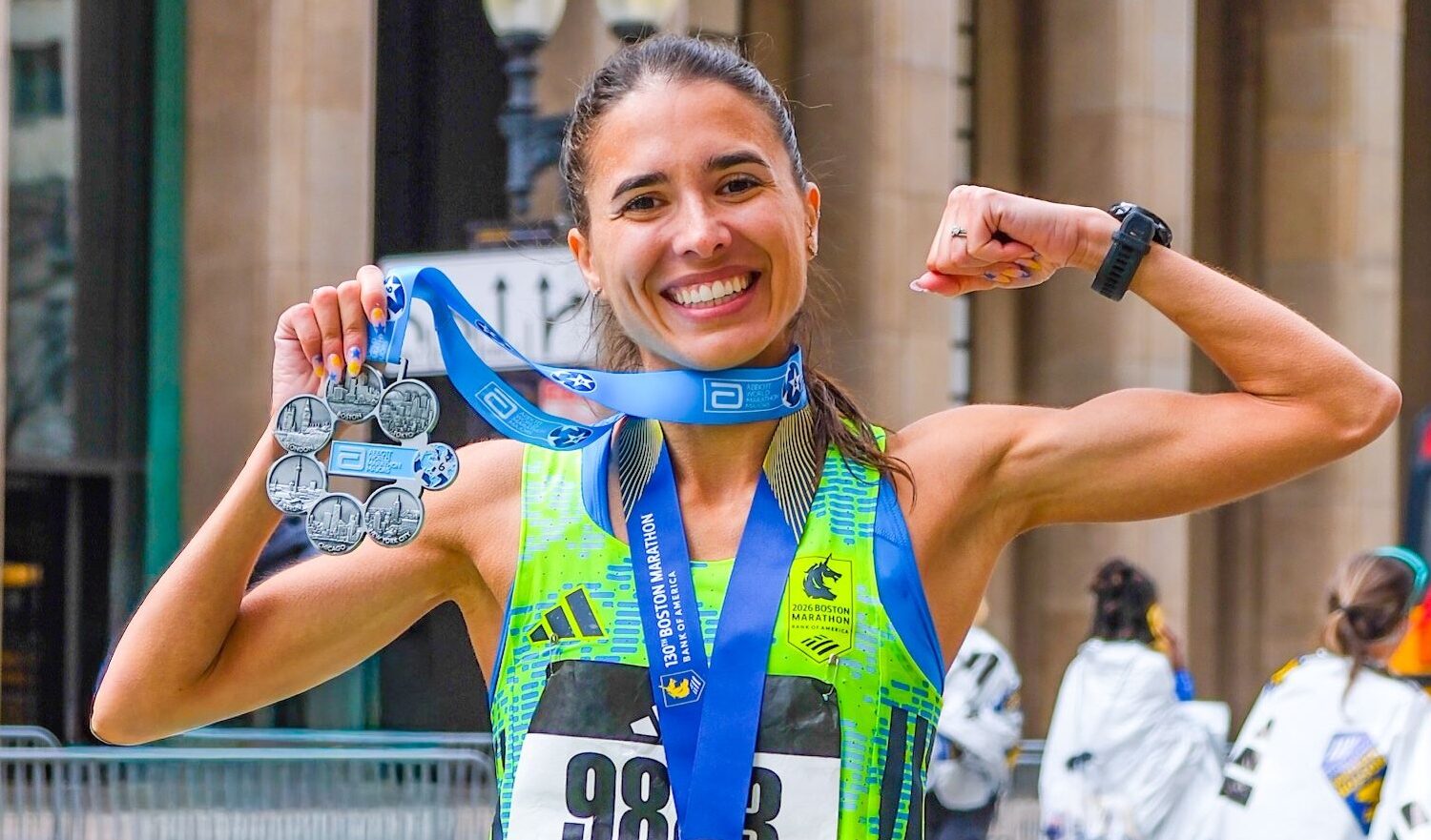
In the calendar of international running, the Boston Marathon remains a distinct step: for history, for selection, for technical characteristics of the track. This is where Lisa Migliorini, The Fashion Jogger, completed the Abbott World Marathon Majors circuit, closing a path built through very different contexts, from Tokyo to New York, requiring adaptation, management and continuity. At the end of his test in Boston, we met Lisa Migliorini to do the point on this goal and on the path that made it possible, between experience in race, personal evolution and the increasingly central role of the race also in the public dimension.
Let’s start with the end: Boston was your sixth Major. What does it mean to you to have closed this path?
Boston as Sixth Major has a strong symbolic value: it closes a circle that requires years of constancy, planning and even mental resilience. It’s not just an extra medal, but confirmation of having built something over time, step by step. It is a path that grows, after each race you are no longer the runner you were leaving.
If you look at all six marathons together, do you live it more like a point of arrival or how to start a new phase?
More than a point of arrival, I live it as a great goal that motivates me even more towards new projects. I will continue to run marathon and I will certainly use the same races, but having already run them allows me to face them in a different mode: with more awareness, without pressure and working on the difficulties of each.
Boston is often considered a selective race: how much do they really affect the route and conditions in running the race?
Boston’s path and conditions affect a lot. It’s a race that doesn’t “regala” anything: go on going up, the stretch of Heartbreak Hill, and often unpredictable weather. It serves intelligent effort management, more than chasing a rigid rhythm.
Among the six Majors, what technical and mental differences have the greatest adaptations required?
Each Major required different adjustments. New York and Boston are more technical and muscle, Berlin is faster and mental in rhythm management, Chicago is regular but can test on climate. Tokyo and London also require great logistic and mental management skills in very different contexts. Surely, as a European, jet lag is to be taken into account and plays a key role both in travel planning and in the performance of the race.
In a project built over time, how much does the planning count regarding the ability to adapt race after race?
Planning is crucial because it gives you a structure, but the ability to adapt is what really makes the difference. Training, physical conditions, weather, unexpected, jet lag: who can read and change the plan in the race has a huge advantage. In any case, the important thing for a lover is to have fun and enjoy every step of the race, because it is an incredible experience and running you explore the whole world. For this reason it is important to control the controllable, but to accept the unforeseen and to leave serenely.
Is there a marathon, between six, that you consider more formative in your path? Why?
All marathons taught me something, but the most formative ones were New York (my first marathon) and Boston (the last one). New York taught me not to leave too strong and that the race arrives after 30th km. It was my first enthusiasm I went too strong, then after the 30th km I paid it. Boston instead taught me to distribute well the effort to avoid bad experiences after the 35th km.
Your sports journey is intertwined with a consolidated digital presence: when did you realize that the race could also become a public language?
I realized the race could become a public language since the birth of The Fashion Jogger. From the very beginning I saw that personal experiences, training, difficulty, progress, races and advice also sounded in others and it was an immense joy. I daily plead my great community of runners, and they motivate me.
How has the way to tell the race on social media changed over time?
The story of the social race changed a lot: at first when I started The Fashion Jogger there were no videos (Reels) but photos, so the essence of the race was a little more trapped, instead with the introduction of the Reels I found the perfect way to tell the race in all its facets. I have always been original and transparent with my community. I share all my workouts and my races and this gives a lot of confidence.
What kind of responsibility do you feel in speaking to a broad community, especially to those who approach sport for the first time?
Responsibility is real, especially towards those who begin. I try to convey a sustainable race idea, far from the extremes, where progress is gradual and listening to your body is central. The important thing is to love what you do and go step by step. Constancy is the key and results come.
Looking forward: after the Six Majors, what will be the next goals and what do you think will be the evolution of the race?
After the Six Majors, the goals can be different: improving time, exploring different distances, or working on more personal and narrative projects. The evolution of the race, for me, will play more and more on the balance between performance and meaning.
The article Boston closes the circle: Lisa Migliorini, <i>The Fashion Jogger</i>, completes the <i>Six Majors</i> proviene da IlNewyorkese.