There is a vertical New York that defies the sky with glass and steel, a scaffolding of ambitions and metal that seems never to have an end, and then there is an inner New York, secret and shadow, which hides behind heavy portals of oak and bronze. For the traveler who has grinned kilometers between the strident sirens of Midtown, the multifaceted voice of the sidewalks and the sharp wind blowing along the High Line walks, entry into a place of worship is not only an act of faith or cultural visit: it is first of all an indispensable act of sensorial survival. It is the stubborn research of that “zero grade” of noise that only the ancient stone, the shadow of the aisles and the soft aroma of the incense still know how to guarantee in the heart of global hyper-capitalism.
Entering a church in Manhattan, especially during the summer months in which the asphalt boils of dense heat or during the peaks of autumn frenzy, means crossing an invisible border and being welcomed by a quiet suddenly fresh. It is not only a trivial question of atmospheric temperature, guaranteed by thick granite walls or modern air conditioning systems, but a real variation in air density. The neurotic sound of the clacsons, the roar of the MTA bus engines and the distant echo of the police patrols turn into an indistinguishable buzz, fade progressively beyond the surface of the stained glass, leaving room only to the cadenzato beat of your heart, to the light breath of the ventilation ducts or to the isolated smooth of a page turned at the bottom of the transept.
It is not at all necessary to be believers to feel the immediate benefit of this deep disconnection. The silence that you breathe within a New York cathedral is an authentic architecture of the spirit: an invisible but solid structure that forces you to regret your daily concerns and to suddenly expand the perception of time. It is the forced and healthy meditation of those who, even for twenty minutes scarce, decides not to be a consumer ready to crawl the credit card or a hungry tourist looking for the yet another shot to hand over to social networks, but simply chooses to become a guest of silence.
In a metropolis dominated by the categorical imperative of performance, where each intersection requires visual attention and each block proposes a commercial stimulus, these sacred buildings function as unexpected urban decongestants. Along the hectic artery of Fifth Avenue, while the human tide flows continuously between high fashion windows and perennial yards, the neo-Gothic mole of Saint Patrick stands not only as a historical landmark, but as an immense decompression chamber. It is enough to push the doors to pass, within three steps, from the exact center of world noise to a solemn pen shadow, where time seems to have stopped in the nineteenth century. One hundred meters further south, the Episcopal Cathedral of Saint Thomas offers the same miracle: vaulted ceilings that open the gaze upwards and a filtered light that transfigures the perception of space.
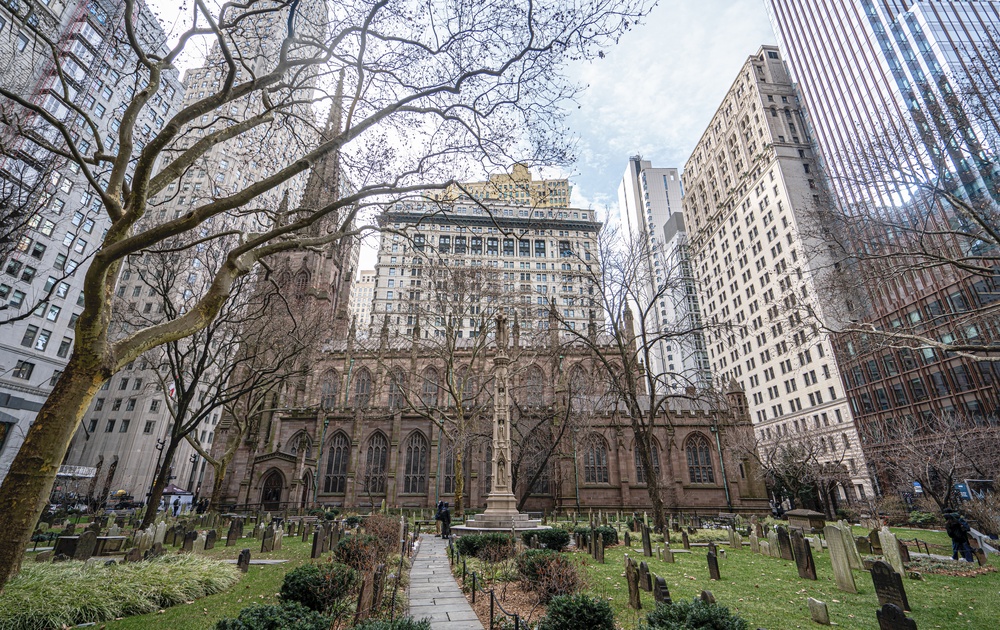
Moving towards lower Manhattan, among the crystal towers of the Financial District where money moves to the speed of optical fiber, Trinity Church appears almost as a living anachronism. Surrounded by the finance giants and the indelible memory of Ground Zero, the church with its small historic cemetery offers an acoustic suspension oasis. In there, the anxiety of the stock market dissolves in the face of the fixedness of the stone and the memory of the long time. It is a practical demonstration of how the city has maintained, in its oldest folds, bags of spiritual resistance capable of surviving construction speculation and the pace of modernity.
The “respectful performer” quickly understands that these are not only covered museums or simple attractions to pounce on a pocket guide, but living spaces, inhabited by an invisible community of people looking for breath. Turning off the phone before crossing the threshold is not only a form of education or a rule to be respected in order not to disturb those who pray: it is first of all a gesture of personal liberation. It means to record for an instant the umbilical cord that binds us to notifications, work e-mails and the incessant flow of information that also follows us on holiday. Closing in church in New York means giving yourself a legitimate truce, a moment of grace not programmed within a tight itinerary.
Sit on a wood bench, with a straight back and a look upward, allows you to observe the light that filters from the colored glass and to grasp a fundamental detail: the true power of New York is not only in what screams, exhibits and illuminates with the neon of Times Square, but resides with equal strength in what knows how to silence. The city can be majestic in chaos, but it becomes infinitely deeper when it offers the net contrast of its quiet. It is in that shadow that one realizes how the metropolis is not a monolith of asphalt, but a complex organism made of continuous full and empty, of sound peaks and sudden dizziness of silence.
Even the interior architecture of these places plays a decisive role in the transformation of urban experience. The space of the aisles, the verticality of the columns that push the eye to detach from the horizontality of the road, the smell of wax and ancient wood create a net discontinuity with the outside. If outside the city develops for rigid grids and commercial directors, within the church geometry meets criteria of harmony and recollection. It is a contrast that acts on the body before even that on the mind: the shoulders relax, the step slows down, the heart rate adapts to the calm pace of the environment.
In a metropolis that constantly asks you to be “connected”, performing, responsive and fast, the sudden break on a church counter is configured as the last true act of contemporary rebellion. It is a choice of civil disobedience at the rhythm of the city that never sleeps. It means reappropriating one’s own breath and inner dimension, taking the luxury of doing nothing, not producing, not consuming and not photographing. It is a time suspended, a necessary parentheses waiting to return outside, in the great and inevitable ocean of Manhattan noise, a little more centered, a little fresher and with the certainty that, under the noise of the world, there is always a place able to guard silence.
L’articolo Between granite and incense, the New York refuge from chaos comes from IlNewyorkese.