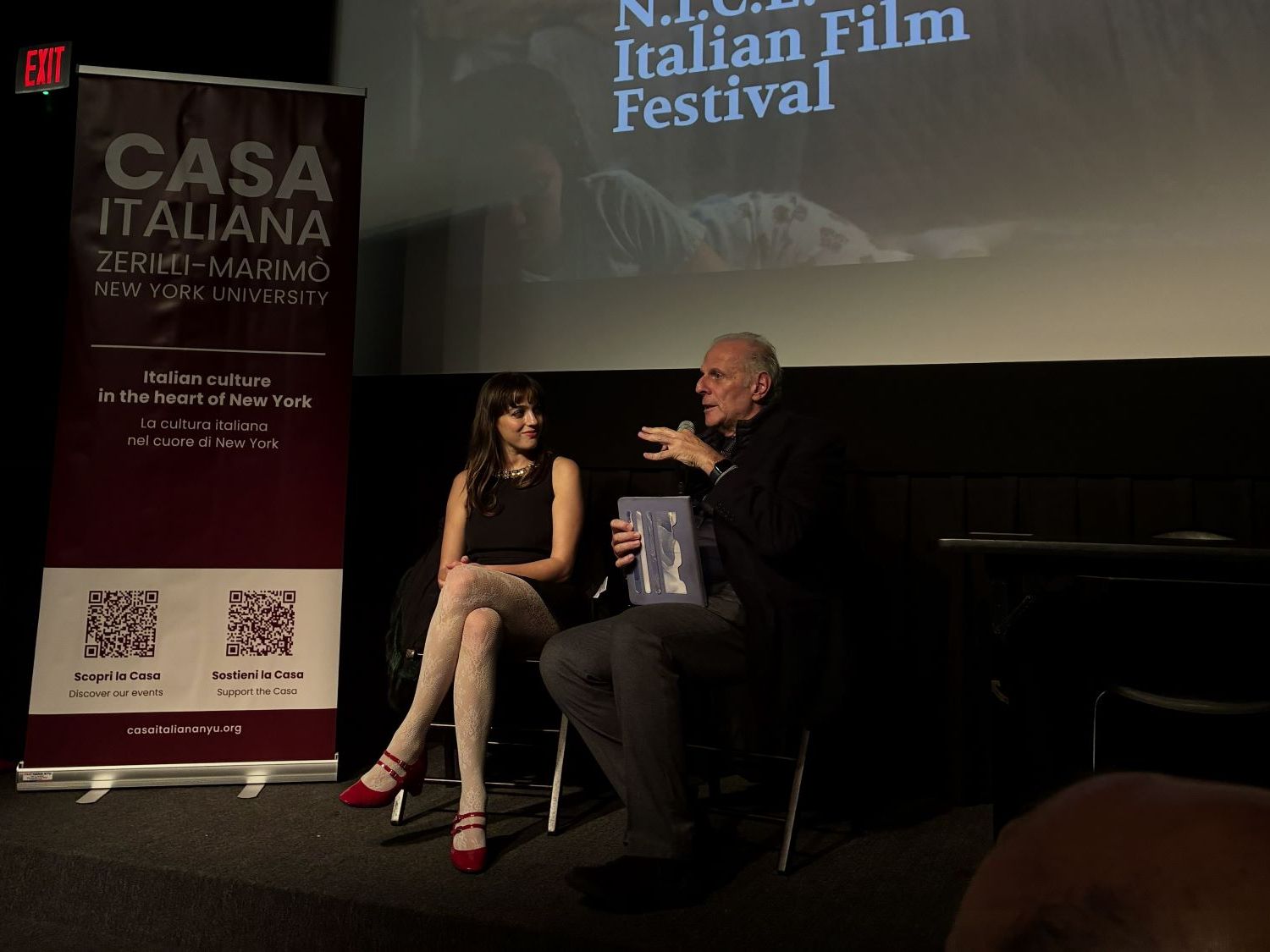
Beatrice Grannò, for the American public Mia of the second season of The White Lotus, is in New York to present Anna: The Untold Story, the film written and directed by Monica Guerritore. On Monday, November 16th we met her from Piadi by La Piadineria, during the Meet & Greet organized by Casa Italiana Zerilli-Marimò of New York University.
Then we went to the Cantor Film Center for the screening of the film, within the 36th American edition of N.I.C.E. (New Italian Cinema Events), followed by a conversation with the actress and the questions of the public, led by Stefano Albertini, director of Casa Italiana Zerilli-Marimò.
N.I.C.E. promotes Italian cinema in the United States and gives space to emerging directors and new voices, with free projections and meetings with guests in cinemas, cultural institutions and universities of different states. This year the focus is on women in the cinema, in front and behind the camera: from the rediscovery of Elvira Notari, pioneer of Italian cinema, to Anna Magnani, told in the film of Guerritore, up to the contemporary look of Carolina Cavalli with The Rapture of Arabella. Mila Tenaglia, creative producer and since 2018 executive director of N.I.C.E. in the United States, which selects the films to be presented to the American public and takes care of the relationships with partner institutions and universities: “My work is to create opportunities for encounter and dialogue between Italian cinema and the American public”.
Anna Magnani, born in Rome in 1908 and disappeared in 1973, was one of the greatest actresses of Italian cinema: from Rome open city of Rossellini to the Oscar as best actress for The tattooed rose, the first won by an Italian interpreter, left an artistic legacy that still inspires cinema.
The film, directed by Monica Guerritore, who also plays Anna Magnani, tells the evening of 21 March 1956, when the actress waits in Rome for the call from Los Angeles on the Oscar. Grannò is the young Carol Levi, who will become the agent of Magnani. With her we talked about the set, the relationship with Guerritore, the path between Italian cinema and international productions and the importance of appointments like N.I.C.E.
In the film you play Carol Levi as a young man, the girl who will become the agent of Anna Magnani. How did you build a character who looks at the Magnani closely but remains a little behind the scenes? And what made you compare to such a central figure of Italian cinema?
To me working on this film was also a way to stand next to a figure that has always inspired me. I’ve been following Monica Guerritore’s work for a long time: she is an amazing actress and an incredible person. In a way, as an actress I was a little behind the scenes, like Carol Levi, a young agent who at some point finds himself dealing with a great actress. That’s why it wasn’t too hard to get me into his shoes.
With Monica we already had a relationship: I was a little girl, she was the established actress, but she never made me feel less, and I really enjoyed it. Often a successful actress tends to close herself in her world, she has always been attentive to everyone. It was also fun to find me on the other side: for once I was not the actress but the agent, and I wondered what it means to do that job. But I think the agents of those years are no longer those of today. There are very good ones, but the way of working with the actors has changed: there is no longer the agent who does everything, alone, to push his actress, the world is much broader.
Monica Guerritore wrote and directed the film and is also the protagonist. How was it working with a director who was on stage next to you? Is there a moment on the set you remember in a particular way?
A big mess, positively. We were walking around Rome, we looked like a bunch of crazy people, and it gave me the feeling of making movies a little like Fellini did, even if I didn’t live it: take, turn, come you, do this thing. There was a very theatrical energy, and it was beautiful.
Monica was a director and everything, she was always taken by a thousand things, but she never lost her fighting spirit, like Anna. When maybe they told her that maybe she didn’t make it, that maybe it was too much, that maybe she couldn’t do it as she wanted, she always struggled. It was a great inspiration for me. Behind the camera were people we trusted, and this allowed us to work with serenity even when Monica was on stage.
The moment I remember most was not on the set, but the day of the audition. She invited me to her house. Intercom, she opens without telling me the plan, but the door was wide open and I already heard her full voice talking about the project. I enter and find it in the kitchen with the help director, already to plan the film. I was there for an audition, but he told me to sit down and I witnessed for a moment the kind of madness that was the preparation. Then he gave me the jokes and we tried.
At that time I was looking for a project that came from a place of purity, passion, and I couldn’t find it. There I realized that for Monica this film came from a place of deep truth, and I thought that thing I wanted to do. Usually the auditions are very formal, there is a director or a casting director, there is the camera. Getting into a room and finding myself a little as in the theater has excited me a lot.
After The White Lotus comes a film in English, Daniela Forever, with Henry Golding. The American audience knows you more and more: how do you see this path between Italian cinema and international productions, and what do you bring with you from Italy when you work here?
I studied acting in London, so the desire to space, to leave Italy, has always been there. It would be a dream to be able to work internationally while remaining Italian, like so many French actresses who move in productions even outside their country. I was very lucky: The White Lotus gave me access to this world. In this last period, many things have happened and I am very excited, because I am building a path between Italy and abroad.
I think European cinema is taking more and more space: there was Sentimental Value, which was very successful. There was a moment when I thought I wanted to stop in America and do American things. In reality a part of me recognizes the value of Italian and European projects, and this is what I want to maintain. Then let’s see what happens.
You’re a guest of the N.I.C.E. Film Festival, which has been promoting Italian cinema in the United States for 36 years, also thanks to the historic collaboration with Casa Italiana Zerilli-Marimò. How important are initiatives like this to make our cinema and culture known to the American public, and what do you hope that viewers will bring home?
We Italians have a history of secular cinema and it is important that we keep this pace. I have many American friends who are inspired by Fellini’s films or Italian actors and actresses. We had a very high moment, they looked at us from all over the world. Now it is more difficult, because the amount of things that circulate has increased. But I believe very much in Italian cinema: there are new authors who are emerging and I think it is very important to keep this reality alive, because we do not know what can happen. Maybe in two or three years Italy returns to represent cinema in the world, and at that point having a reality like this will be fundamental.
But it’s fundamental now. I am excited that the festival and Casa Italiana continue to bring Italian cinema to the American audience, and I am happy to be here.
L’articolo Beatrice Grannò tells the set of Anna and the dream of working between Italy and international cinema proviene da IlNewyorkese.