ROMA (ITALPRESS) – Artificial intelligence can help make the National Health Service more efficient, recovering valuable time for professionals, improving performance management and enhancing available resources. But in order for technological potential to be translated into concrete benefits for patients, it is necessary to continue investing in the training of doctors and health professionals, in the reorganization of services and in the evaluation of results.
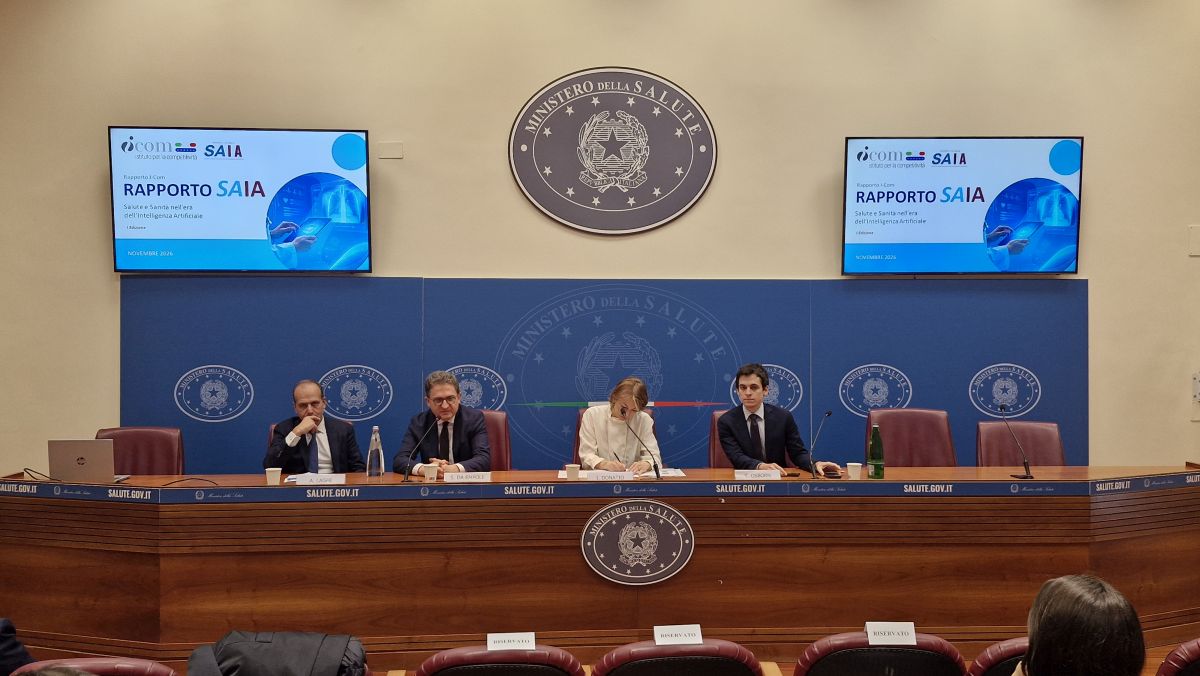
It is the photograph taken by the SA-IA Report – Health & Health in the age of Artificial Intelligence created by the Institute for Competitiveness, the think tank based in Rome and Brussels chaired by economist Stefano da Empoli. The study, at its first edition, analyses the impact of artificial intelligence on Italian health, from biomedical research to clinical practice, from organizational efficiency to the evolution of professions and also deepens the role of AI in pharmaceutical research, diagnostics and innovative therapies, as well as the conditions necessary to enhance health data, strengthen interoperability and ensure safety, reliability and equity in access to innovations. The research was presented in Rome at a public conference at the Ministry of Health attended by numerous speakers from academics, experts and representatives of the institutions, politics and the world of enterprises and was promoted with the non-conditional contribution of Agora Labs, Almaviva, Andra, Fora, Philips and with the media partnership of Italpress.
One of the most significant results of the Report is the economic and organizational benefits deriving from the automation of clinical documentation. According to the simulation elaborated by I-Com, the introduction of AI environment scribing systems in the Italian emergency room could generate an annual economic value of the recoverable professional time up to €53.2 million, depending on the level of diffusion of technology and the minutes saved during each turn. The ambient scribing allows you to acquire and re-elaborate conversations between doctor and patient, automatically producing draft clinical documentation that are subsequently verified and validated by the professional. The goal is to reduce the time dedicated to compiling folders and referts, restoring space to the care activity and the care report.
The I-Com analysis considers an audience of 4,748 medical emergency-emergency specialists, a conventional time cost of 65 euros and 220 annual shifts per professional. Twelve scenarios were elaborated, combining three time assumptions recovered, equal to 20, 30 and 47 minutes per turn, and four levels of adoption, from 25% to 100%. Assuming a recovery of 47 minutes per turn, the potential economic value varies from 13,3 million euros with an adoption to 25% up to 53.2 million with a universal spread. There are no savings already made by the SSN nor automatic reductions in health expenses: it is the economic enhancement of the potentially released time, which could result in greater performance, lower administrative loads and more attention to patients.
The IA can also affect the management of waiting lists, through predictive systems capable of improving agenda programming, identifying the risk of failure to present patients and optimizing the use of personnel and infrastructure. Among the Italian experiences analysed by the Report is that of the ASL Napoli 3 Sud, where the Robo-Cup system, which integrates confirmations, cancellations, calls and reassignment of appointments, has reported a halving of the rate of no-show, passed from 40% to 20%, on over 500 thousand bookings analyzed in 2024. The result
covers the whole of the technological and organizational components of the service, without allowing to isolate the specific contribution of AI.
The Rapporto I-Com also dedicates a deepening to the preparation of future health professionals. The reconnaissance of the Italian educational offer for the academic year 2026/2027 returns an evolving picture, characterized by an increasing spread of artificial intelligence, but also by differences in the organization and accessibility of teachings. On 49 educational realities of Medicine and Surgery examined, 31 (equal to 63.3%) provide teachings, modules or structured courses on AI and related technologies. Considering also the unstructured initiatives, at least a form of approach to artificial intelligence therefore affects 93.9% of the identified realities. Among the 39 state institutions, 25 present a structured offer, equal to 64.1%, while in the 10 private entities the share reaches 60%. There are also 11 universities offering medical and surgical paths with an explicit technological address, integrating medical skills with computer science, bioengineering, robotics and data analysis. The presence of mandatory teachings is explicitly documented in 8 state universities, while at least 12 involve activities of choice.
The I-Com analysis highlights an offer also articulated in specialist training and research. There are 36 master nods at 21 Italian universities, including 11 of the first level and 25 of the second level. The public component includes 31 routes, equal to 86.1% of the total, while 5 are attributable to private universities. The Report also identifies 15 doctoral courses, of which 11 refer to public universities, 3 private universities and one developed jointly by public and private.
“In this path, regulation and public policies play a decisive role in ensuring reliability, safety and predictability. The framework outlined by the SA-IA Report highlights the need to coordinate AI discipline with that relating to the protection of personal data and with the specific regulations of the healthcare sector,” said President I-Com Stefano da Empoli and Andrea Laghi, professor of radiology, director of the Diagnostic Department for Humanitas and president of the SA-IA Advisory Board. “We need clear and consistent operational indications, procedures proportional to the risks and administrations with the necessary skills to apply them effectively. The evaluation of IA systems, moreover, cannot be limited to the stage before the introduction into clinical practice. Continuous surveillance is required during use, as model updates, data distribution changes and population differences can change their performance over time.”
To transform the opportunities into results, the Report proposes first of all a multicentric pilot program on the ambitious scribing, promoted by the Ministry of Health in agreement with the Regions, starting from first aid and specialist outpatients. Another front concerns the implementation of regulator sandboxes and the transition from isolated projects to ordinary adoption: AGENAS, in collaboration with the Regions, could collect and share the results of experimentation, while public purchases should assess clinical and organizational benefits, interoperability, security and costs along the entire life cycle, not only the initial price. Finally, on skills, training should continue in the Continued Education in Medicine, with attention to critical reading of algorithms, data protection and professional responsibilities, as well as the involvement of doctors and nurses in redesigning processes and measures to reduce territorial differences.
-photo xi2/Italpress –
(ITALPRESS).