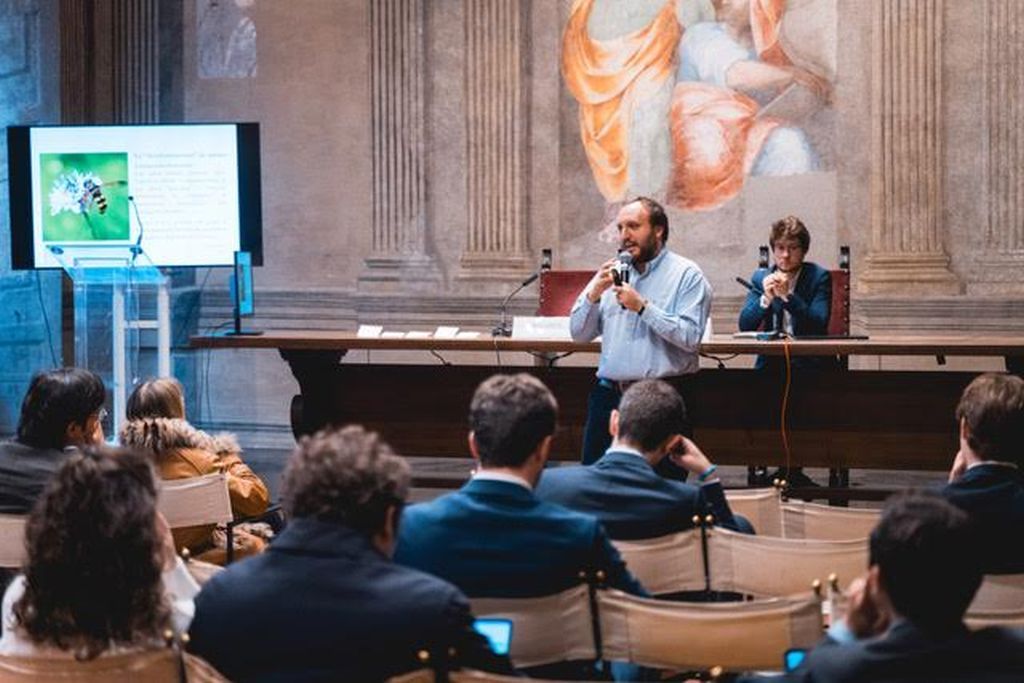
ROMA (ITALPRESS) – Today at Palazzo Baldassini, in Rome, the event “Scientific research and fake news: building trust through communication”, realized with the non-conditional contribution of Fondazione MSD Italia. The initiative, aimed at university students and young people, has deepened the relationship between scientific research, health information and disinformation, with the aim of providing concrete tools to recognize misleading news, verify the reliability of sources and correctly communicate scientific evidence. The comparison has placed an increasingly important issue at the centre: the dissemination of health information without reconversion can affect the perception of risks and compromise confidence in science. In the opening, Marina Panfilo, Director of the MSD Italia Foundation, recalled the importance of promoting a culture of conscious information, especially among the new generations. “The confidence in science also arises from the ability to understand and evaluate the information we receive. This is why Fondazione MSD strongly supports this day of confrontation and experimentation, which focuses on a fundamental theme of our mission: health literacy. Giving young instruments to recognize scientific evidence and distinguish reliable sources from misleading content means to make them more aware, more autonomous and more protagonists of the choices regarding health today and tomorrow.” The first study was devoted to the mechanisms that promote the circulation of fake scientific news. Lorenzo Gagliardi, researcher at the Interdepartmental Centre for Ethics and Integrity in Research of the CNR, illustrated the role of cognitive biases in the evaluation of news and the main debunking techniques, from the reconstruction of the origin of a content in comparison with authoritative sources. “A false news can appear credible because it confirms already rooted convictions or because it is presented convincingly. This is why it is important to learn to question the origin of information, verify its context and compare it with reliable data and sources. Debunking is not only to deny a statement, but also to explain why it is wrong.” The relationship between research, journalism and public opinion was dedicated to the intervention of Gianluca Dotti, a scientific journalist, who deepened the responsibilities of disclosure when dealing with complex health issues. Particular attention was paid to the need to make search results accessible without misleading simplifications and to distinguish the conclusions supported by evidence from the hypotheses still to be checked. “Communicating science also means making the method, limits and uncertainties of research understandable. Strict information is not limited to reporting a result, but helps the public understand its meaning and recognize when a news about health presents conclusions not supported by data.” The training part is followed by a practical workshop, during which participants, divided into five groups and flanked by the speakers, confronted directly with as many false news in the healthcare sector. After the presentation of the guidelines, each group has verified the information, selected at least one authoritative source and prepared the script of a short dissemination video of 45-60 seconds, aimed at explaining clearly and accessible the correction of the news. The activity has allowed to translate the principles discussed during the interventions in a concrete exercise of verification of sources and scientific communication. The day highlighted how the contrast to health disinformation requires not only reliable content, but also critical skills, comprehensible languages and a constant dialogue between the world ofresearch, information professionals and new generations.
– photo press office Esperia Advocacy –(ITALPRESS).