MILAN (ITALPRESS) – Transplanting the patient’s adipose tissue to treat one of the most difficult complications of Crohn’s disease. This is the path explored by the ATTIC study, just published in the authoritative international scientific journal JCC – Journal of Crohn’s and Colitis, launched three years ago and today ended, opening new therapeutic perspectives for those who develop complex refractory fistulas to conventional treatments.
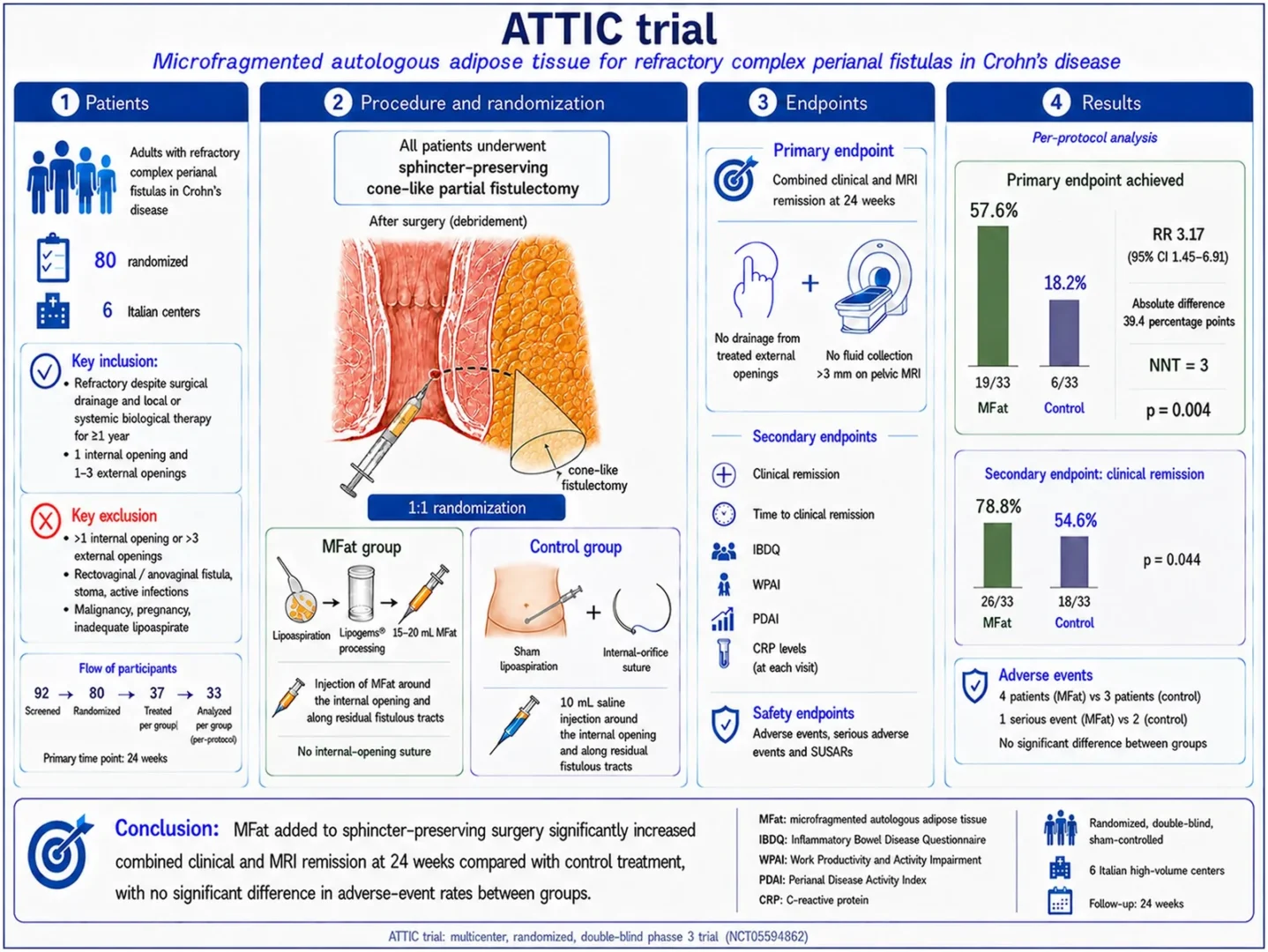
The results are very promising: 57.6% of patients treated with injection of microfragmented autologous adipose tissue, associated with the complete surgical drainage of septic outbreaks, reached the combined remission of perianal fistulas, compared to 18.2% of the control group. A fact that turns the attention on the potential of this approach and offers a new possibility to patients who live with a particularly complex and disability condition. For those suffering from Crohn’s disease, in fact, perianal fistulas can represent a further and gravous complication of a pathology already difficult to manage.
The disease, characterized by chronic inflammation that may affect, in a segmental manner, the whole digestive system, causes the appearance of fistulas and/or perianal abscesses in about a third of the cases (23-38%). In particular, young people, whose quality of life can be profoundly impaired: the difficulties connected with pathology are added restrictions that affect everyday life, personal relationships and working life. And it is precisely for these patients, often already debilitated and without satisfactory answers from standard therapies, that identifying new treatment possibilities assumes a particularly important meaning.
The randomized multi-centered clinical trial ATTIC was coordinated by the IRCCCS Policlinico Sant’Orsola-Malpighi di Bologna, in collaboration with the IRCCCS Humanitas Clinical Institute in Milan, the IRCCS Fondazione Policlinico Universitario Agostino Gemelli di Roma, the Luigi Sacco Hospital of Milan, the Federico II Hospitaller of Naples and the Hospitaller Company. At the centre of the trial, the technology developed by Lipogems International SpA, an Italian company specialized in the development of medical devices for the treatment and use of microfragmented autologous adipose tissue. The approach is based on the use of the adipose tissue of the patient himself obtained by liposuction and processed during the same operating session to make it easily injectable and rich in cells with high pro-regenerative, anti-inflammatory and immunomodulating activity.
The study involved 66 patients, all subjected to phystulectomy surgery with sepsis cleaning. Of these, half received in addition an infiltration of autologous fatty tissue microfragmented in the tissues surrounding the fistulas, while the other half, the control group, received a placebo solution. At a distance of 24 weeks, researchers evaluated the effectiveness of the treatment, recording a statistically significant difference in the results of the two groups. To strengthen the solidity of the evidence collected is also the method of evaluation of the outcome adopted: the remission was not only verified through the clinical examination, but also through the execution at 6 months from the intervention of a magnetic resonance, a fundamental tool for validating and objective outcomes.
“The results of the ATTIC study are an important milestone and fuel new hopes for people suffering from Crohn’s disease who live with complex perianal fistulas and who often do not find in conventional therapies a satisfactory answer” said Professor Silvio Laureti, Principal Investigator of the ATTIC study, Associate Professor of General Surgery of the University of Bologna and responsible for the SS “Experimental Procology” of the U. Chirurgia del Tratto Alimentare e Urgenze dell’IRCCS Policlinico Sant’Orsola – Malpighi di Bologna. “It can count on a therapeutic strategy that uses the transplant of adipose tissue of the patient itself, taken, prepared and reinjected during a single surgical session, means offering a new possibility to those facing a particularly difficult and disabled condition. It is also a treatment with low costs, an important aspect also in terms of sustainability and accessibility of care. The results obtained encourage us to continue on this road and explore further possibilities of application. In clinical practice we are evaluating the association of injection of microfragmented adipose tissue to other surgical procedures, exploring the effectiveness also in different proctological manifestations related to Intestinal Chronic Inflammation Diseases and evaluating the potential improvement of results after repetition of treatment in non-responsive patients. Our goal is to further improve outcomes and provide patients with ever more effective care prospects. It is a research path that looks to the future with confidence, focusing on the quality of life of people.”.
The ATTIC study represents a scientific contribution of particular importance in the international research of complex perianal fistulas in Crohn’s disease. The methodological solidity of a prospective, randomized and double-blind study, together with the originality of the therapeutic approach based on the use of microfragmented adipose tissue, make it an innovative and distinctive research experience in a field where therapeutic options continue to pose a clinical and scientific challenge. The publication on JCC is an important recognition of the value of the work done and of particular pride for Italian surgical research, capable of developing and bringing on the international scientific scene original ideas, skills and innovation.
– ATTIC studio photos –
(ITALPRESS).